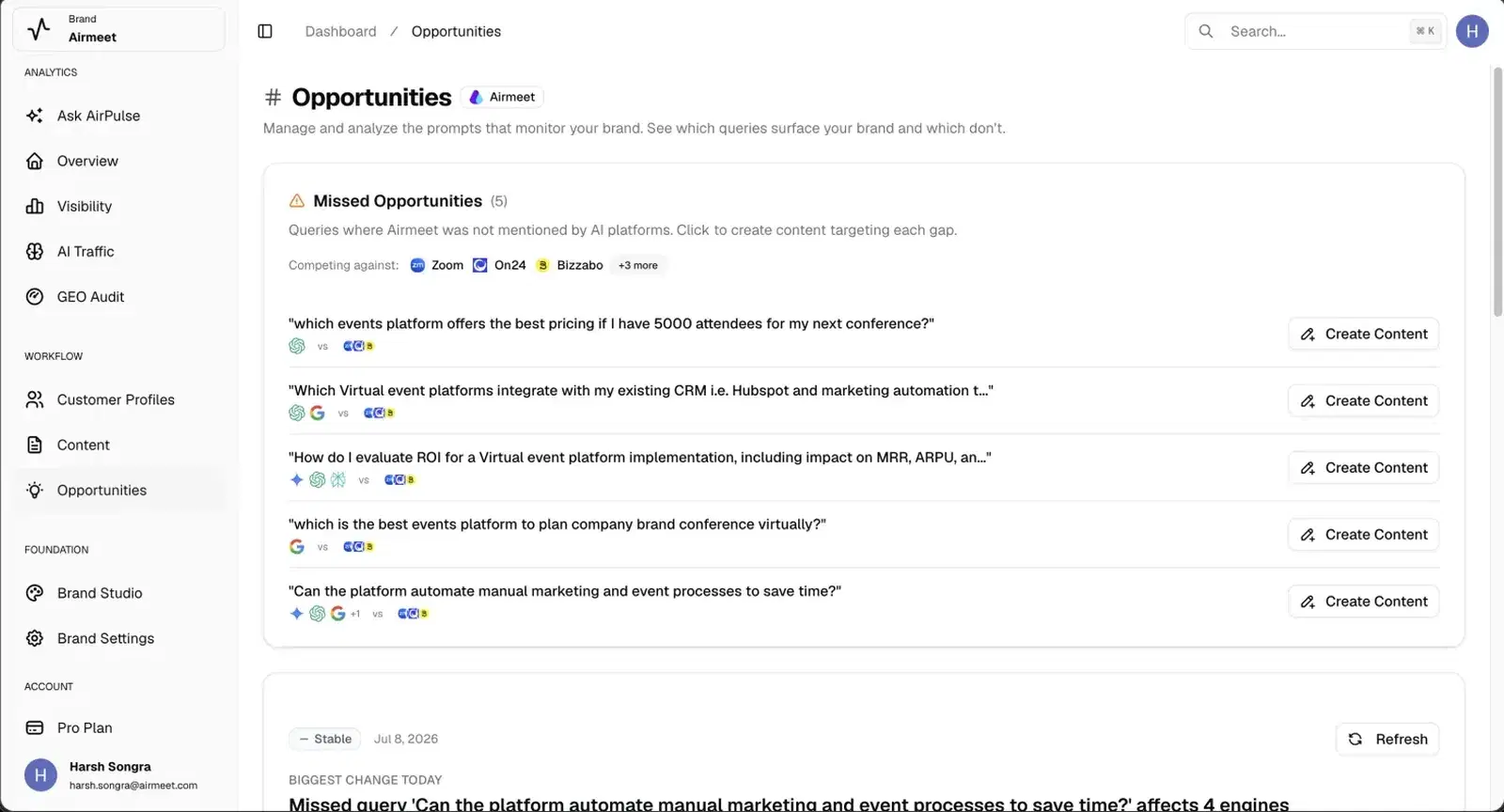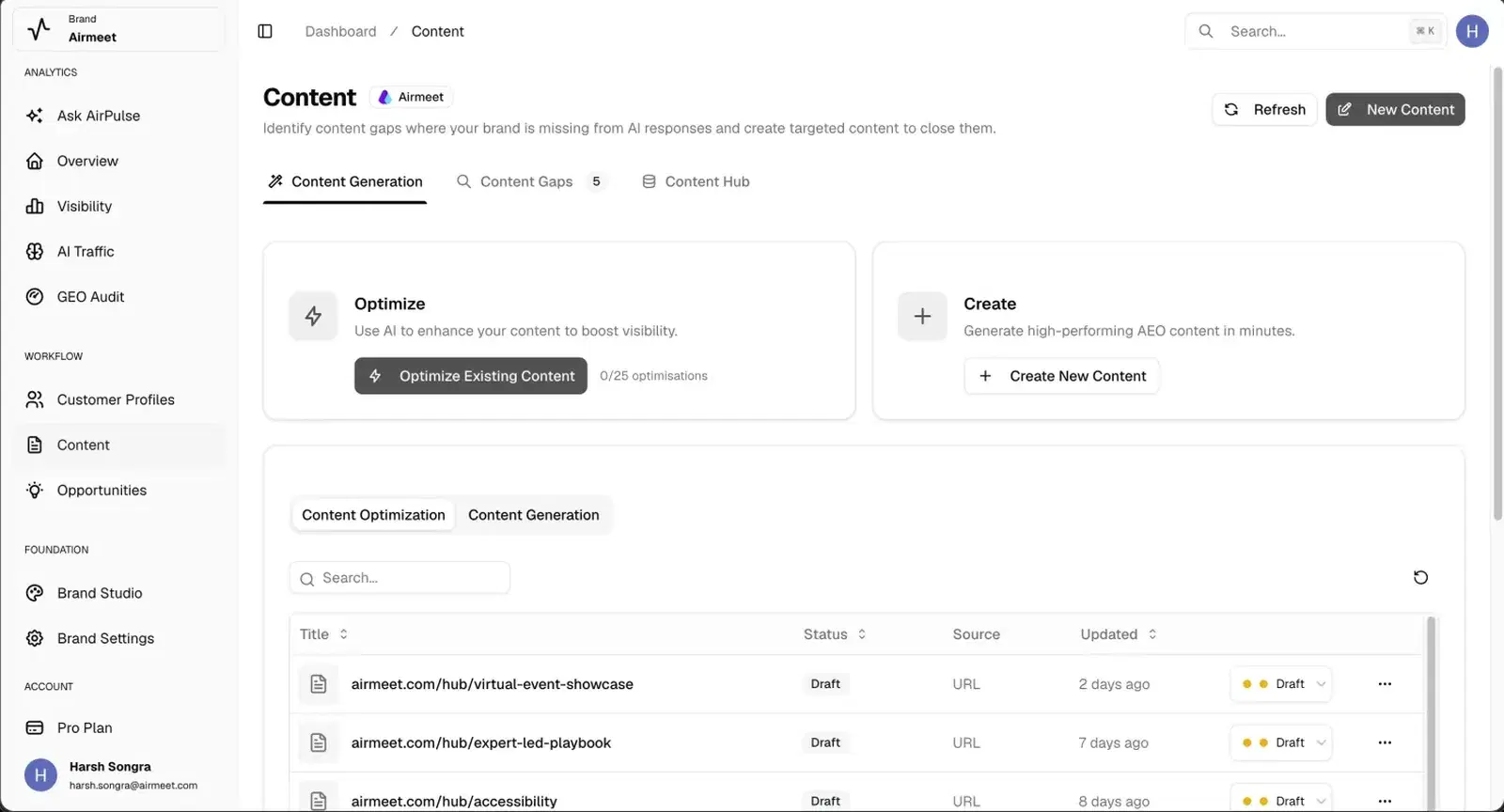
Measure
Visibility
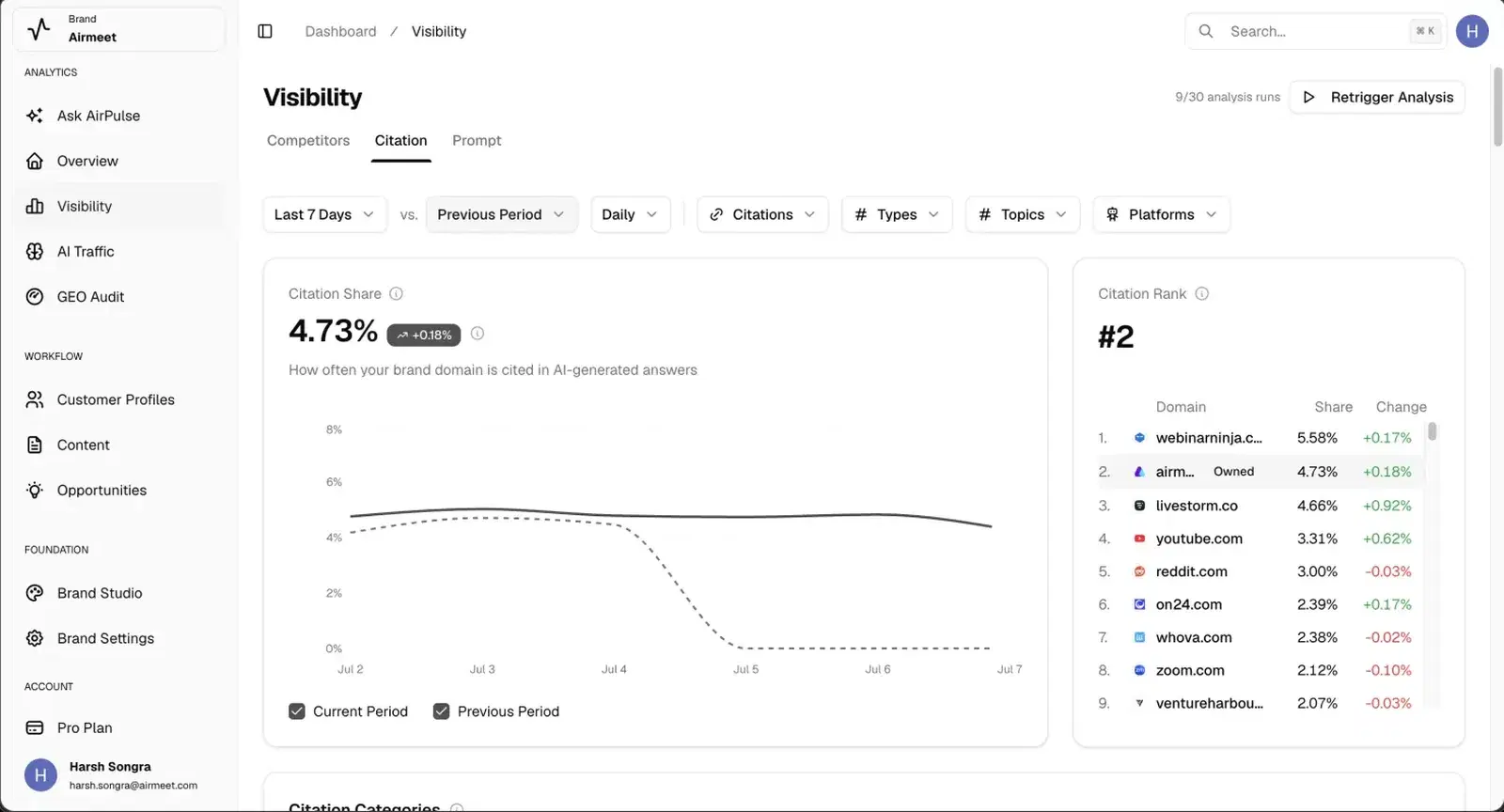
Score by engine, competitor heatmap, citation share and AI traffic, tracked daily on the prompts your buyers ask.
Site index for AI agents: /llms.txt. Documentation pages under /docs are also served as markdown at the same URL plus .md (e.g. /docs/geo-audit.md) or via an Accept: text/markdown request.

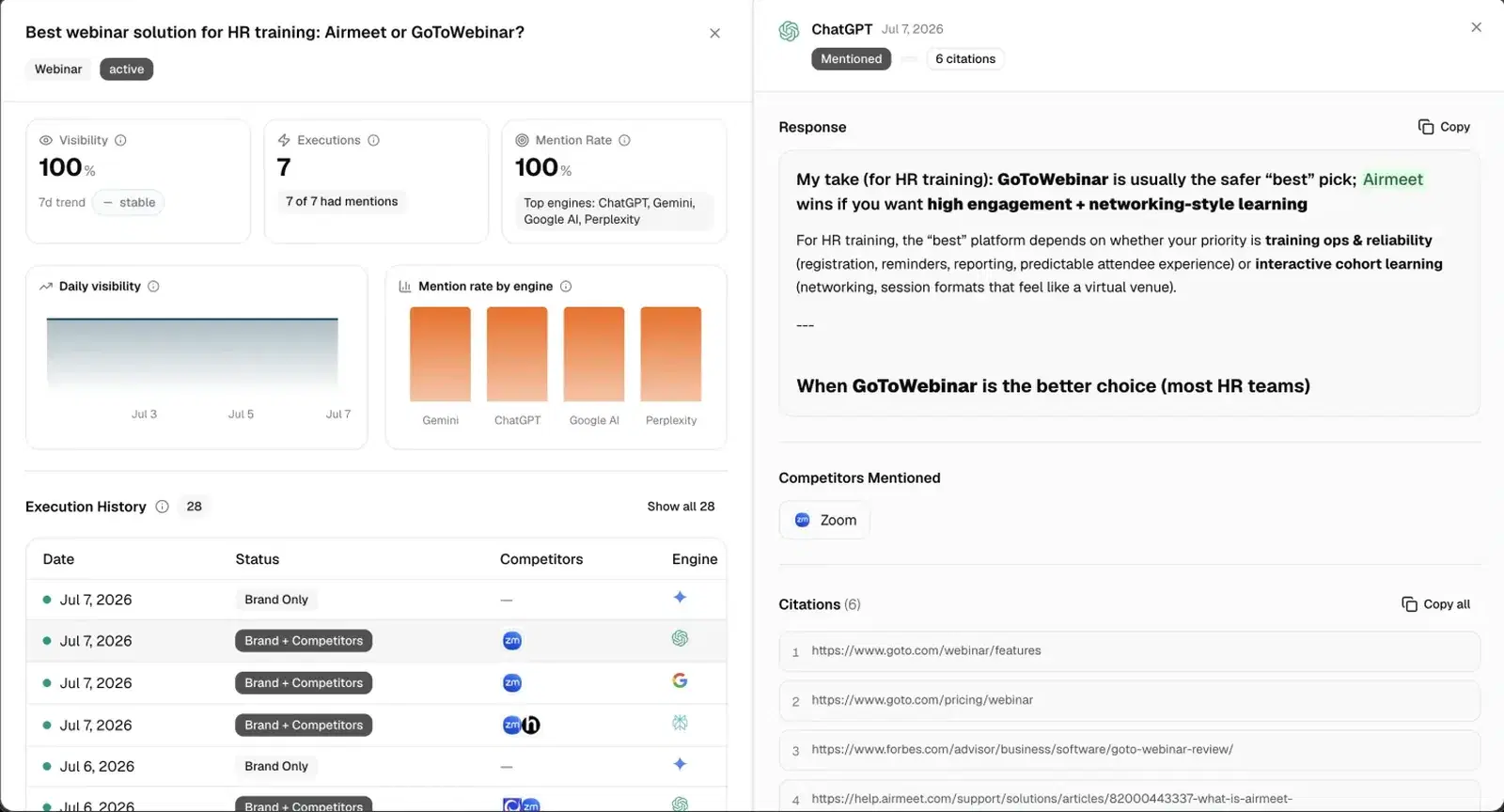
Your buyers' questions, asked daily on ChatGPT, Perplexity and Google AI (Gemini on Enterprise), with every answer that names you.
For every prompt, AirPulse shows whether you are mentioned, how you rank inside the answer, and how that changes on each engine.
AirPulse shows which of your URLs earn a place in the source list, on which engine, and in which position.
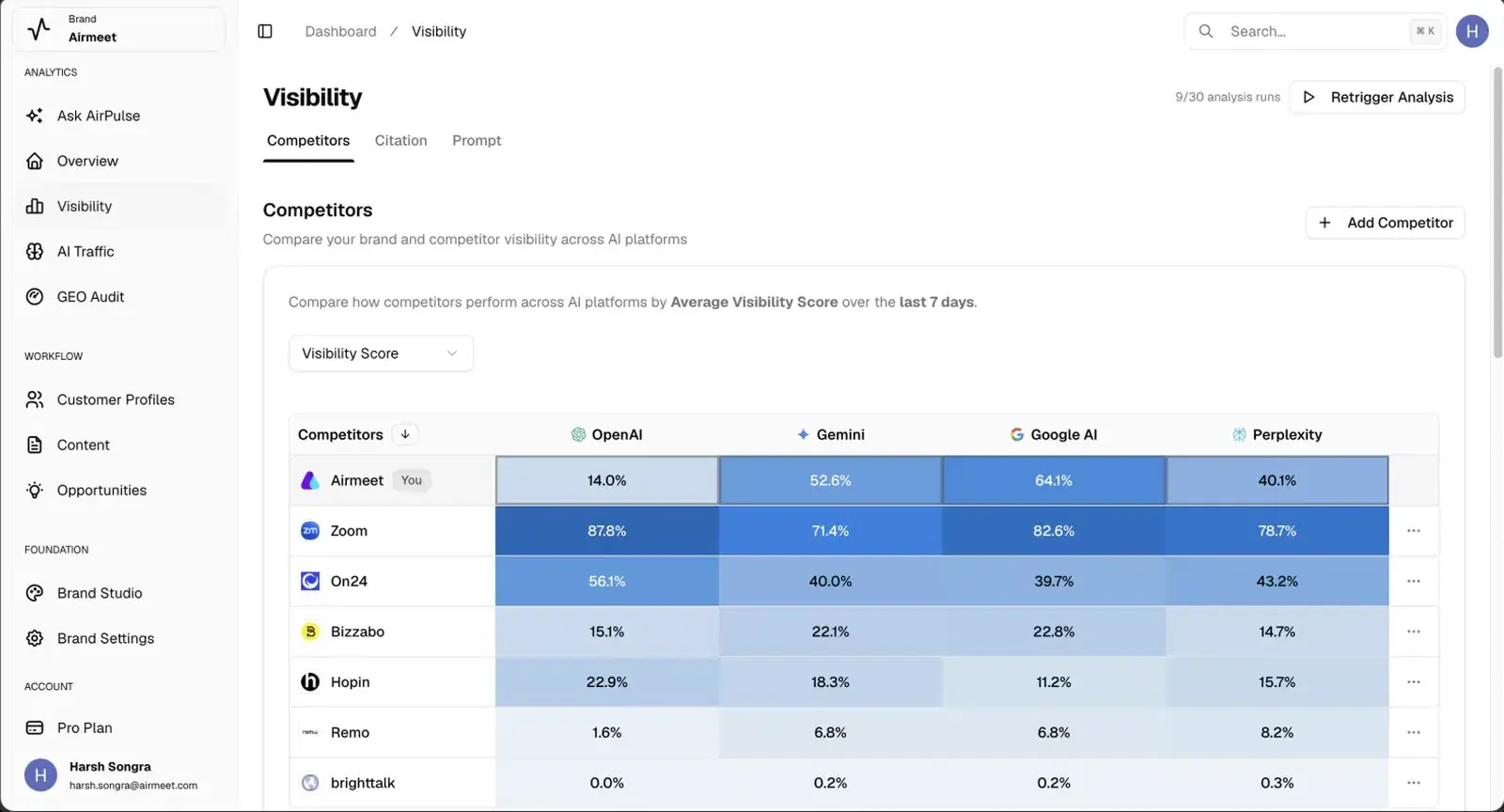
Benchmark your share of answer against every competitor on the same prompt set.
AirPulse reads your analytics and server logs to separate human sessions from answer engines and visits from AI crawlers.
One answer can carry several of these labels at once, so they are never added into one score. The short names used across the site are named, cited, shortlisted and recommended; research attribution is reported with citations.
| Result | What it means | What it does not mean |
|---|---|---|
| Citation | One of your URLs appears in the answer's source list, or is linked inline. Counted once per answer, per engine. | That the answer names your brand, or recommends it. An engine can cite a guide of yours while naming only your competitors. |
| Research attribution | The answer quotes or paraphrases a fact and attributes it to you by name or link, for example a study you published. | That the answer offers you to the buyer among the vendors. |
| Vendor mention | The answer text names your brand among the providers of what was asked. | That you are on the shortlist. A mention can be a passing reference or a comparison point. |
| Shortlist | Your brand is one of the options the answer lays out for the buyer to choose between, in a list, a table or a sequence of named options. | That the answer prefers you. Position in the list is recorded separately. |
| Explicit recommendation | The answer tells the buyer to choose you, or names you the best fit for the stated need. | A permanent state. Recommendations differ between runs and engines, so they are read over windows. |
A stock-broking app AirPulse tracks in India, unbranded questions about which trading app to trust, window ending September 29, 2026.
The app is named in about half of the answers. Its own site supplies 1.7% of the citations behind those answers; the engines quote rivals' help pages, comparison sites and the regulator instead.
Being named and being cited are different counts. Adding them would double-count the answers where both happen.
Airmeet, the company behind AirPulse, 52 buyer questions about event and webinar software, ChatGPT and Perplexity, May to September 2026.
Airmeet's own pages went from 1.27% to 6.66% of citations on the same questions, and the engines cite 152 of its pages. Answers that lay out options for "engagement-heavy programs" list Airmeet among them.
Citation share is the published number. Shortlist and recommendation are read from the answer text and reported on their own.
Questions run in the regions you set for the panel. Each engine is read on its own. When a provider changes how answers and citations are captured, the affected window is marked and not compared.
Every result is tied to a question set, a date window, an engine and a region. Change any of them and it is a different measurement. A run that did not complete, or a question an engine refused, is marked unavailable. It is never a zero. A result read from the answer text rather than from a link is reviewed, and the review state sits next to the label. The method, sample sizes and stability figures are in the measurement research; one change read against these labels is on the Actions walkthrough.
A walkthrough on your own prompts, engines and competitors.