Competitor visibility

Someone is being recommended. Find out why.

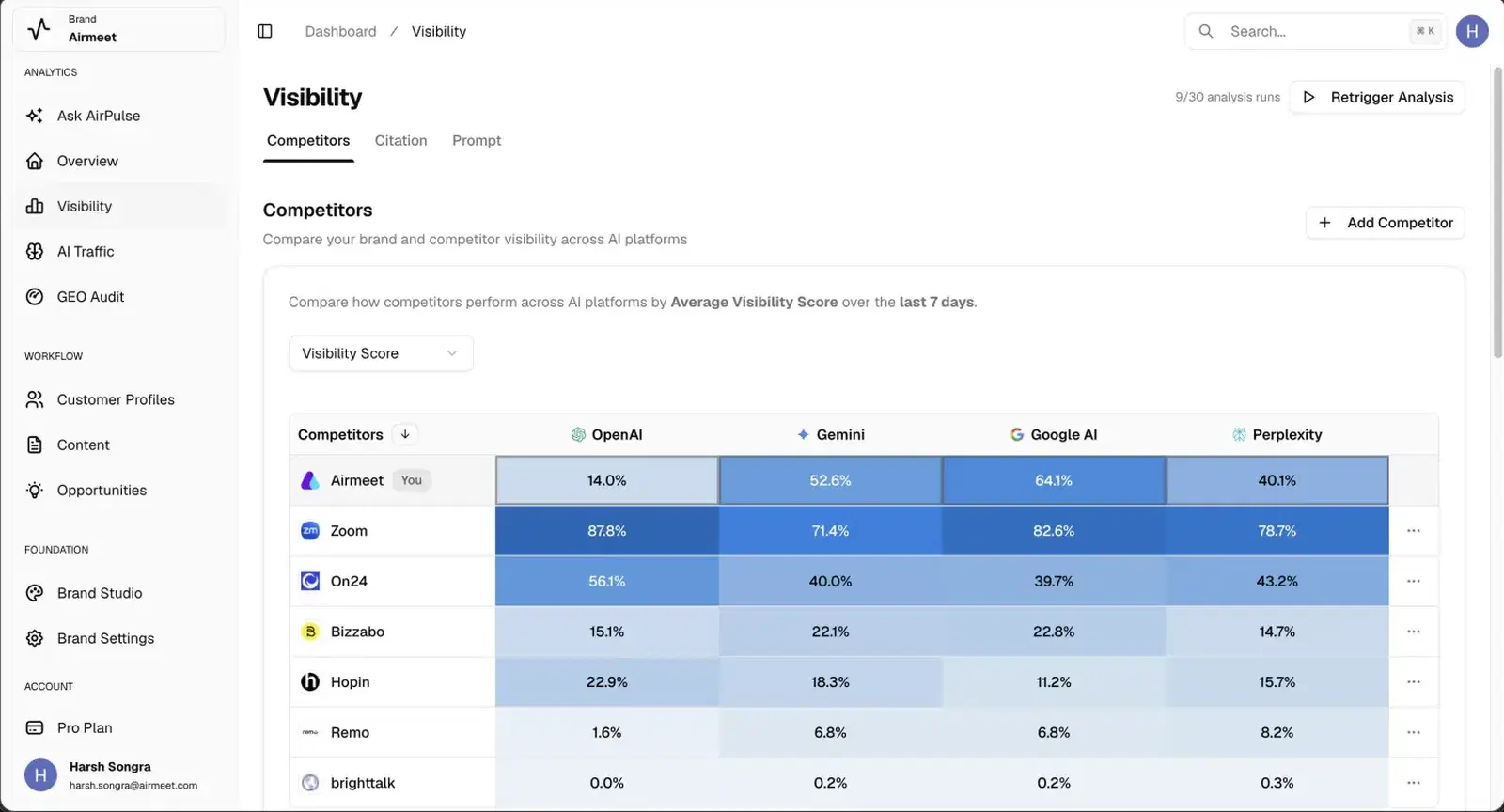
Benchmark how often competitors are mentioned, cited, ranked and recommended across answer engines for high-intent buyer prompts, and see the sources that are making them the safe choice.

The problem

Losing before the buyer reaches your site

When a buyer asks an engine to recommend a tool, they get a shortlist. If you are not on it, there is no bounce rate to investigate and no lost session to attribute. The loss happens before anything reaches your analytics, and the first sign of it is a pipeline number that softens for reasons nobody can name.

Knowing you are absent is not enough. What decides the fix is why the competitor is present: which sources the engine cited when it recommended them, which strengths it repeated, and which of your capabilities it never mentioned.

What it does

Inside the feature

The same measurement system as Prompt Visibility, turned to face the other way.

Share of answerHow often you and each competitor appear across a priority prompt set, benchmarked side by side rather than reported in isolation.
Mention rankWho gets named first, who gets grouped in as an "alternative" at the end, and how that ordering shifts over time.
Citation source overlapThe domains, pages and proof points engines lean on when recommending a competitor. This is the most actionable screen in the feature.
Positioning analysisHow competitors are described, which strengths the engine repeats unprompted, and which of your differentiators it never surfaces.
Engine coverageCompare all of the above across ChatGPT, Perplexity, Google AI Overviews, Gemini, Claude and Copilot, because a competitor can own one engine and be invisible on another.
Movement alertsNotification when a competitor gains ground on a prompt set, with the source or entity change that plausibly explains it.
What you get

The output, not the dashboard.

A share-of-answer benchmark across engines, prompt clusters and buyer-journey stages.
The specific third-party sources doing the work for your competitor.
The strengths engines repeat about them, and the ones they never repeat about you.
A counter-content list: which comparison, alternative and category pages to write, in what order.
What it will not do

This measures how engines describe competitors, not how good those competitors are. An engine repeating a competitor's strength is evidence that the claim is well-sourced, not that it is true. Treat the citation overlap as a map of where they have built credibility, and do not mistake it for a product roadmap.

FAQ

Competitor Visibility, in questions

It is how often a brand appears inside the generated response across a set of prompts, expressed against the competitors appearing in the same responses. Unlike a search ranking, it measures presence within the answer itself, including recommendations, summaries and comparisons.

Search rank asks which page is listed. Share of answer asks whether you are named at all when the engine writes the answer. A brand can hold the first organic result and still be absent from the AI answer above it, because the engine built that answer from sources it trusted more.

Track the ones engines already name in your category prompts, which is often not the list your sales team would give you. The gap between the two is worth a meeting on its own, because it tells you who the market thinks your alternatives are.

Different engines trust different sources. A competitor with strong Reddit and review-site presence tends to win on engines that lean on the open web, while one with strong owned documentation can win where the engine prefers first-party sources. The citation overlap screen shows which pattern you are looking at.

Two things. Write the comparison, alternative and category pages the engine has no good source for, and build presence on the third-party sources it already trusts. The first is content work. The second is not, and teams that only do the first plateau.

Yes, and it is often revealing. Engines routinely group brands the market does not consider comparable, because they cluster on the problem rather than on the category. Finding out you are being grouped with an adjacent tool is a positioning problem worth knowing about early.

See who the engines name instead of you.

The free audit includes a competitor leaderboard on your own category prompts.