
These run counts are a practical floor from external repeated-measurement research, not a guarantee of a fixed margin of error in every market.
AirPulse's frozen production study covered 30,504 prompt-engine responses. Mention status changed between consecutive observations 9.7% of the time. 35.9% of cells observed at least three times changed state at least once during the 30-day window. Consecutive citation-source sets had a mean Jaccard overlap of 0.396.
One answer is evidence of what happened once. It is not an estimate of how visible a brand is.
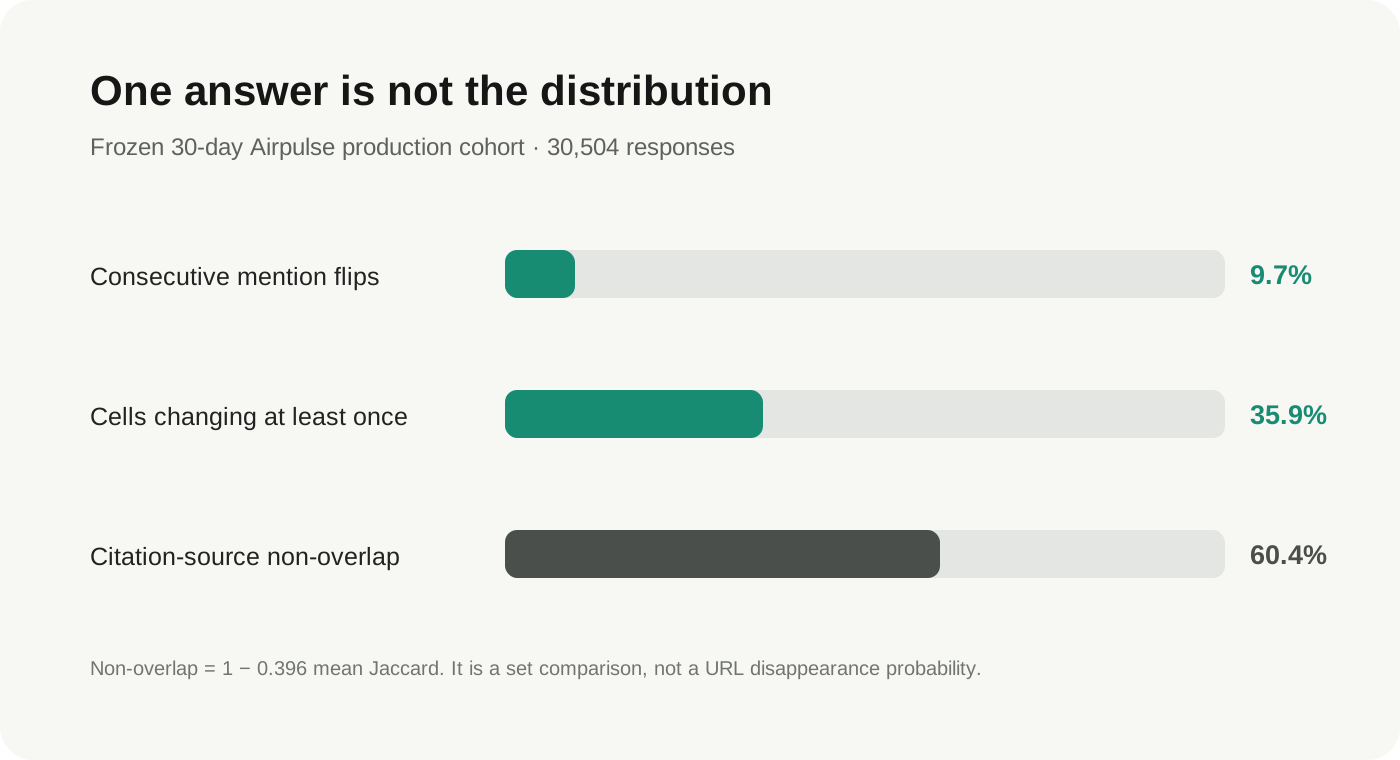
The evidence in one table
| Measure | Frozen study | Fresh 30-day validation | What it means |
|---|---|---|---|
| Valid response observations | 30,504 | 30,146 | Prompt-engine answers included after the stated filters |
| Completed jobs | 456 | 469 | Production analysis jobs contributing responses |
| Cells observed at least three times | 1,334 | 1,507 | Brand × prompt × engine units used for stability classification |
| Cells that changed state at least once | 35.9% | 33.9% | A substantial share was neither always present nor always absent |
| Consecutive mention-state flip rate | 9.7% | 10.0% | The next valid observation disagreed with the prior one about one time in ten |
| Mean source-set Jaccard overlap | 0.396 | 0.390 | Consecutive cited-domain sets shared less than half their combined sources |
The fresh validation was calculated from the production read replica on July 20, 2026. It is not pooled into the frozen study, so a moving window cannot change the original headline.
Why one run gives the wrong level of confidence
An AI answer is generated, not retrieved as a fixed ranked list. Model, search layer, source set, prompt wording, account state and time all affect what appears. A brand can be present in one answer and absent in the next for the same wording.
The question becomes “In how many valid runs did the brand appear, for which prompt, on which engine, over what period?”
What AirPulse measured
The fundamental unit was a prompt-engine cell: one fixed prompt paired with one fixed answer engine. Every valid run stored a timestamped answer and its available citation data.
For the frozen 30-day cohort, AirPulse analysed:
- 30,504 valid response observations;
- 456 completed production jobs;
- 1,559 distinct brand-prompt-engine cells;
- 1,334 cells with three or more observations;
- four reported engine groups: ChatGPT, Gemini, Google AI and Perplexity.
Each valid response either mentioned the tracked brand or did not. Consecutive observations were ordered by timestamp within the same cell. A flip occurred when the state changed.
Source URLs were converted to normalised domains. For each pair of consecutive source sets, Jaccard similarity was the intersection divided by the union: 1 means identical sets, 0 means no shared domain.
Finding 1: mention status changed about one time in ten
Across all comparable consecutive observations, mention state flipped 9.7% of the time. The engine-level rates were different:
| Engine | Consecutive mention flip rate |
|---|---|
| ChatGPT | 8.5% |
| Gemini | 6.2% |
| Google AI | 14.7% |
| Perplexity | 9.3% |
The rates describe this cohort, its prompt roster, its dates and AirPulse's parsing rules, not a permanent ranking of engine stability. They do show why engines should not be pooled into one score.
Finding 2: more than one-third of repeated cells changed at least once
Among cells observed at least three times, 35.9% contained both a mentioned and an unmentioned result during the window. A single observation would classify some of these cells as “always visible” or “never visible,” depending on the day.
This is cell-level. It does not mean 35.9% of prompts will flip next time; it means 35.9% of sufficiently observed brand-prompt-engine units were mixed during the period.
Finding 3: cited sources moved more than brand mentions
Consecutive source-domain sets had a mean Jaccard overlap of 0.396 and a median of 0.333. About 60% to 67% of the combined set was not shared. That is a set comparison, not a URL survival probability.
A brand mention can stay present while the pages supporting the answer change. Track three outcomes separately:
- brand mention rate;
- own-domain citation rate;
- third-party citation rate and source coverage.
Prompt Visibility and Citation Visibility report them as separate views. Keep them separate in exports too.
How many runs should a team start with?
Use seven brand-detection runs and eight source-coverage runs per prompt-engine cell as a starting floor, from Don't Measure Once: Measuring Visibility in AI Search. AirPulse's study supports repeat measurement but does not independently prove seven and eight are sufficient everywhere.
Spread the runs across two to four weeks. Eight runs in ten minutes measures short-term generation variability, not day-to-day retrieval, model or index changes.
Increase the run count when:
- the estimated rate is near a decision boundary;
- the prompt is commercially important;
- the observed outcomes differ sharply by engine;
- source coverage is still growing with each run;
- a model, prompt roster or measurement method changed during the window.
A minimum reporting template
Every reported result should state:
- the exact prompt or a stable prompt identifier;
- the engine and relevant model/surface identifier;
- the valid-run numerator and denominator;
- the measurement dates and timezone;
- mention rate, own-domain citation rate and third-party citation rate separately;
- a confidence interval or equivalent uncertainty display;
- the prompt-roster and parser version;
- exclusions, failures and missing-source handling.
Calculations and storage rules are in the measurement methodology. Prompt-roster design is covered in which prompts to track. The trial protocol turns repeated runs into an intervention test.
What this study does not prove
This is an observational production cohort, not a random sample of brands, prompts or AI users. It does not estimate the causal effect of publishing a page, adding schema or changing crawler access. Model and retrieval systems can change after the study period.
The study also does not support these shortcuts:
- “A brand has a 9.7% chance of flipping next time.”
- “Every URL has a 60.4% chance of disappearing.”
- “Seven runs always provide the same confidence.”
- “One blended score can compare all engines safely.”
- “Being indexed guarantees retrieval or citation.”
Access is a prerequisite. OpenAI says publishers should allow OAI-SearchBot for content to be considered in ChatGPT search citations (publisher FAQ), and Google separates crawling, indexing and serving (crawling documentation). Neither promises citation.
Download and reproduce
The files contain aggregate statistics only: no customer names, tenant IDs, raw prompts or raw answers.