
Your brand can appear in AI-generated recommendations, but this doesn’t guarantee that a competitor won’t replace it. And the change in website rankings isn’t always the problem.
When new sources come in, AI answers eventually change. Different questions or a platform update can also be the reasons. Trend data helps businesses spot these changes, understand what audiences are searching for, and prepare for emerging opportunities.
This guide talks about predicting the next AI update and also gives brand, content, and search teams a way to build that advantage across AI search and social discovery.
Decide What Kind Of Update You Are Trying To Anticipate
The next AI update might not be the same thing as it was before. With the insertion of a new model, the way an AI tool responds can change as well, and that change in search may affect which websites it uses, and a new feature may change how people interact with the platform. Understanding these differences helps you track the right signals.
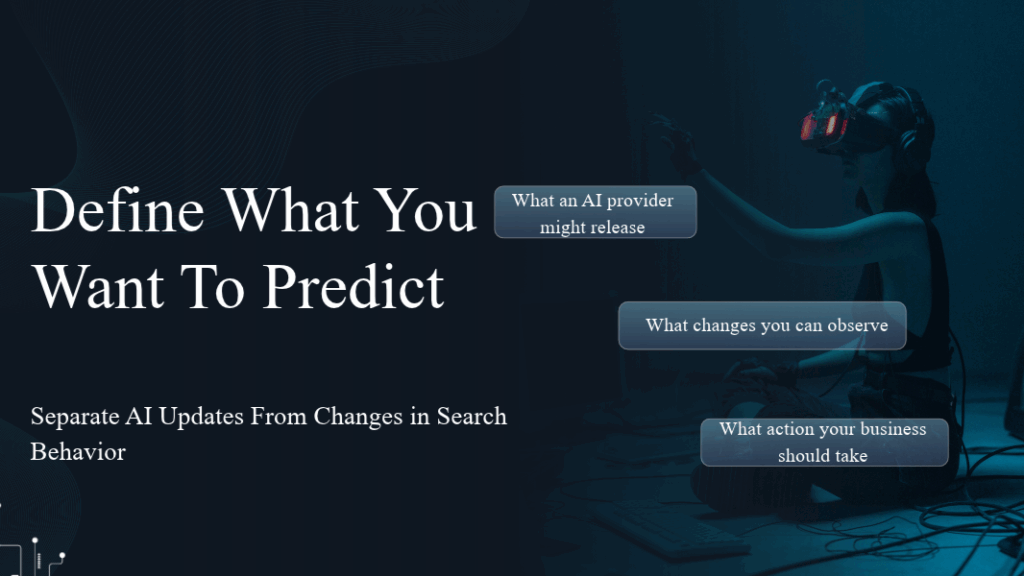
Define What You Want To Predict
Do not fall into predictions like “AI search will change.” Instead set a clear goal instead, like, “Within the next 30 days, our regular buying-related questions will show a noticeable change in the websites cited by an AI search platform.” ” With this, you will get something particular to monitor as well as measure.
Separate AI Updates From Changes in Search Behavior
Keep three things in mind while predicting the next AI update -
- What an AI provider might release: Look for official announcements and product updates.
- What changes you can observe: Regularly test AI responses to identify changes in answers and cited websites.
- What action your business should take: Use your findings and business goals to decide whether any changes are necessary.
Build An Evidence Hierarchy Before A Watchlist
Before tracking potential AI updates, separate confirmed changes from individual observations and unverified claims. An official release note confirms what a provider has shipped, but not whether your buyers have access or your brand’s visibility has changed. Similarly, a screenshot shows one observed result, not a platform-wide change.
Use the following hierarchy to decide what an observation can support, in the process of predicting the next AI update.
| Signal | Useful for | Main limitation |
| Provider documentation and release notes | Confirmed capabilities and availability terms | May not describe every behavior change |
| Repeated tests on fixed buying questions | Detecting movement in your sampled experience | Limited to tested surfaces and conditions |
| Search demand and first-party buyer questions | Discovering emerging needs and language | Demand does not establish release timing |
| Independent practitioner observations | Finding a behavior worth reproducing | Shared reports may repeat one original claim |
| Research and benchmark results | Identifying possible capability directions | A research result may never become a product |
| Rumors and viral posts | Generating questions to investigate | Weak evidence for operational decisions |
For example, the Gemini API release notes distinguish dated changes to a developer service. Google’s Search Status Dashboard separately records ranking updates. These sources track different systems. A release in one is not evidence of an update in the other.
Independence matters more than the number of links. Ten posts citing one screenshot remain one observation. Save the original URL, observation time, product surface, access conditions, and the specific claim you believe it supports.
Read Trend Data Without Confusing Attention With Intent
Google Trends is useful for figuring out the next AI update, as it helps compare interest in a question or topic over time. Its values are sampled, normalized, and scaled from 0 to 100; they are not absolute search counts. Low-volume terms can show zero, and small spikes can reflect noise. Google also states that internal searches made by AI Mode and AI Overviews are excluded.
Google Trends does help in tracking changes in search interest, and that’s where AirPulse helps you check how your brand appears throughout the AI search platforms. With this platform, you can track -
- Brand mentions.
- Citations.
- Competitor visibility to identify shifts.
All these are AI-generated answers and figure out where your brand lags behind in important buyer conversations.
Keep Your Trend Data Consistent
Keep a dated copy because changing the comparison window changes the scale. Do not join independently normalized exports as if they shared an absolute baseline.
To predict the next AI update, it is necessary to choose a
- Consistent geography
- Time range
- Category
- Search type
Compare terms within the same export when possible. Record whether you selected a search term or a topic.
Focus on Search Questions That Drive Revenue
Start with questions close to revenue because they reveal what potential customers are looking for before making a purchase. For a brand selling workflow software, “best project management software for design agencies” has a clearer commercial context than a model’s trending name.
To identify these questions, pair the demand signal with sales questions, site-search terms, support conversations, and recurring questions in relevant public communities. These can provide a fair understanding of the buyer’s need as well as identify topics that are worth addressing.
Look Beyond Search Volume
Look for aspects like persistence, specificity, and consequence because these are generally very important aspects in the next AI update. A sudden spike in search interest can reflect curiosity instead of genuine buying intent. Does the question recur after launch-day interest fades? Does it contain a real constraint such as team size, compatibility, or budget? Could answering it change a buying decision?
Research on online search behavior suggests that specific queries can reveal stronger purchase intent than broad searches. To identify these patterns, track recurring questions across -
- Sales conversations.
- Customer support.
- Relevant online communities.
A quieter question that repeatedly blocks a purchase may deserve attention before a spectacular spike in a broad AI term.
Create A Repeatable Baseline For AI Discovery
Start small enough that the team can maintain the process. A proposed pilot could use 20 buyer questions across discovery, comparison, and purchase validation, tested on two relevant AI surfaces. This is a manageable starting design, not a statistically representative sample of all users.
Include Branded And Unbranded Questions
Include both unbranded questions and questions that name your company. The former help reveal whether a brand enters the shortlist without prompting. The latter help identify inaccurate descriptions and missing evidence. Keep a fixed core set for comparison and a separately labeled exploratory set for emerging demand.
Record Every Observation
For each observation, record the exact prompt, platform, visible model or mode, date, country, language, account state, browsing setting, and whether it was a fresh session. Save the answer and cited URLs where permitted. When a product hides its model version, record “not disclosed” rather than guessing.
Run Multiple Trials Under Consistent Conditions
Run multiple independent trials under consistent conditions. Anthropic’s evaluation guidance explicitly recommends repeated trials because outputs vary, and it distinguishes an agent’s reported actions from the actual outcome. Apply that discipline to discovery: a brand mention, a recommendation, a clickable citation, and a qualified visit are separate observations.
Track a few clearly defined measures:
- Brand inclusion rate: valid responses naming the brand divided by all valid responses in the fixed sample.
- Owned-domain citation rate: valid responses linking to your domain divided by all valid responses in that sample.
- Description accuracy: manually checked claims that agree with current product evidence.
- Commercial response: identifiable visits and qualified actions from relevant sources, where attribution is available.
Log errors and unavailable features separately so the denominator does not silently change. Keep results by platform and question type. An aggregate can hide a gain in branded prompts and a loss in unbranded comparison prompts.
Convert A Signal Into A Forecast You Can Evaluate
A useful forecast needs a clear outcome, a deadline, supporting evidence, and conditions that could weaken the prediction. Here’s how to structure your forecasts, evaluate their accuracy, and convert reliable signals into informed decisions.
Define A Measurable Forecast
To make a forecast measurable, specify an outcome, a deadline, evidence, and a condition that would weaken it. For example: “By the end of the next four weeks, comparison prompts on Surface A will cite a different set of domains on three scheduled test days.” Write down what counts as a different set before the deadline.
Maintain A Dated Forecast Register
Use a dated forecast register. Each entry should contain the hypothesis, supporting observations, alternative explanations, an owner, the next review date, and the cheapest useful response. Distinguish “confirmed release,” “observed behavior,” and “hypothesis” in the evidence field. Do not convert an internal confidence score into a claim about a provider’s plans.
Avoid Overconfidence In Predictions
Avoid assigning precise probabilities simply because a dashboard allows them. If the team does use probabilities, retain every resolved forecast, including misses, and check whether confidence matches outcomes over time. A small set of forecasts will not establish reliable calibration.
Test Forecasting Methods Against Real Data
For numerical series such as weekly demand, compare any forecasting method against a simple baseline and evaluate it on later observations that were not used to build it. Forecasting guidance emphasizes test data and time-series cross-validation. Randomly mixing future and past observations can make a weak model look useful. Accurate demand forecasts still do not establish when a provider will launch a model.
Use Three Response Levels To Guide Action
Use three response levels as a working policy. Watch when evidence is isolated and the proposed action is expensive. Test when a credible signal can be checked with a small, reversible experiment. Act when a documented change or repeated relevant observation justifies a specific fix. Set these rules around your costs and risk tolerance; there is no universal score that predicts AI releases.
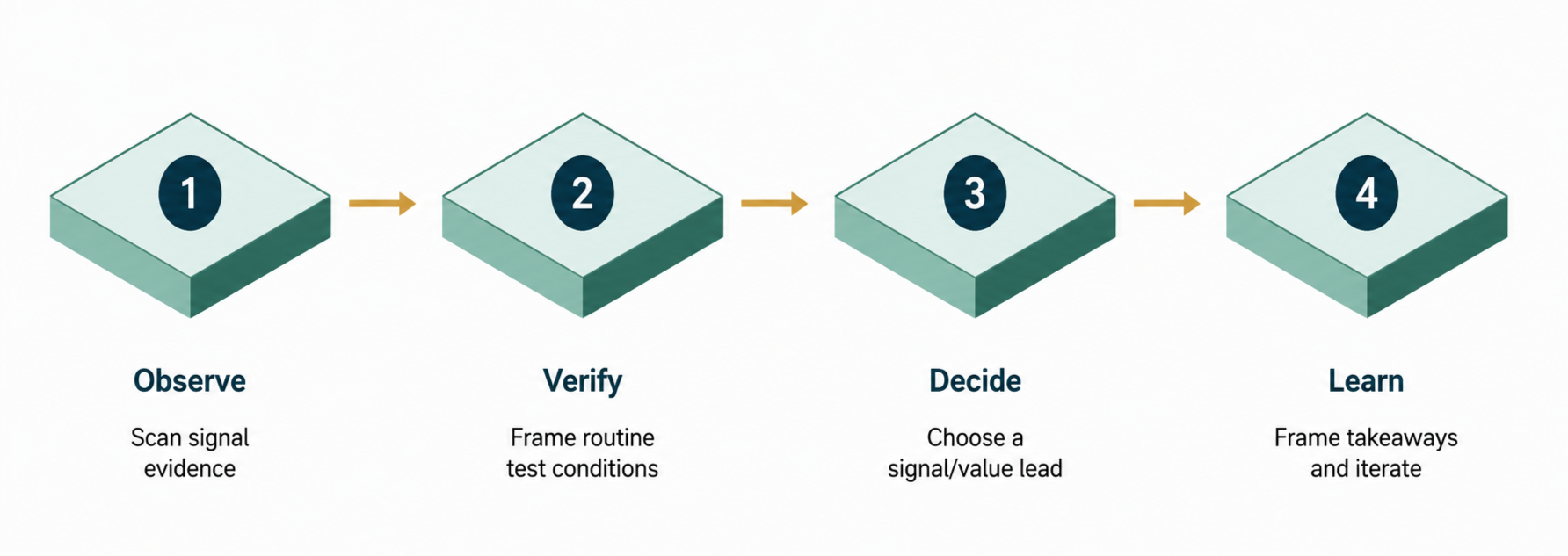
A Worked Example From Signal To Decision
Consider a brand selling project management software. Its team notices more discussions about client approvals in online agency communities. Searches for related terms are also increasing, and AI comparison answers frequently cite competitors’ guides on approval workflows.
These signals don’t prove that a new AI update is coming. However, they suggest that buyers have new or growing questions that the brand isn’t answering well.
Identify the Content Gap
The team decides to create a detailed guide covering:
- Who can approve projects and tasks.
- How client revisions and feedback are handled.
- What limitations buyers should consider.
- How the product supports approval workflows.
The team also links product claims to updated documentation and connects the new guide to relevant existing pages.
Track the Results
After publishing, the team monitors AI citations, relevant website visits, and changes in search visibility over the next month. It keeps the same set of test questions to make comparisons consistent.
A later improvement in visibility would be encouraging, but it wouldn’t prove that the new guide caused the change.
Focus on actions that benefit your audience even if your prediction is wrong. Answering buyer questions, correcting outdated information, and making useful content easier to find are more valuable than rewriting an entire website based on an AI update rumor.
Know What Your Measurements Cannot Tell You
AI visibility and traffic measurements do not always explain why a change happened. A fall in traffic is not sufficient evidence of the next AI update. Check indexing, availability, analytics configuration, seasonality, changes in paid activity, and your own site releases before assigning a cause. Separate the date a feature was announced from the date you first observed it in your market.
Understand Why AI Search Results Can Vary
Google says its AI search experiences may use multiple related searches to construct responses, and answers and supporting links can vary between AI Mode and AI Overviews. It also says eligibility relies on existing search fundamentals, with no special AI schema or new AI text file required for inclusion.
This means that a change in citations or brand mentions does not automatically hint towards an algorithm update. Rather than focusing on unverified optimization theories, monitor -
- Crawlability
- Accurate information
- Evidence
Look Beyond Visibility Metrics
Visibility measures also have blind spots. A mention may be neutral or negative. A citation may support a competitor comparison rather than recommend your product. A useful answer can influence a buyer who never clicks. Referral reporting captures only the portion of that journey your analytics can observe.
Validate AI-Generated Evaluations
If an AI judge helps classify answers, validate its judgments against human reviews. Research on LLM judges documents position, verbosity, and self-enhancement biases. A fluent explanation of a score is not proof that the score is correct. Human review is particularly valuable for product accuracy, implied recommendations, and misleading comparisons.
This approach keeps your original arguments while making the connection between the research and its practical implications clearer.
Tracking AI trends becomes fruitful when organizations can align those with their brand visibility. By checking the brand mentions, citations, and other aspects as talked about previously across AI search platforms, organizations can determine where their brand pops up and where it has visibility gaps.
AirPulse helps convert these insights into actionable opportunities, allowing organizations to prioritize useful content and make informed decisions about improving their visibility in AI-generated answers and high-intent conversations.
Bottom Line
The next useful signal may be a question your team has repeatedly overlooked while predicting the outcome. Give it a clear answer, make the evidence easy to find, and check whether your brand appears accurately when buyers explore their options.
Explore Airpulse to strengthen your brand’s discovery in high-intent conversations across AI search and social. Bring a concrete question: where should your brand be considered today, and what evidence would help a buyer choose it?
Frequently Asked Questions
Can trend data predict the exact date of the next AI update?
There is no dependable public-data method established here for predicting private release dates. AI trends can help identify changes worth preparing for. Treat a release date as confirmed only when an authoritative source announces it, and check any stated availability conditions.
How often should a brand monitor AI answers?
A weekly review is a practical starting recommendation for a small team. Increase observation frequency around a confirmed relevant rollout or a persistent anomaly. Keep testing conditions consistent; collecting more incomparable answers will not improve the evidence.
Does higher search interest mean buyers are using AI more?
Not necessarily. Search interest measures activity on the search service represented by the dataset. It may reflect curiosity or news. Combine it with
- First-party questions
- Repeated discovery tests
- Commercial behavior
And then change your strategy.
Should every AI announcement trigger new content?
Only when it changes a relevant buyer question, factual claim, discovery opportunity, or operating requirement. Many announcements justify a note in the register and no further work. Content should earn its place by helping a buyer decide.