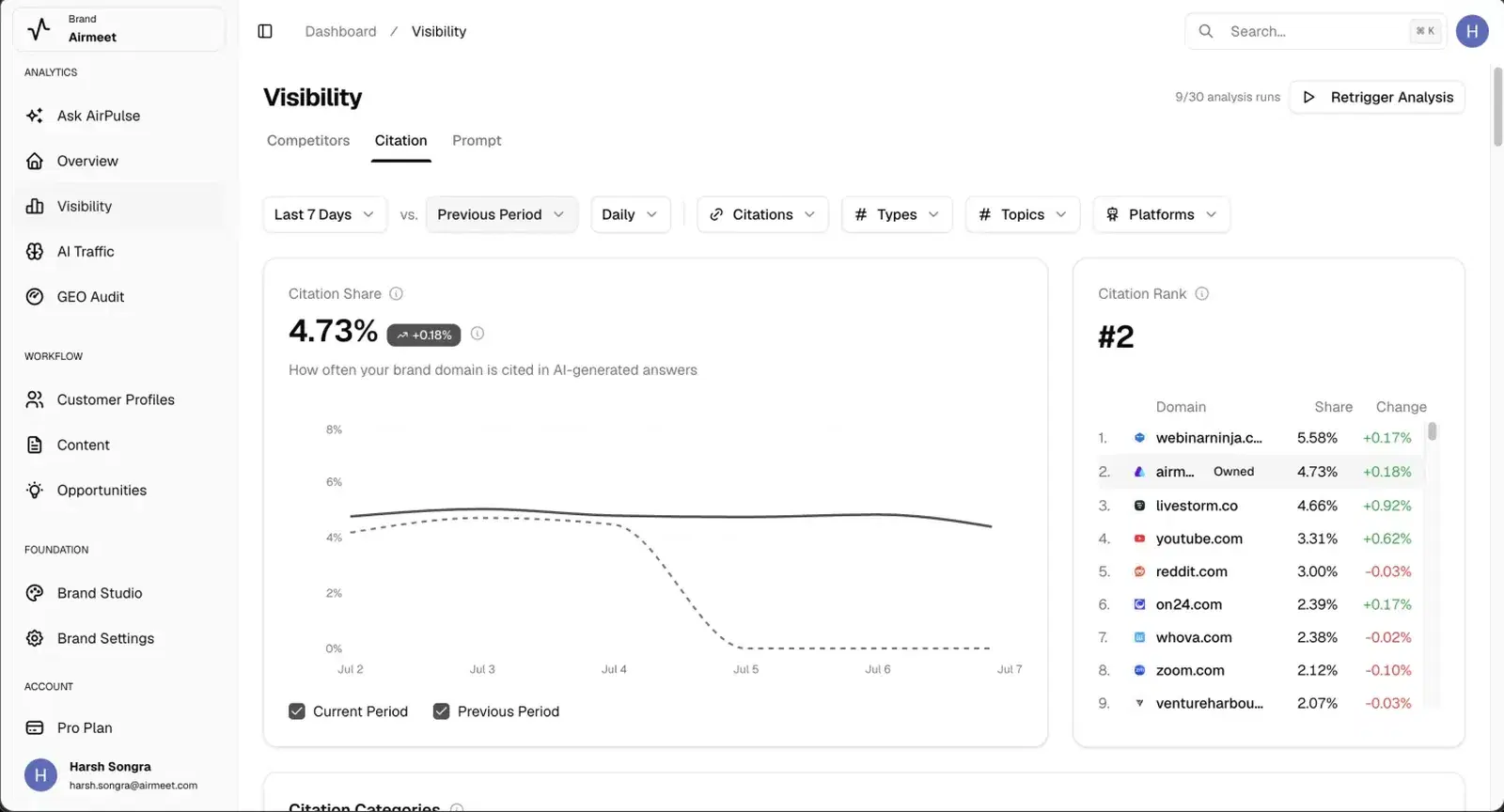
Citation visibility

Being mentioned is not being cited.

Track whether your articles, guides and landing pages are used as sources inside AI answers, where each URL sits in the citation list, and which ones you are losing.

The problem

Your best page might be doing nothing

A brand mention is cheap. A citation is the engine saying it trusted your page enough to build an answer on it, and it is the thing that survives when the model is retrained. Most teams cannot tell the two apart, because their analytics never sees either one.

Citation position compounds the problem. The same article can be the first source on Perplexity, buried sixth in a Google AI Overview, and absent from ChatGPT entirely. Reported as one number, that averages into something meaningless. Reported per engine, it tells you precisely which asset to strengthen.

What it does

Inside the feature

The unit of measurement here is the URL, not the brand. That changes what you can fix.

Article URL trackingMonitor the specific blogs, guides, research assets, comparison pages and landing pages you want engines to reach for.
Citation coverageHow often each URL appears as a cited source across your priority queries and each answer engine.
Citation positionWhether the page is cited first, inside the top three, further down the source list, or not at all. Higher-placed sources shape more of the answer.
Engine-by-engine citationsCompare which URLs get cited on ChatGPT, Perplexity, Google AI Overviews, Gemini, Claude and Copilot. The winners are rarely the same page.
Source snippet captureThe passage the engine actually leaned on, so you can see how your content is being summarised, quoted or misread.
Gained and lost citationsAlerts when a URL wins a citation, loses one, or gets downgraded, each tied back to the specific page rather than to the domain.
What you get

The output, not the dashboard.

A ranked list of which content assets are earning citations and which are inert.
Average citation position and top-three placement per URL, per engine.
The exact passages engines quote, so you can fix a misreading at the source.
Won and lost citations, attributed to individual pages rather than the site.
What it will not do

A citation is not a visit. An engine can cite your page, answer the reader's question completely, and send nobody. That is the channel working as designed. Read this alongside AI Traffic rather than expecting one to explain the other.

FAQ

Citation Visibility, in questions

It tracks whether your specific URLs are used as sources in AI answers, and where each one appears in the engine's source list. It moves the unit of measurement from the brand to the page, which is the level at which you can actually fix something.

Blogs, guides, comparison pages, research assets, documentation and the landing pages meant to support high-value queries. In practice the pages engines cite are rarely the pages marketing optimised, and finding that mismatch is most of the value.

The engine weights its sources. A first-position citation shapes how the answer is framed and how your brand is characterised. A sixth-position citation is often reduced to a link nobody clicks, appended after the answer has already been written.

Usually because the competitor's page is easier to extract a claim from: a clear definition near the top, a specific number with a source, a comparison table. Engines reward content that answers directly. They quietly skip content that requires reading three paragraphs to find the point.

First check whether the page changed or the query did. A citation lost after an edit usually means you buried the passage the engine was using. A citation lost with no edit usually means someone published something more citable, and the fix is to make yours more specific, not longer.

No, and this is the uncomfortable part. In our own citation data roughly 72% of citations come from sources the brand does not control, which is why third-party presence matters at least as much as your blog. Citation Visibility tracks your URLs. It does not pretend they are the whole picture.

Find out which pages engines actually trust.

The free audit shows the sources behind the answers about your brand today.