GEO audit

One score, and the reason behind it.

A weighted audit of whether answer engines can discover, understand, trust and cite your site, broken into six dimensions, every failing check tied to a page, and a fix queue ranked by impact against effort.
The problem

Rankings and traffic will not tell you this

Your existing reports measure whether people can find you. None of them measure whether a machine can read your page, understand what entity it describes, decide you are credible, and quote you. Those are different capabilities, and a site can be excellent at the first and hopeless at the rest.

The signals are also scattered. Crawler access lives in one tool, structured data in another, authority in a third, and answer-engine presence nowhere at all. Without weighting them against each other, teams reliably optimise the thing that is already strong. A site with immaculate technical SEO and no third-party presence will keep polishing the technical SEO.

What it does

Inside the feature

Four screens: the score, the findings, the fix queue, and the trend.

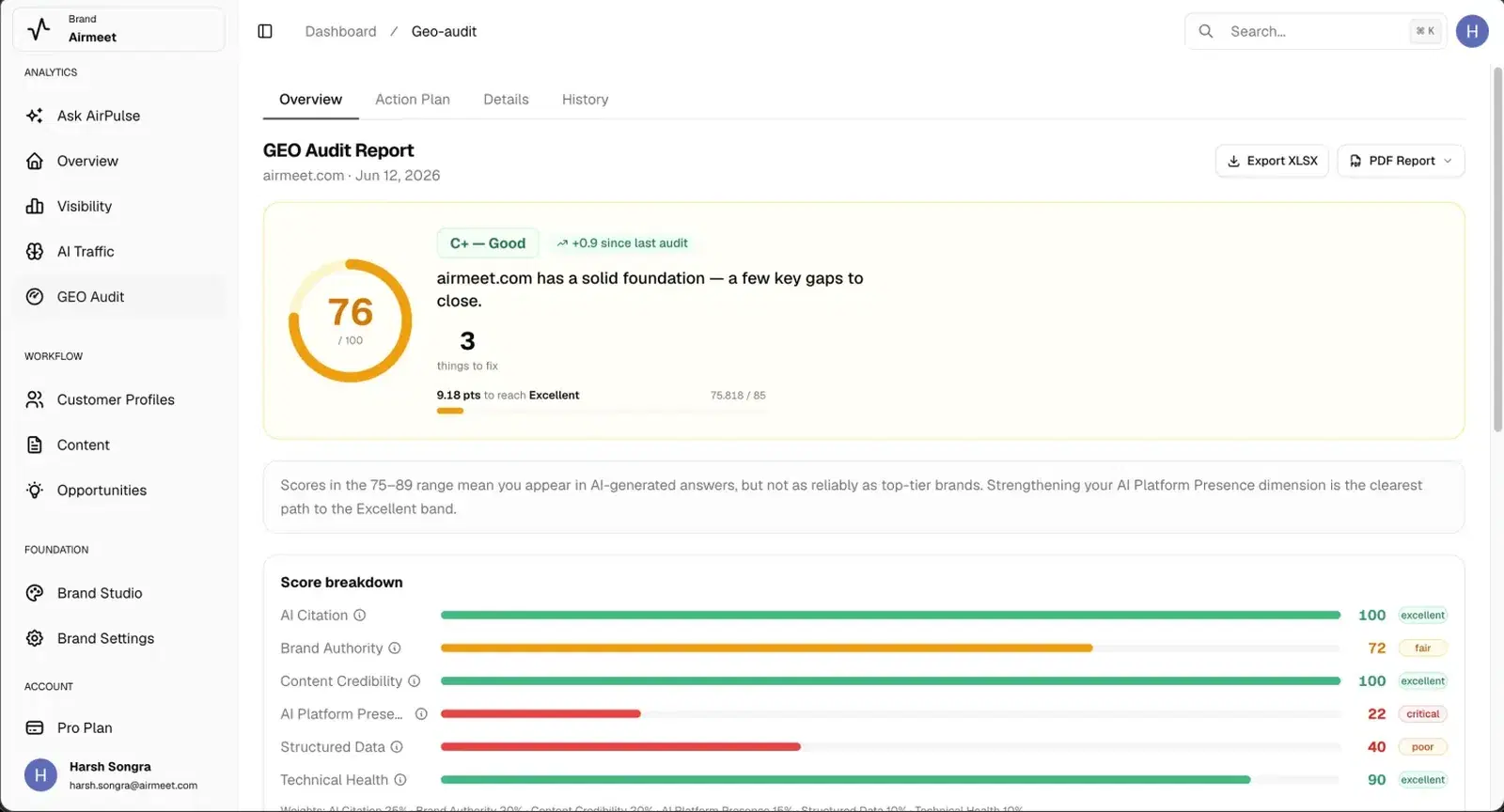
The scoreOne weighted number and a band: Needs Work, Good, Strong or Excellent. The band exists so the number can be reported upward without being explained every time.
Six dimensionsAI citation (25%), brand authority (20%), content credibility (20%), AI platform presence (15%), structured data (10%) and technical health (10%). The weights are published because a score whose arithmetic is secret is a score you cannot argue with.
Engine readinessHow prepared the site is for each of ChatGPT, Perplexity, Google AI Overviews, Gemini, Claude and Copilot separately, and which surface or source signal is holding a given engine back.
FindingsEvery failing check, at high, medium or low severity, tied to the specific page it was found on and the specific fix. Filterable by severity, page, dimension or the team that owns it.
Action planThe findings re-sorted by likely impact against implementation effort, each carrying an owner, the affected page, a plain-language description of the issue, and why an answer engine cares about it.
HistoryScore and per-dimension movement across runs, so a gain can be attributed to the release that caused it and a single declining dimension cannot hide behind a rising total.
What you get

The output, not the dashboard.

A defensible number for leadership, with the weighting shown rather than asserted.
A diagnosis for practitioners: which page, which check, which severity.
A queue for the people doing the work, ordered by impact over effort and assigned to content or engineering.
A trend line, so the programme can be proved rather than described.
What the score is and is not

The weights are a considered judgement, not a law of nature. They encode our view that being citable matters more than having perfect schema, which is defensible and still a view. Treat the score as a way to rank your own work against itself over time, not as a number that means the same thing for a media site and a B2B SaaS product. The dimension deltas in History are more useful than the total, and that is by design.

FAQ

GEO Audit, in questions

It evaluates whether a website is ready to appear in AI-generated answers: whether engines can crawl it, parse its structure, resolve the entities on it, judge it credible, and cite it. That is a broader question than whether it ranks, and the two frequently disagree.

From six weighted dimensions: AI citation at 25%, brand authority at 20%, content credibility at 20%, AI platform presence at 15%, structured data at 10% and technical health at 10%. The weights are shown in the product rather than hidden, because a score you cannot decompose is a score you cannot act on.

Needs Work, Good, Strong and Excellent. The band is there so a score can travel through an organisation without a footnote. The dimension breakdown is what you actually work from.

It weighs the affected page, the type of issue, how close the page sits to conversion, the visibility opportunity, and the role the fix plays in crawlability, structured understanding, source trust and answer quality. A missing schema block on a pricing page outranks the same issue on an archived post.

They are a trust and hygiene signal, and they are almost always a low-effort fix on a high-value page. They will not single-handedly move your score, and the action plan ranks them accordingly rather than pretending otherwise.

Take a baseline before starting any GEO work, then monthly, and additionally after a redesign, a CMS migration, a schema change or a significant content release. Running it more often than monthly mostly measures noise.

Because a total can absorb a decline. A brand-authority gain can mask a structured-data regression from last week's template change. This is exactly why History reports the six dimensions with individual deltas instead of only the headline.

The public audit at /geo-audit is free and needs no card or call. It runs your buyers' questions against four engines and returns the score, the competitor leaderboard and the structural checks. You keep the fix list either way.

Score your site in about a minute.

Free, no card, no call. You keep the fix list whether or not you ever talk to us.