An AI answer names three competitors, but your brand is missing. The useful question is what your team can do next.
You need to examine the evidence, improve the relevant pages and monitor whether those changes make a difference over time. Choosing an AI visibility platform involves more than comparing monthly subscription prices. You also need to consider each tool’s monitoring capabilities, content workflows and reporting features.
If your team needs to move from measuring AI visibility to improving content, AirPulse is worth considering as an AthenaHQ alternative. OtterlyAI may suit teams starting with a smaller monitoring program, while Peec AI may be a better fit for teams that prioritize analytics. AthenaHQ remains worth considering for teams that need broader AI engine coverage and organizational controls.
This comparison is based on publicly available product documentation rather than hands-on testing. It evaluates the platforms using practical criteria, including starting cost, ease of use, and the ability to act on findings. It does not assess compliance with digital accessibility standards.
What Makes an AI Visibility Platform Accessible?
A low subscription price is useful only if the plan covers your monitoring needs and your team can act on the findings.
A dashboard can create another reporting task for a marketer who already manages the website, content calendar, and sales requests. In that situation, a cheaper tool may not reduce the actual workload.
Instead, evaluate four factors: the total cost of monitoring, the effort required to interpret the results, the process for turning findings into improvements, and the ability to measure the impact of those improvements. These are practical buying criteria rather than product scores.
How Do the Main AthenaHQ Alternatives Compare?
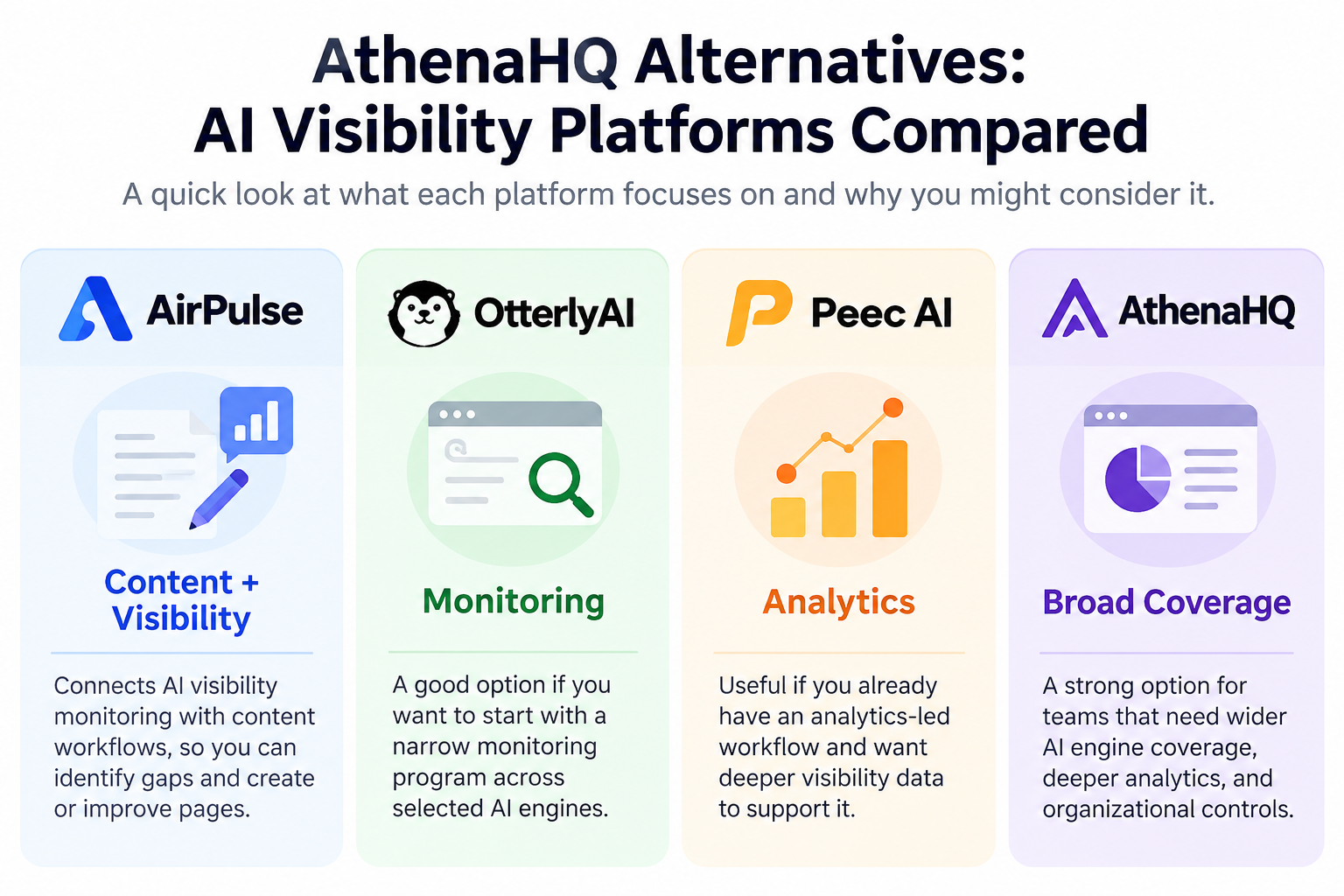
Each platform approaches AI visibility differently. Some prioritize monitoring and reporting, while others connect visibility insights directly to content workflows or offer broader analytics and organizational controls. The comparison below highlights these differences to help you identify the platform that best fits your team’s needs.
| Option | Published entry point | Main reason to evaluate |
| AirPulse | Starter: $89/month, 25 prompts, ChatGPT + Perplexity | Connect AI visibility monitoring with content work. |
| OtterlyAI | Lite: $29/month, 15 prompts, four engines | Start with a narrow monitoring program. |
| Peec AI | Starter: 50 prompts, three selected models, verify current pricing | Support an existing analytics-led workflow. |
| AthenaHQ | Essential: free with 300 credits, Starter: $295/month | Maintain broader coverage and a deeper toolset. |
Which AthenaHQ Alternative Fits Your Workflow?
Start with the problem your team needs to solve. If you cannot tell whether buyers encounter your brand in AI-generated answers, prioritize monitoring. If you already have visibility data but struggle to turn it into better pages, prioritize content execution. If your main challenge is communicating results across teams, prioritize reporting and data access.
Trying to solve all three problems at once can create complexity before your team has a repeatable process.
A useful product demonstration should start with a real question your buyers ask. Ask the vendor to show the AI-generated answer, identify its sources, explain any information gaps, and demonstrate the next step your team can take.
A polished visibility score alone does not tell you whether the workflow will work for your team.
- AirPulse
AirPulse is worth evaluating if your team wants to identify AI visibility gaps and turn those findings into actionable content improvements.
AirPulse’s Content Engine documentation describes workflows for turning visibility gaps into content briefs, new drafts, and improvements to existing pages. Its Content Impact view is intended to help teams monitor changes after publication.
This raises a practical question: Can your team turn a buyer query where your brand is absent into a useful content improvement without having to transfer information between multiple tools?
Suppose AI-generated answers favor competitors because their pages explain approval workflows, client access and workload planning more clearly. First, verify whether your product supports these capabilities. If it does, improve the relevant page with accurate feature descriptions, clear limitations and a specific use case.
If your product does not support these capabilities, rewriting the page alone will not resolve the underlying mismatch.
AirPulse’s Opportunities documentation describes queries where competitors appear while your brand does not. It also provides a route into content creation.
AirPulse also talks about AEO capabilities, like Reddit Intelligence, for finding those relevant conversations and helping your team shape responses. Take a look at these features alongside what you already use in your content workflow, and confirm that the plan you choose actually includes the abilities you need.
AirPulse offers different plans based on the number of prompts tracked, available integrations, and workflow features.
| Plan | Price | Key Features |
| Starter | $89/month | 25 monitored questions and 30 analysis runs per month |
| Growth | $179/month | 50 tracked prompts per brand, Google AI support, and Google Search Console integration |
| Pro | $399/month | 100 tracked prompts per brand, agent workflows, and an action feed |
| Enterprise | Custom pricing | Additional AI engines, multi-brand support, and agency workspaces |
Free trial: AirPulse offers a 14-day trial. Check its pricing page for current terms.
For more AI engines, various brands or complex processes, see the latest plan information before you buy.
Don’t evaluate AirPulse solely on its starting price. Instead, identify the AI engines, brands, prompts & workflow features your team needs, then choose a plan that supports those requirements.
Also, differentiate between the software subscription and managed services. AirPulse’s product and service overview describes these separately, so the starting subscription price should not be treated as the total cost of a fully managed program.
- OtterlyAI
OtterlyAI may suit teams that want to start with a smaller AI visibility monitoring program and keep initial costs low.
OtterlyAI’s Lite plan tracks daily updates from ChatGPT, Google AI Overviews, Perplexity, and Microsoft Copilot. Paid add-ons include Gemini, Google AI Mode and Claude. The normal package is $189 per month for 100 search prompts.
The Lite plan may suit businesses monitoring a focused set of buyer queries, while companies covering multiple industries may need a larger prompt allowance.
Before choosing a plan, list the buyer questions you want to monitor and confirm that its prompt allowance meets your needs.
Also test how the platform handles failed or missing responses. Your reporting should distinguish an actual answer that omitted your brand from a failed request that produced no usable result.
- Peec AI
Peec AI may suit teams with an established content publishing process that want to analyze AI search visibility through reporting and analytics.
Its pricing page lists daily monitoring, unlimited users, and one project for the Starter plan. Its product comparison also covers visibility, position, sentiment, and share of voice.
If you evaluate Peec AI, use the same prompt roster you plan to test with other platforms.
Ask to see the raw answer behind a chart. Check how the platform handles countries and languages. Review the export available within your exact tier.
These checks matter more than deciding which interface looks simplest in a screenshot.
- AthenaHQ
Switching platforms is not automatically better than improving the workflow you already have.
AthenaHQ Starter plan offers visibility across 11 models, CSV exports, and on-page and off-page actions. Additional credits and API access are sold separately. Enterprise includes controls like SSO, audit logs, and multi-region support.
Content gap analysis and optimization recommendations are also part of its workflow, according to AthenaHQ’s product summary.
If your team already has these capabilities in place, consider the cost of migration, as well as the availability of historical data and retraining people before changing platforms.
AthenaHQ’s free Essential plan also affects how its entry-level pricing compares with that of other platforms. Check whether credits are replenished, what happens when they run out and whether the free allocation is sufficient for your monitoring needs. An initial allocation of free credits should not be mistaken for an unlimited monitoring allowance.
How Should You Compare AI Visibility Tools Beyond Price?
Monthly subscription pricing does not reflect the full cost of AI visibility monitoring. Costs vary by platform because providers use different billing models. When comparing plans, consider the monitoring workload each subscription supports.
For example, suppose you monitor 20 buyer questions across three AI engines every day for 30 days. This produces 1,800 question-and-engine observations.
20 questions × 3 engines × 30 days = 1,800 observations
If you repeat each check twice daily, the total increases to 3,600 observations-
20 questions × 3 engines × 30 days × 2 checks per day = 3,600 observations
Disclaimer: These estimates are for illustration purposes only and are not vendor quotes.
How Do Vendor Allowances Compare With This Workload?
Because vendors measure usage differently, the same monitoring workload may use different amounts of each plan’s allowance.
- AthenaHQ: Its published Starter plan includes 3,600 monthly credits, with one credit representing one AI response. Verify the current allowance and billing terms on the AthenaHQ pricing page.
- AirPulse: Its published Starter and Growth plans each list 30 monthly analysis runs. The vendor describes an analysis run as a complete re-ask across the plan’s included engines.
- Important distinction: An analysis run is not equivalent to one AthenaHQ response credit. Before comparing costs, confirm how tracked prompts, analysis runs, scheduled monitoring, reruns and failed requests are counted under each plan.
What Other Costs Should You Consider?
When estimating the total cost of running a platform, consider-
- Subscription & mandatory add-ons.
- Content and implementation efforts.
- Time to review.
- Prompts and engine counts.
- Countries and frequency of refresh.
- Seats, exports, and support.
Ask each provider to price the same requirements, including prompt volume, AI engine coverage, monitoring frequency & any necessary add-ons. This will help you compare the actual cost of your intended workflow with each platform’s advertised starting price.
What Evidence Should You Expect From an AI Visibility Platform?
The easiest score to understand is not always the most useful measure.
A brand may be mentioned without a link to its website. A website may be cited without its product being recommended. Similarly, a visitor may arrive through AI search without becoming a customer.
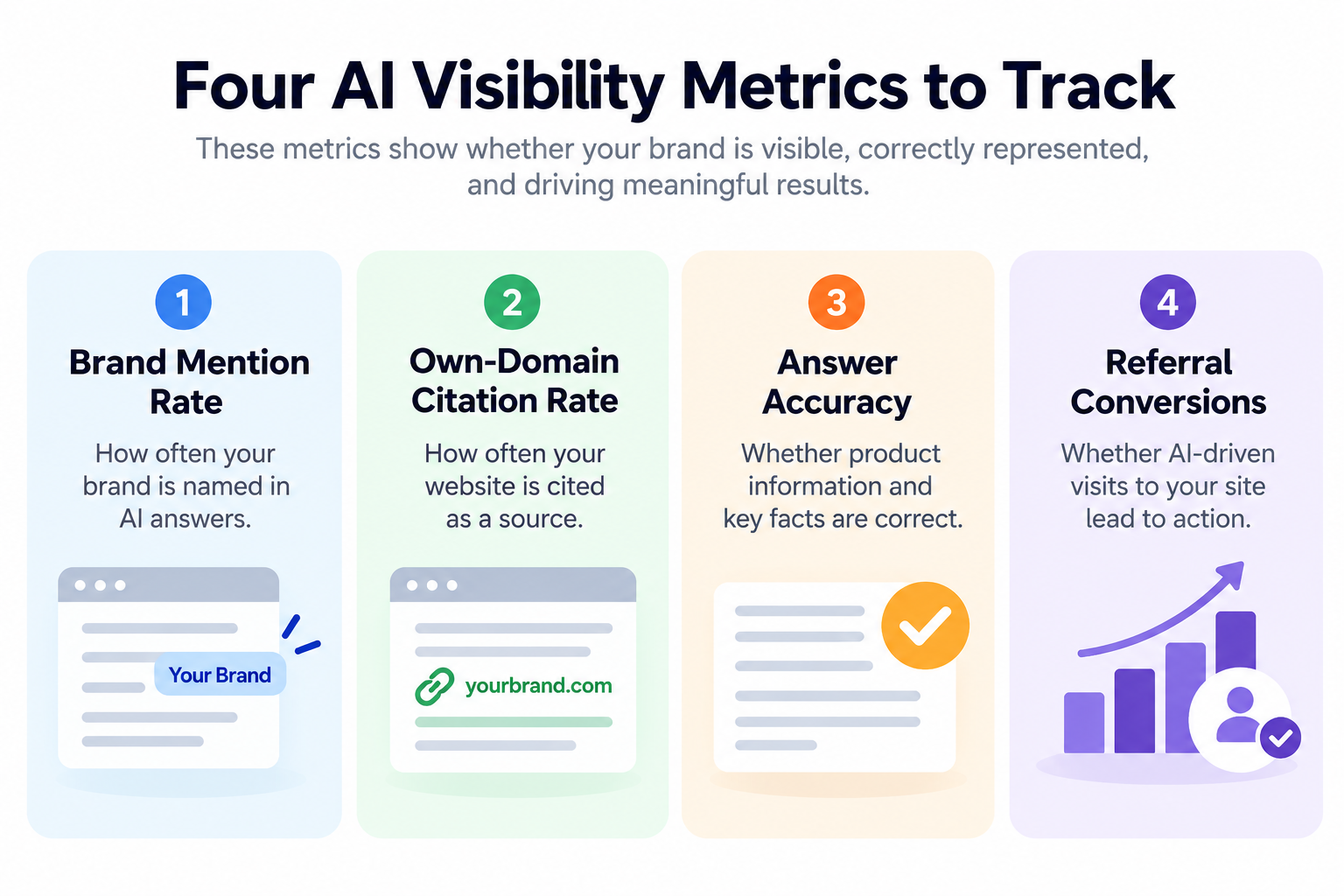
Track these outcomes separately:
| Measure | What it answers | What it does not prove |
| Brand mention rate | How often did valid answers mention our brand? | That the answer recommended our product |
| Own-domain citation rate | How often did answers cite our site? | That users clicked the link |
| Answer accuracy | Were the product facts in the answer correct? | That every buyer received the same answer |
| Referral conversions | Did measured visits from AI-related referrals lead to a useful action? | The full influence of AI discovery |
Define the denominator before calculating any visibility metric.
For example, if your brand is mentioned in 12 out of 40 valid observations, its mention rate for that sample is 30%. This does not mean that 30% of all potential buyers saw your brand.
Record failed requests separately from valid responses. Otherwise, a data collection error could be mistaken for a valid response in which your brand was not mentioned.
Why Do AI Visibility Scores Need Context?
AI-generated responses can vary across repeated queries. Ronald Sielinski’s 2026 arXiv preprint examined repeated inquiries across three generative-search platforms, and three consumer-product categories. The study found substantial variation in cited sources, and highlighted the importance of acknowledging uncertainty.
It does not set a one-size-fits-all sample size for all businesses. However, it does encourage a conservative approach to single-run visibility scores.
When comparing periods, use the same terminology, engine, market, and observation frame.
AirPulse’s published AI-search visibility assessment technique distinguishes between brand mentions, own-domain citations and other source outcomes. It also recommends saving raw answers with timestamps.
If your visibility score increases after you add simpler, brand-specific queries, the change may reflect a different sample rather than an actual improvement in AI discovery.
What Does Google Say About AI Search Visibility?
Google states that established SEO fundamentals remain relevant to AI Overviews and AI Mode. It does not require special AI markup or a separate machine-readable file for inclusion in these features.
To be eligible for these features, a page must be indexed and eligible to appear as a search snippet. However, inclusion in an AI-generated feature is not guaranteed.
Google also reports these AI features within overall Web performance in Search Console. You can review the guidance in Google Search Central’s documentation on AI features and your website.
Instead of focusing on claims about guaranteed AI rankings, ask vendors to demonstrate observable coverage, reliable measurement, and a useful improvement process.
A tool can support your workflow. It cannot make another company’s answer engine consistently choose your brand.
Frequently Asked Questions
Can you compare visibility scores between different vendors?
Yes, but only after understanding how each platform calculates its scores. Results can be affected by prompt selection, AI engine coverage, country, monitoring frequency, response collection and error handling. For a meaningful comparison, use a consistent set of prompts, and examine the underlying responses rather than relying solely on each platform’s headline score.
Does an AI citation mean the engine recommends your product?
No. A citation identifies a source referenced in an AI-generated response, while a recommendation suggests that a product or service is suitable for a particular need.
Read the whole answer to learn the difference. The AI answer can refer to your comparison site but name a competitor product.
Can you start monitoring AI visibility without subscribing to a tool?
Yes. Start by using a spreadsheet to record key buyer queries, AI-generated responses, cited URLs and observation dates. Treat individual results as snapshots rather than definitive evidence, and repeat the checks over time.
With manual monitoring, you can spot patterns, but the more queries, AI engines, marketplaces, and historical comparisons you add, the more work you have to do. A specialized platform can be helpful if you require more methodical tracking and reporting.