
A visibility report can tell you which competitors are being mentioned in AI-generated responses, but it can’t restore the missing elements on your website. In the same way, producing new content doesn’t guarantee that shoppers will notice your brand or think about your products.
Understanding AI visibility monitoring vs. content development and GEO helps organizations discover what they need to improve.
- Monitoring shows how artificial intelligence systems represent a brand.
- Content generation provides important information.
- Generative engine optimization (GEO) brings these two activities together through focused enhancements and continuous assessment.
But what you need to do depends on
- The issues you’re facing
- The quality of your content
- Your technical setup
- How well you can act on the findings
So, in this blog, we will clarify the distinction between AI visibility monitoring, content generation, and GEO, and how each strategy helps brands to keep an eye on their visibility in AI-generated replies, creating relevant content, and increasing their chances of being cited by AI platforms.
What Is the Difference Between AI Visibility Monitoring, Content Creation, and GEO?
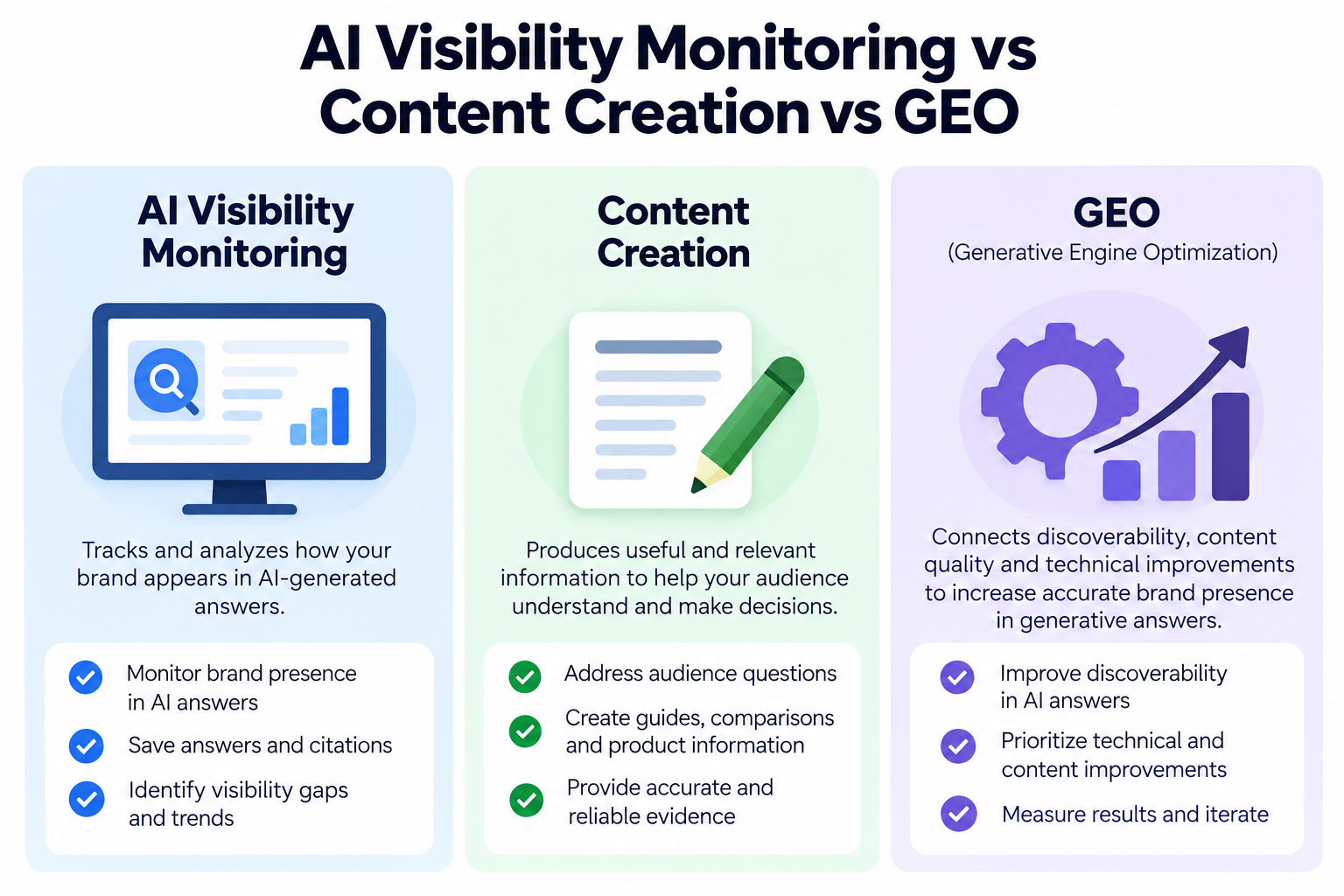
These three activities support AI discovery in different ways. Understanding their roles helps you decide where your team should invest its time and resources.
| Factor | AI Visibility Monitoring | Content Creation | GEO |
| Primary purpose | Track brand presence in AI answers | Address audience questions with useful information | Improve brand discoverability in generative answers |
| Typical output | Saved answers, citations, and trends | Guides, comparison pages, and product information | Prioritized improvements and experiments |
| Main benefit | Identifies visibility gaps | Supplies relevant information and evidence | Connects discovery problems with corrective actions |
| Common limitation | Reports findings without action | Produces content without addressing real needs | Treats individual tactics as guaranteed solutions |
| Next step | Assign actions to important findings | Verify accuracy and usefulness | Recheck affected questions after improvements |
Monitoring AI answers could reveal that a product is described wrongly. Then your content team can add the correct information to the right page. And GEO then connects this correction to the discovery problem and tests if the brand’s portrayal changes.
Google’s recommendation on optimizing sites for generative AI features includes optimization for its generative search experiences as part of SEO.
When Should You Prioritize AI Visibility Monitoring?
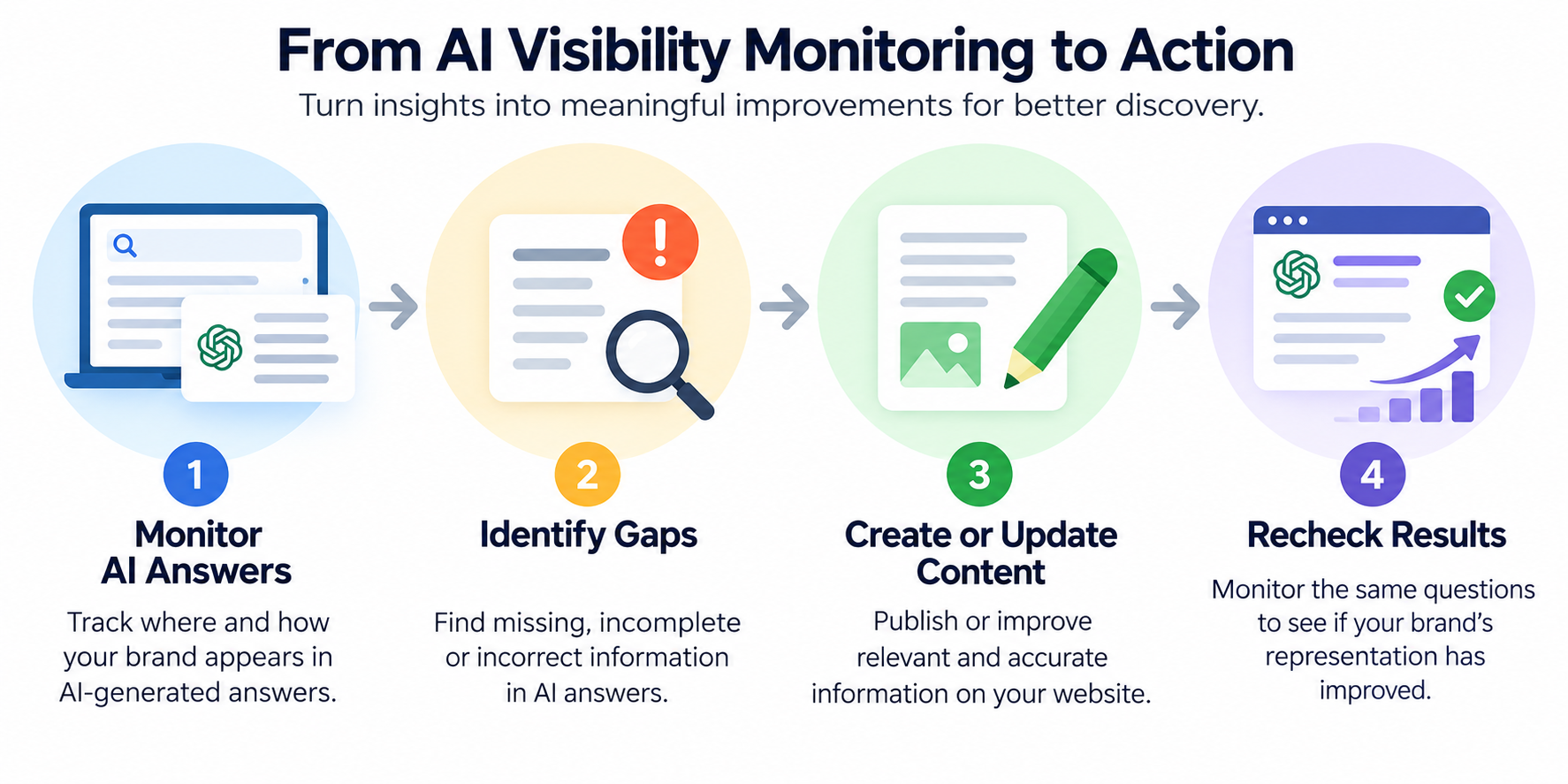
You find AI visibility monitoring helpful when you want to understand how the responses provided by AI represent your brand, products, or services.
Consider, for example, a tiny software company that sells inventory management products. Its team has written various articles on the benefits of inventory management. But potential buyers are asking one specific question in this case: Which inventory system works well for a shop with three stores and minimal installation support?
If you find rivals regularly popping up in answers to this query, a different introductory piece may not fix the problem. The missing information may include such things as
- Implementation requirements
- Store-level rights
- Migration support
- Product constraints
Monitoring allows the team to look into these gaps and decide what to do.
What Should You Track in AI-Generated Answers?
A useful monitoring program should preserve enough evidence to explain its findings. For each observation, record the question, complete answer, and linked sources, date, AI engine or interface, and language and location settings where available. Also record whether the interface used a web search, if that information is available.
Keep three measurements separate:
- Brand mentions: The answer names your company or product.
- Owned-page citations: The answer links to a page on your website.
- Product recommendations: The answer presents your product as suitable for the stated requirement.
These measurements reveal different aspects of visibility. An AI answer might cite your educational article while recommending a competitor. Alternatively, it might recommend your product using an independent review rather than your website.
So, it is better to read the surrounding context before interpreting either result. A mention that assigns your product an unsupported capability is not necessarily positive. Similarly, an AI answer that excludes your product for a valid reason may accurately reflect its limitations.
Key AI Visibility Metrics to Track
Once you establish a monitoring process, you have to define how you will measure its findings. Avoid combining brand recognition, citation activity, factual accuracy, and commercial outcomes into one unexplained score.
| Metric | Suggested calculation | What It Measures |
| Mention rate | Valid answers naming the brand ÷ all valid answers | How often the brand appears |
| Owned citation rate | Valid answers linking to your domain ÷ all valid answers | How often does your website supply cited evidence |
| Recommendation rate | Answers recommending the product ÷ valid buying-intent answers | How often the product receives consideration |
| Claim accuracy | Reviewed factual claims judged correct ÷ reviewed factual claims | Whether public information represents the product accurately |
| Commercial outcomes | Attributable visits, qualified leads, and purchases | Whether discovery connects with business value |
These are proposed operating definitions rather than universal industry standards. Establish rules for brand aliases, multiple products, broken links, mixed recommendations, and answers without relevant factual claims before reporting results.
For example, if your brand appears in 12 of 60 valid observations, its observed mention rate is 20%. If five of those 60 answers cite your domain, the owned citation rate is approximately 8.3%.
These figures are illustrative. Repeated runs of the same questions are not necessarily independent observations, so avoid presenting the results as precise estimates of overall market visibility.
Record technical failures separately. Exclude failed requests from valid-answer calculations and disclose them. For Google-specific monitoring, record cases where no AI answer appears as a separate outcome rather than treating them as missing data.
Does AI Visibility Translate Into Website Traffic?
Visibility and traffic should be measured separately because appearing in an AI answer does not guarantee a website visit.
A July 2025 Pew Research Center study found that traditional search-result links received clicks on 8% of visits with a Google AI summary, compared with 15% of visits without one. Links inside AI summaries received clicks on 1% of visits with a summary.
The study looked at browsing data from 900 U.S. individuals in March 2025 and collected corresponding search results in April. These results are a description of behavior in a given time period. They don’t show that the same trend applies across all businesses, and they don’t show that the AI summaries made the difference.
So, on the basis of the findings, you should track recognizable AI referrals where possible, relevant landing page conversions, and voluntary responses to inquiries such as “How did you hear about us?”
Consider these signals individually before putting them together. Someone may find your brand through an AI recommendation and return later via some other channel without generating an obvious AI referral.
When Should You Invest in Content Creation?
Content creation should address a specific information gap that prevents readers from making informed decisions. Before commissioning an article or landing page, identify the decision your audience needs to make.
Returning to the inventory software example, a retailer might need to determine whether three stores can implement the product without dedicated IT staff.
The content brief should identify the evidence required to answer that question, including supported migration methods, setup responsibilities, training expectations, ongoing administration, and implementation dependencies.
This approach changes how you evaluate content. Instead of judging a page by its word count, assess whether it helps readers understand their options and make better decisions.
What Makes Content Useful for AI Discovery?
Begin with the things your company is able to support. Depending on the subject, this might be a product walkthrough, a defined process, an allowed customer example or original research with a clear approach.
If the original evidence is not available, cite reliable external sources, describe what they show, and describe what is ambiguous.
The material should represent the decision it supports:
- Comparison pages should make comparisons on a like-for-like basis.
- Cost guidelines should describe the assumptions and calculations used.
- Customer tales should separate quantitative results from personal opinions.
- Product pages need to properly define capabilities, requirements and restrictions.
These approaches enhance the utility and trustworthiness of information. But they don’t ensure an AI system will credit or recommend a certain page.
Should You Create a New Article for Every AI Search Question?
No. One comprehensive resource may efficiently answer several related issues.
Begin by auditing existing pages that already discuss the issue. If a page is close to answering the topic, improve it rather than publishing yet another article automatically.
Create different pages if the demands or tasks of the audience are significantly different. Just because you ask the same question in a different way doesn’t necessarily mean you need alternative content.
Google’s generative AI optimization guidance cautions against making pages just to influence ranks or generative answers. It also negates the need for an AI-specific page length, necessary content chunking, and particular AI markup for its search experiences.
AI technologies can be useful for outlining, organizing research, and drafting. Assign a reviewer to verify product details, sources, comparisons, and final wording, however. Faster manufacturing is only useful if the knowledge is still correct and reliable.
How Does GEO Connect Monitoring and Content Creation?
GEO connects discovery research with the improvements needed to help AI systems access and represent a brand accurately.
A company might publish strong content that search systems cannot access easily. Another company might have accessible pages that lack convincing evidence. A third might maintain accurate website information while outdated descriptions elsewhere misrepresent its product.
GEO helps teams identify these barriers and coordinate their responses.
- Start With Technical Accessibility
Before generating more material, examine whether the pages that matter are accessible to search services.
As Google’s guide on AI features and your website states, the supporting links in AI Overviews and AI Mode must be indexed sites that are eligible to show with a snippet. The advice also emphasizes crawl access, internal links, key information in text form, and consistency between structured data and visible content.
These prerequisites don’t guarantee a page will show up in an AI answer. But unresolved access or indexing problems may limit discovery opportunities.
- Improve the Accuracy of Your Brand Information
Check the facts on your website and in relevant external sources.
Check that the page names, introductions, product descriptions and supporting references are consistent. Make it so your customers can easily tell your organization apart from other ones with similar names. Also, if you’re making any promises that could become less true over time, then add dates and specific limitations to those claims before they get stale or outdated.
If an authentic item or review is factually incorrect about a product feature, you may seek a factual correction through the publisher’s standard process.
Participate in public conversations and reveal your involvement with the company when appropriate, when you can address inquiries effectively. These conversations can be used to learn what the public cares about and to help legitimate discovery, not to create endorsements.
AI Visibility Monitoring vs Content Creation vs GEO: Where Should You Invest?
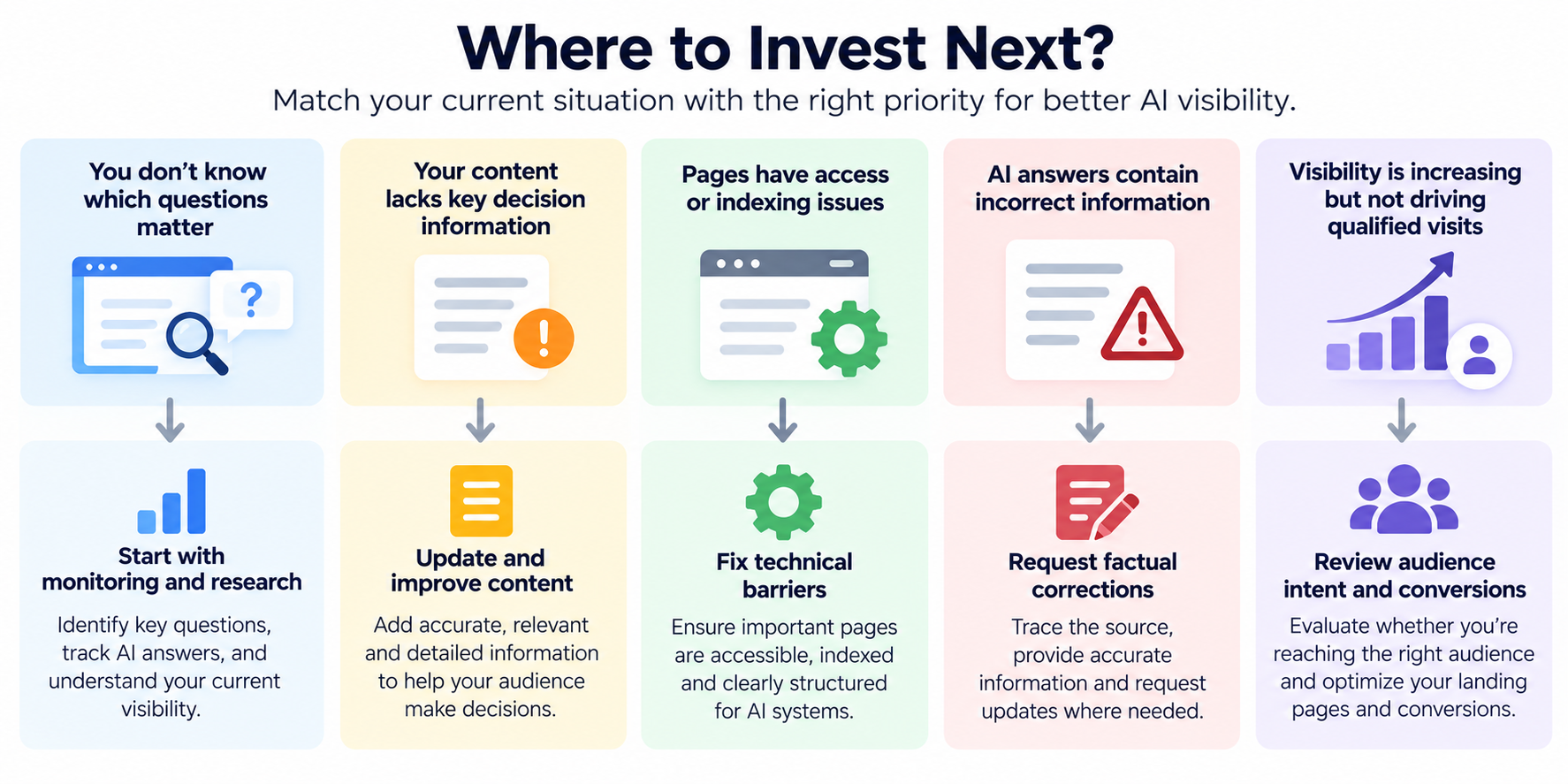
Your next investment should address the most important barrier to discovery. A fixed budget split would overlook differences in content quality, technical health, and implementation capacity.
| Current Situation | Recommended Priority | Reason |
| You do not know which buyer questions matter | Establish a baseline and research your audience | A larger content plan would rely on assumptions |
| Existing pages omit important decision-making evidence | Update content and involve subject-matter experts | The information gap is already identifiable |
| Strong pages face access or indexing problems | Investigate technical barriers | More content will not remove the existing obstacle |
| AI answers contain incorrect product information | Trace sources and request factual corrections | Additional mentions could reinforce the error |
| Visibility increases without qualified visits | Review audience intent and conversions | The problem might involve audience fit |
| Reports accumulate without meaningful changes | Assign ownership and improve production capacity | Additional reporting offers little practical value |
Before buying a product or a service, ask the provider to demonstrate how it does the process.
How to Use AI Discovery Insights?
Start with a high-intent question your brand has to be a credible choice for. Review the AI-generated answer and identify any evidence that is missing or wrong. Rate it as the lowest level of useful development.
Back to the same question, notice what has changed.
AirPulse helps brands connect with high-intent conversations across AI search and social channels. It helps teams identify relevant discovery opportunities and decide where to focus their content efforts.
Explore AirPulse to see how it can support your brand’s AI visibility strategy. Book a demo or check the available plans to find the right fit for your team.
Final Takeaway
AI visibility monitoring, content production and GEO all serve different purposes to enhance how customers discover your company through AI-generated replies.
Monitoring spot visibility holes. Content production then addresses missing information, and the GEO part links it all together through tech upgrades and ongoing evaluation. The best method depends on your business goals and on the actual issues that affect your existing visibility.
Instead of only chasing mentions or citations, use these findings to make more informed decisions about what comes next. Don’t just focus on mentions or citations, because these findings really help you judge your next steps more wisely.
Also, compare competitor visibility, spot content gaps, and check which topics trigger meaningful AI recommendations. Then, use that to set priorities for content refreshes, sharpen your wording, and keep attention on the openings that match what your audience is searching for.
Frequently Asked Questions
Can AI visibility monitoring enhance visibility alone?
Monitoring doesn’t necessarily provide you with better vision, but it does give you evidence for making better decisions. It’s useful for what you do with it next, whether that’s fixing misinformation, improving content or fixing technological issues. Make sure you know whether a service you’re buying is for implementation or just reporting.
Is GEO different from SEO?
GEO examines a brand’s prominence in AI-generated replies. It frequently overlaps with SEO, content planning, and reputation management. Google includes optimization for its generative search experiences inside its SEO recommendations, and established search basics are a key part of the process.
Does each query that is monitored require a separate article for companies?
One key resource can address numerous related questions that meet the same audience need. Create separate pages when readers have significantly diverse needs. Content decisions should be driven by monitoring questions, not set by the publishing timetable.