Choosing the appropriate AI visibility technology helps organizations understand how their brands are portrayed in AI-generated responses.
Bluefish AI helps organizations to manage brand visibility on AI search platforms, track mentions and citations, and analyze competition. Smaller teams may use comparisons to discover tools that align with their aims without the added complexity.
If you’re a single-brand team trying to match AI visibility with your content development, AirPulse is a great option to consider. It helps track mentions of brands, visibility of competitors, citations, and gaps in material on AI search platforms.
In this blog, we will explore the best Bluefish AI alternatives for non-enterprise teams.
Why Should You Look Beyond Bluefish AI?
Bluefish AI has enterprise-level marketing features, but smaller teams may not need the complete suite of services. Also, their website employs a demo-led buying approach, without any conventional self-service subscription pricing published, which can make budget planning less clear.
If your team’s primary goal is brand presence across AI search platforms, a larger marketing platform may be more than you need right now.
Maybe you’re seeking an easier approach to:
- Track buyer inquiries on AI platforms
- Monitor Brand Mentions & References
- Identify content gaps and visibility deficiencies
- Competitor performance comparison
- Turn findings into content enhancements
For these reasons, a more targeted solution may be easier to analyze, administer, and integrate into your marketing budget.
What Should a Small Team Actually Ask an AI Visibility Tool to Do?
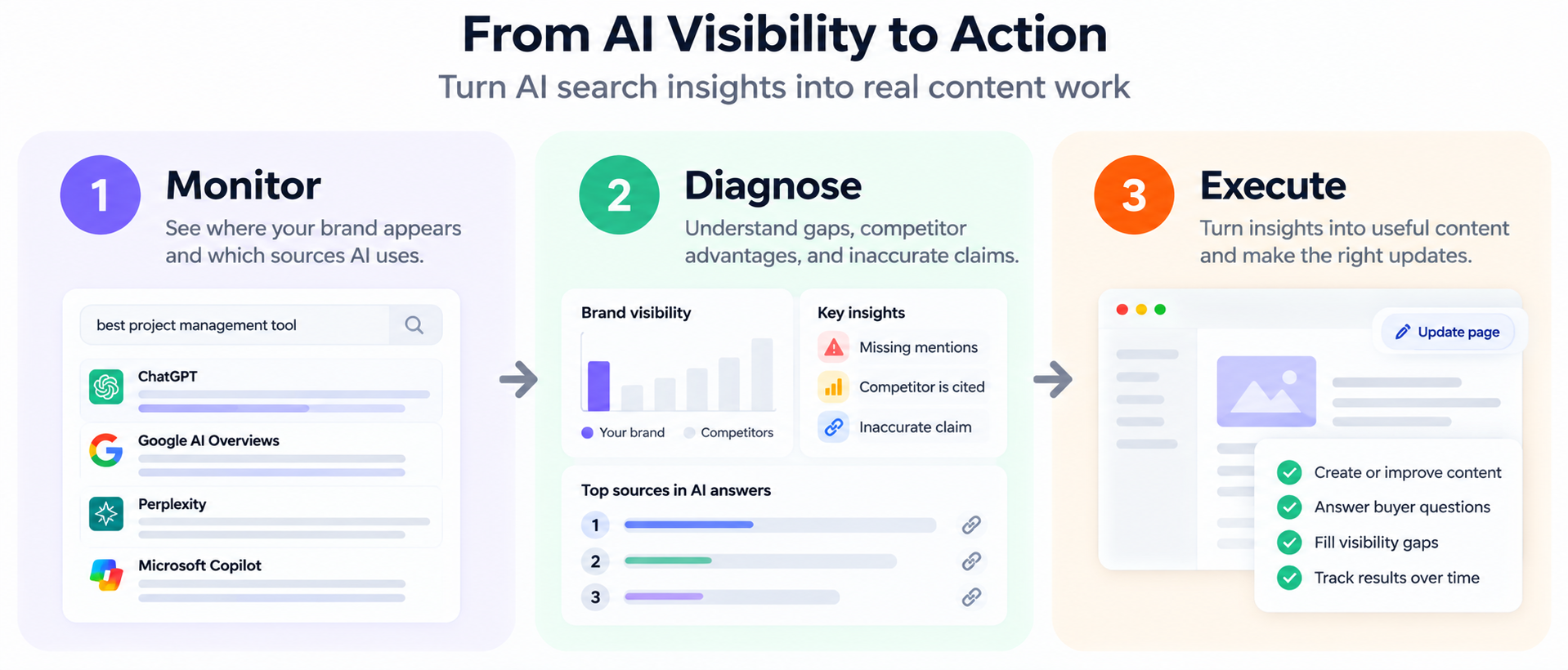
AI visibility workflows usually have three separate jobs:
- Monitoring - You check where your brand appears and which sources AI platforms use for answering questions.
- Diagnosis - This is the part that helps sort out why the brand is missing, what competitors are doing better, or if a response has some wrong or inaccurate claims.
- Execution - Execution translates those results into useful work. This may include upgrading a page, making a comparison, adding product details, or joining a related discussion.
A platform can accommodate several of them, but what you choose depends on what slows your team down the most. Expensive execution features you don’t use a lot are a waste of money, and cheap monitoring isn’t of much help if your team doesn’t have the time to act on its discoveries.
Which Bluefish AI Alternatives Are Worth Considering?
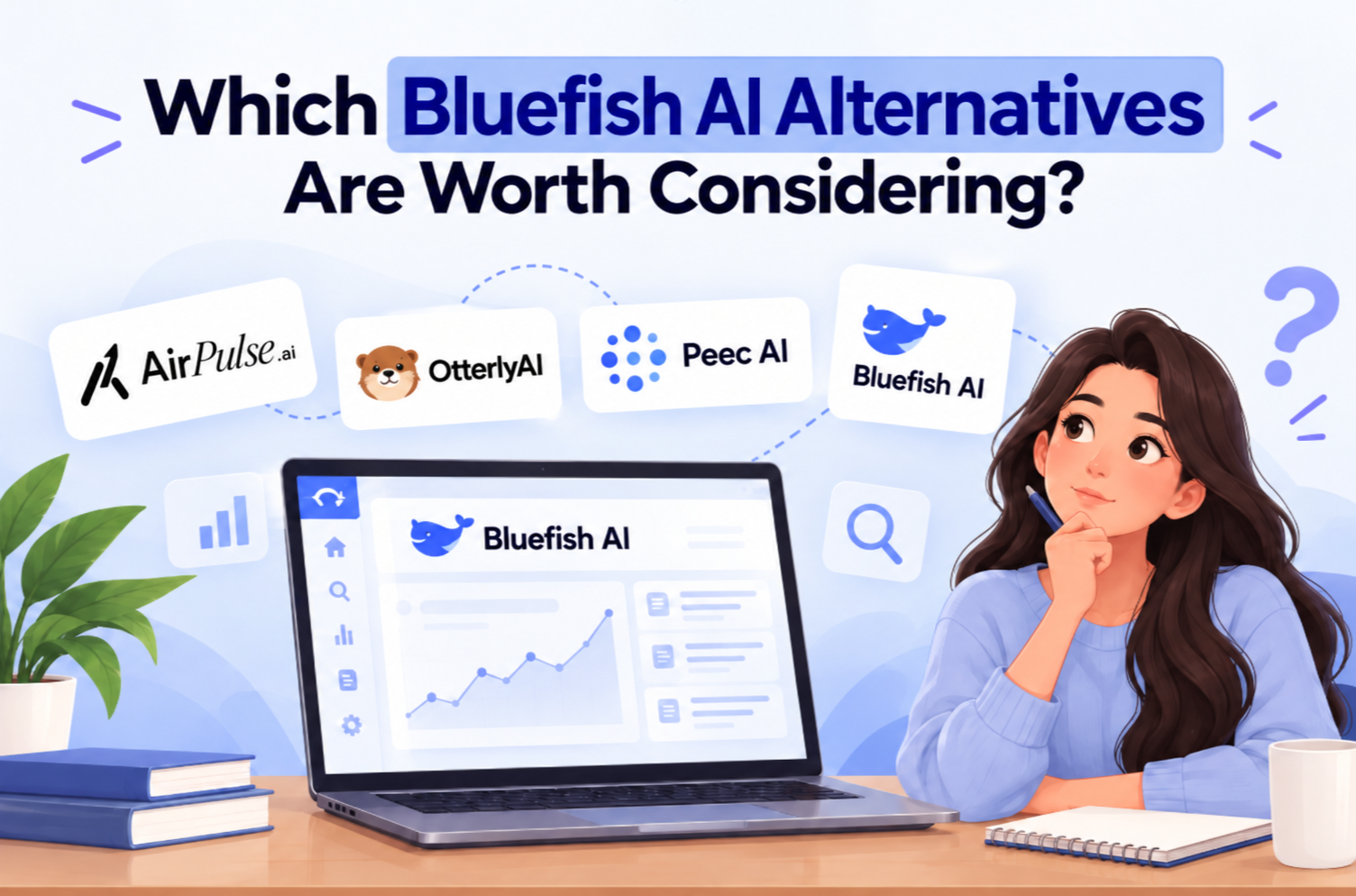
The main options in this comparison serve different types of smaller teams.
| Platform | Starting scope | Best reason to evaluate |
| AirPulse | $89/month, 25 prompts, ChatGPT and Perplexity | One brand that needs monitoring connected to content work |
| OtterlyAI | $29/month, 15 prompts, four AI search engines | A low-cost monitoring pilot |
| Peec AI | $95/month, 50 prompts, three selected models | Teams focused on comparative AI search analytics |
| Bluefish | Demo-led, custom buying process | Cross-functional enterprise AI marketing |
These are starting configurations, not equivalent packages. Prompt limits, engine coverage, add-ons, reporting, and execution features can change the actual value of each plan.
Is AirPulse the Best Bluefish AI Alternative for Content-Focused Teams?
AirPulse is worth evaluating when it’s the same person or a small team handling both AI visibility and actual content execution. Its documentation links visibility monitoring with a GEO audit and also folds in content briefs, drafts, and even Reddit intelligence.
Reddit Intelligence helps brands identify relevant Reddit discussions that may influence AI-generated answers. The platform describes content workflows around prompts where a brand is missing and Reddit intelligence around relevant threads and reply opportunities.
That makes it particularly useful when the problem is not simply knowing that your brand is missing.
The bigger question is what should you create or improve because of that gap?
AirPulse currently lists the pricing:
- Starter: $89/month with 25 tracked prompts
- Growth: $179/month with 50 tracked prompts
- Pro: $399/month with 100 tracked prompts
- Enterprise: Custom pricing for multi-brand teams and agencies
ChatGPT and Perplexity are the two AI platforms AirPulse monitors on its Starter plan. It checks how often your brand appears in answers to selected buyer questions and tracks competitor visibility and citations. This helps smaller teams understand where their brands stand in AI search without paying for broader platform coverage.
What Would a Useful AirPulse Trial Look Like?
Imagine a small B2B software company that appears in broad category answers but disappears when buyers add a specific requirement.
The scenario is illustrative, but the workflow is practical.
Start with one high-intent buyer question. Look at the answer, identify the sources being cited, and understand why the brand is missing.
Then use the platform to determine whether the resulting content recommendation is actually useful.
A good trial should answer three questions:
- Is the suggested brief specific to your product?
- Can the resulting content be supported by real evidence?
- How much editing does the draft need before publication?
A draft only saves time when it survives product and editorial review.
If social discovery is part of your strategy, evaluate that separately. A useful response in a relevant Reddit discussion is different from placing promotional comments wherever a keyword appears. Relevance, disclosure, and community rules still matter.
AirPulse is strongest to consider when visibility analysis and content execution belong to the same workflow.
Is OtterlyAI Better for a Small Monitoring Experiment?
OtterlyAI is a strong candidate when you want to begin with a smaller monitoring experiment.
Its current Lite plan costs $29 per month and includes 15 search prompts, four AI search engines, unlimited team members, and daily tracking. The included engines are ChatGPT, Google AI Overviews, Perplexity, and Microsoft Copilot.
Its standard plan increases the allowance to 100 prompts at $189 per month, while premium provides 400 prompts at $489 per month. Additional engines such as Claude, Gemini, and Google AI Mode are available as add-ons.
That makes OtterlyAI attractive for a team that already knows which questions matter.
You can start with a small set of prompts, observe the results, and decide whether the workflow provides enough useful information to justify expanding it.
The limitation is scope. Fifteen prompts may be enough for a first experiment. They may not be enough for multiple products, markets, customer segments, or buying stages.
Before calling it the cheapest option, price the engine add-ons and prompt volume you actually need.
When Does Peec AI Make More Sense?
Peec AI is better suited to teams that want analytics to explain competitive differences.
Its starter plan includes 50 prompts, three selected models, one project, unlimited users, and daily tracking. Its product information also describes competitive visibility, position and sentiment analysis, source analytics, gap analysis, and recommended actions.
This makes it worth considering when an SEO or content lead wants to understand more than whether a brand appeared.
You may want to know:
- Which topics do competitors dominate
- Which sources influence AI answers
- Where visibility gaps exist
- How the brand’s position changes
- What actions could address those gaps
Peec lists Starter at $95 per month in its published pricing information. Pricing and plan details can change, so confirm the current amount and model choices before budgeting.
The key point is that analytics only creates value when someone can act on it.
For a fair trial, use the same core questions across Peec and your other finalist. Compare the answers, source detail, investigation process, and time needed to reach a defensible next action.
A cleaner dashboard is useful. It is not proof that a recommendation will improve discovery.
How Should You Run a Bluefish AI Alternative Pilot?
A good pilot should help you make a purchase decision, not simply produce another report.
1. Start With a Small Baseline
Choose a focused group of high-intent questions that both finalists can track.
Keep the language, geography, and named competitors consistent.
Record:
- Missing brand mentions
- Inaccurate descriptions
- Competitor appearances
- Frequently cited sources
- Questions where your brand has an obvious gap
Also, decide who will act on each finding.
Read several underlying answers yourself. If a tool cannot show enough evidence to explain its score, ask for a demonstration before committing.
2. Ship One Useful Improvement
Find an honest gap that your team can fill.
It might be:
- An ambiguous integration page
- Outdated pricing explanation
- A significant limitation absent from the comparison
- A product site that fails to answer a typical customer question
Correct product information and a clear answer would improve the page. Note the date it was published and the specific modifications made.
3. Check Whether Recommendations Support SEO Best Practices
AI visibility tools should help you improve your website, not take over and replace established SEO practices. Google confirms that existing SEO best practices are still relevant for AI Overviews and AI Mode, and there aren’t any extra technical requirements or special markup.
During your pilot, you should check if the tool spots practical improvements like missing product details, outdated content, unclear answers, or just plain gaps across existing pages. Don’t lean too hard on promises of guaranteed AI placement.
The whole point is to figure out if the platform actually helps your team surface useful changes and then prioritize work that supports both search visibility and the real needs of users, not just some theoretical performance.
4. Give the Pilot Enough Time to Be Useful
A two-week pilot can help you assess usability.
Look at:
- Setup effort
- Quality of evidence
- Transparency reporting
- Time to edit
- Practicality
- If the team did truly do useful work
But we can’t credibly verify higher revenue or long-term visibility gains in two weeks.
Keep measuring results over a longer time frame that matches your website and buying cycle. Stabilize your prompts. Track relevant visits and conversions if possible. Document additional changes that could affect the results. An observation is an enhanced AI answer after publication. It is not proof by itself that one page update caused the improvement.
Which Bluefish AI Alternative Should You Choose?
There is no single best Bluefish AI alternative for every non-enterprise team.
- If you want to combine AI visibility tracking with content work, go with AirPulse. This is especially true if you have one person or a small team who needs to discover the gaps and turn them into content actions.
- If you want the cheapest published admission price of these alternatives, then choose OtterlyAI.
- If analytics are your priority, choose Peec AI. Its methodology works well for organizations looking to compare visibility, sources, rivals and performance across chosen models.
- If your firm is looking for enterprise-level collaboration across numerous marketing functions, think Bluefish. Its platform is clearly aimed at the marketing demands of Fortune 500 and large companies.
The best tool is ultimately the one your team can operate every week.
If nobody owns the work produced by the platform, a cheaper subscription will not solve the problem. If your team already has strong execution, paying more for overlapping features may add little value.
Frequently Asked Questions
Is AirPulse the best Bluefish AI alternative?
Yes, AirPulse is like a strong choice for a small, single-brand team that really wants to link up AI visibility monitoring with their content work. The “best” option might change, though, if your priority is the absolute lowest price.
Is AirPulse worth its price for smaller teams?
AirPulse starts at $89/month for 25 monitored prompts, with ambitions to cover wider AI platforms and more workflows as you scale. Its value is in the interlinking of visibility tracking with GEO audits, content briefs, drafts, competitive analysis and Reddit intelligence.
This combination justifies the cost over using separate technologies for teams that need AI visibility insights and actionable recommendations on material.
Can an AI visibility tool replace SEO?
No. AI visibility tools can show how selected questions and AI answers relate to your brand. They can also help prioritize content work. They do not replace a useful, accessible website or foundational SEO. Google confirms that existing SEO best practices remain relevant to its AI search features.
Can I start tracking AI visibility without paying for a platform?
Yes. Start by manually recording a small, consistent set of buyer questions, answers, sources, and dates. This approach takes more time, but it helps you understand what information you actually need before buying software. Once repeated monitoring and analysis begin taking time away from content work, automation can become easier to justify.