
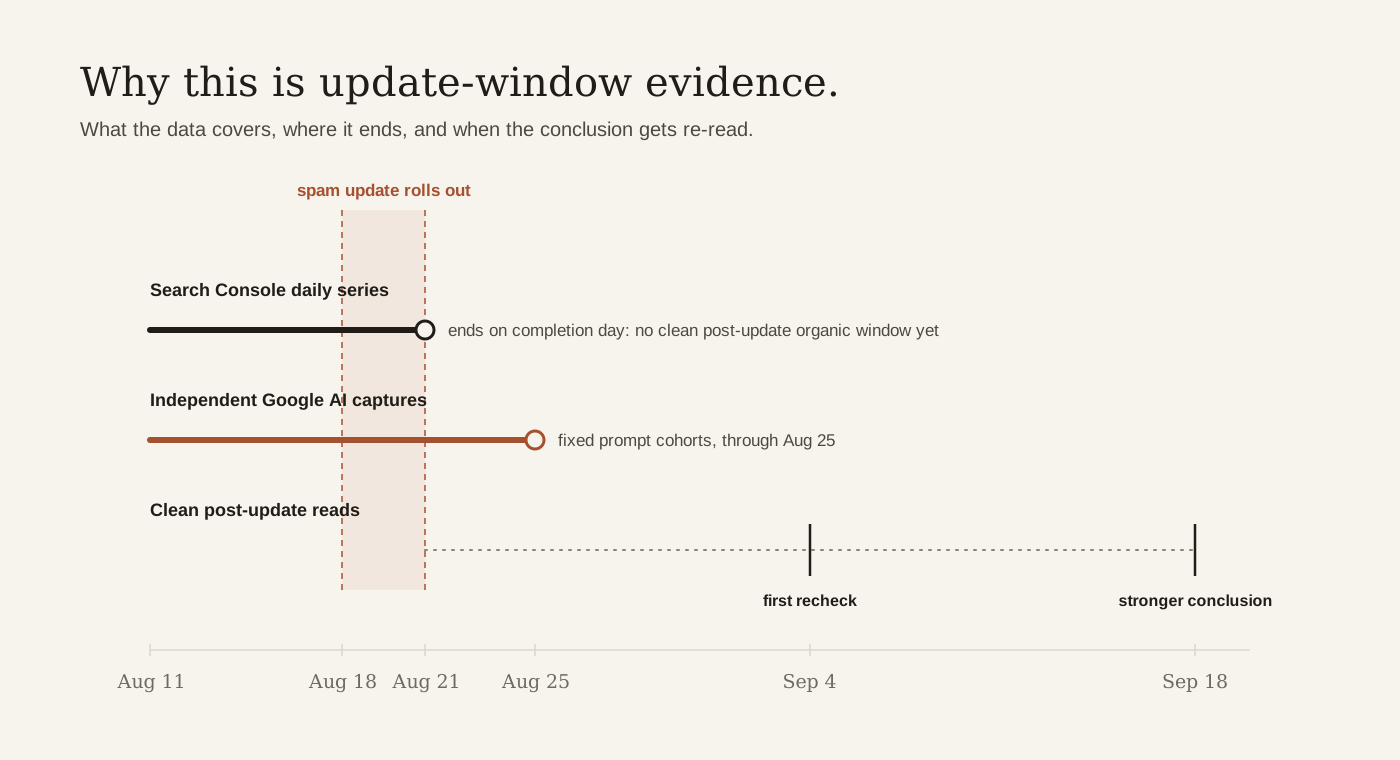
The August 2026 spam update ran globally across all languages from Aug 18 to Aug 21, 2026. Public rank trackers showed no market-wide volatility spike, Airmeet showed no immediate broad penalty, and AirPulse moved in a mixed direction that needs more post-update data. Search Console data here runs through Aug 21; independent Google AI captures run through Aug 25.
In the latest full Search Console snapshot, Airmeet clicks and impressions each fell about 1.4%, CTR was flat, and average position weakened by about three places. AirPulse: clicks flat, impressions up 7.4%, CTR down 6.9%, average position almost 13 places worse. That is more reach at lower rankings, not a visibility collapse.
The main limit is timing. The daily Search Console series ends on the day the rollout completed, and the latest snapshot had only six observed daily rows because of Search Console lag. This is update-window evidence: enough for an early signal, not enough to declare a penalty, a recovery or a durable effect.
What Google announced
A spam update, not a core update, applied globally to all languages. Google did not publish the systems changed, the query share affected, the industries or the page types targeted. Records: the incident record and the ranking update history. Google says spam detection runs continuously and a named update is a notable improvement to it. After a spam update, Google recommends reviewing the spam policies and warns that automated reassessment can take months.
What Google did not say
- That it targeted AI-written content as a category.
- That it targeted SaaS research pages, comparison pages, WordPress blogs or any industry.
- An affected-query percentage or a winner-and-loser list.
- Any connection to AI Overviews, AI Mode, Airmeet or AirPulse.
Public trackers stayed calm
Two public tracker series were calm during the rollout. The providers use different samples and scales, so the numbers are not comparable across providers, but neither recorded a broad market-level reshuffle.
| Provider series | Earlier mean | Rollout mean | Reading |
|---|---|---|---|
| Semrush Sensor, US desktop | 0.61 | 0.60 | Flat |
| Semrush Sensor, US mobile | 0.63 | 0.67 | Small increase |
| AccuRanker, global | 10.13 | 9.31 | Lower movement |
| AccuRanker, US | 10.16 | 9.65 | Lower movement |
Spam updates can be selective, so this does not mean nobody was affected. Broad trackers did not record a market-wide shock in their fixed keyword samples.
Study design
Three measurement surfaces, kept separate:
- Organic Google Search: daily Search Console site totals plus full device and country snapshots.
- Query and page composition: privacy-filtered Search Console rows, used only for branded, non-branded and page-class diagnosis.
- Google AI answers: independent AirPulse captures for fixed prompt cohorts with a stable provider, model and country per brand.
The immediate comparison uses matched weekdays just before and during the rollout. The rolling comparison uses the two latest snapshots, each with six observed days because of data lag.
| Issue | Why it matters | How this page handles it |
|---|---|---|
| No clean organic post period | Daily data ends on the day the rollout completed. | Calls the result early and avoids recovery or penalty claims. |
| Search Console privacy filtering | Query and page rows do not equal total site traffic. | Uses device totals for top-line results; query rows only for segmentation. |
| Changing query mix | Average position can worsen as new lower-ranking queries appear. | Reads position together with impressions, CTR, clicks, and fixed cohorts. |
| Very small AirPulse click counts | A handful of clicks can materially change a rate. | Reports directions and relative changes; avoids significance claims. |
| Different search surfaces | Organic Search and generated answers run on different systems. | Reports Google AI separately from web ranking. |
Data quality gate
A data-sanity check on AirPulse production data found duplicate competitor configuration, run gaps, suspicious share-of-voice rows and recent fleet-wide metric steps. Product share of voice and normalized visibility were therefore excluded. Search Console aggregates are the organic source of truth; query and page rows are labelled incomplete, privacy-filtered segmentation. Crawler logs do not contain ordinary Googlebot, so they cannot establish Search crawl frequency.
Google separately confirmed that Search Console underreported Generative AI Search impressions in the immediate pre-update period. That was a reporting error, not a behaviour change, and core web Search rows are not listed as affected. That report was excluded; Google AI uses independent answer captures.
Result 1: Airmeet did not show an immediate broad penalty
The full device snapshot is the safest top-line comparison; it is more complete than privacy-filtered query rows.
| Metric | Change vs earlier snapshot | Reading |
|---|---|---|
| Clicks | -1.4% | Nearly flat |
| Impressions | -1.4% | Nearly flat |
| CTR | Flat | No click-quality shock |
| Weighted average position | 2.97 places worse (33.46 to 36.43) | Weakened; the slide began pre-update |
Demand and clicks were almost unchanged. Average position weakened, which happens when a site appears for more lower-ranking queries, when the country or device mix changes, or when existing queries move down. Flat CTR and nearly flat clicks argue against a broad penalty.
The matched-weekday comparison agrees. During the rollout, clicks rose 1.1%, impressions fell 5.1%, CTR improved 6.5%, and average position weakened 3.24 places. Removing the partial launch day still leaves higher clicks and CTR alongside weaker position. The metrics do not move together like a site-wide demotion.
The weakening began before the update. Airmeet average position was already 40.06 and 38.68 on the two days before launch, and Google has said the named update did not begin early. The update cannot be the sole cause.
Airmeet splits that weaken a penalty claim
- Desktop clicks fell 6.6% while impressions rose 1.7%; position weakened 3.56 places.
- Mobile clicks rose 8.4% while impressions fell 12.1%; position improved 1.27 places.
- India clicks rose 9.9%; US clicks fell 22.8% even though US average position improved 1.61 places.
- Opposite device and country directions are inconsistent with one global site-wide penalty.
Privacy-filtered query rows add composition, not totals. Non-branded clicks rose 10.4% while non-branded impressions fell 4.3%. Blog and Insights-class clicks rose 23.8% while impressions fell 2.9%. Homepage clicks fell 19.7%. These rows do not reconcile to totals because Google suppresses low-volume queries.
Page-level decisions for a tangential content estate
Four rollout days are not grounds to mass-delete a blog estate; that can destroy rankings, links and demand without making the remaining domain stronger. Decide page by page.
| Decision | When to use it | Action |
|---|---|---|
| Keep and strengthen | Close to events, webinars, community, or buyer use cases; has demand, links, conversions, or a clear information role. | Update evidence, add first-party examples, improve structure, and link to the relevant product or research evidence. |
| Consolidate | Several URLs answer the same intent or split authority. | Choose one canonical page, merge useful material, redirect weaker URLs, and repair internal links. |
| Reframe | Demand exists but the Airmeet connection is weak. | Add a real events or community angle only when it helps the reader. Do not force product mentions. |
| Noindex or remove | Materially unrelated, duplicated, low-value, and no useful links or conversions. | Remove from the index or delete. Redirect only when a relevant replacement exists. |
Score each page on topical fit, original value, organic demand, backlinks, conversions, AI citations, duplication, freshness and maintenance cost. The publishing platform is not the quality signal; the page is.
Result 2: AirPulse shows weaker rank quality, but not a visibility collapse
| Metric | Change vs earlier snapshot | Reading |
|---|---|---|
| Clicks | Flat | No change on a very small base |
| Impressions | +7.4% | More reach |
| CTR | -6.9% | A rate move on very few clicks |
| Weighted average position | 12.96 places worse (33.67 to 46.63) | The signal to watch |
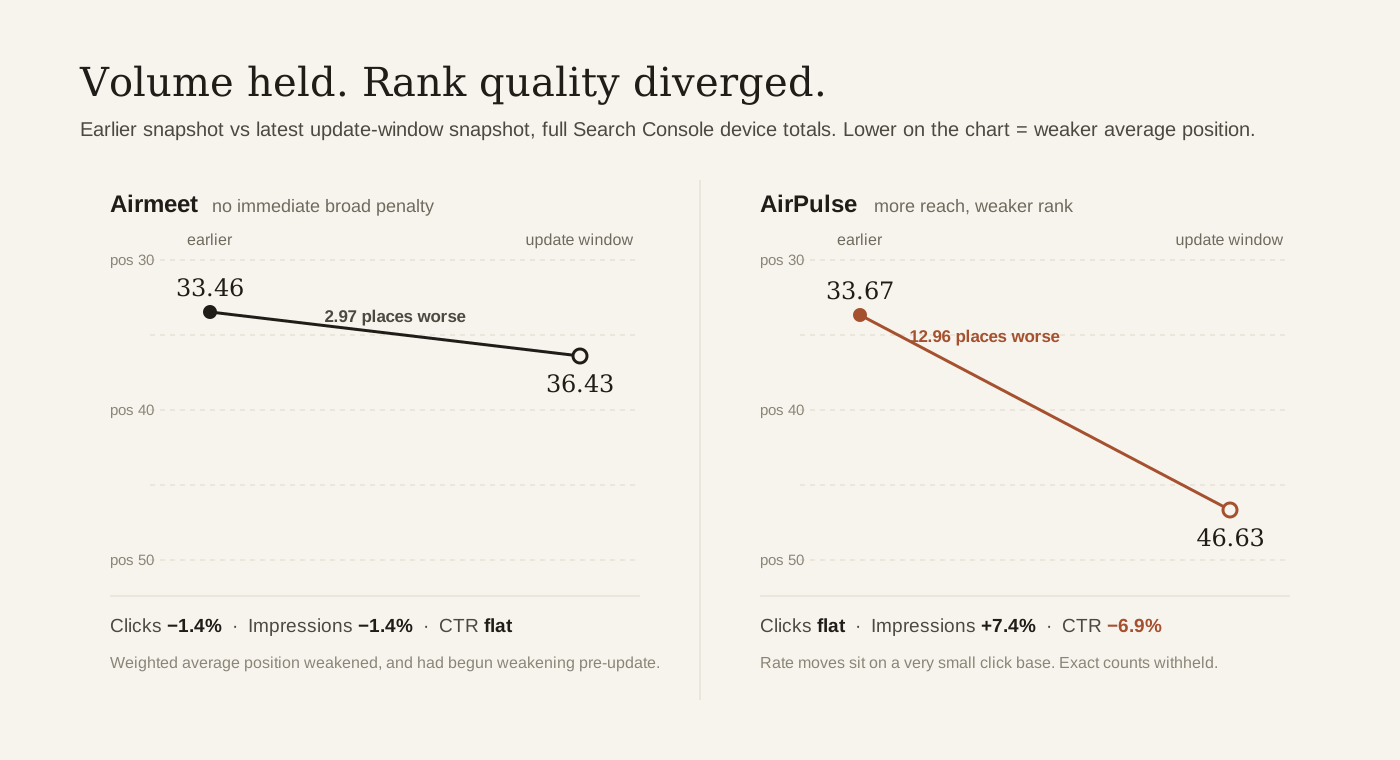
AirPulse reached more search results at weaker average positions while clicks held flat. That happens when a young site gains impressions from new or broader low-ranking queries, or when existing queries move down; the data does not separate the two.
The matched-weekday comparison looks more negative on rank quality: impressions up 21.4%, clicks down 12.5%, CTR down 27.9%, average position 12.67 places worse. But the window contains very few clicks, and a handful changes the rate. Too little volume for a penalty claim.
Timing also argues against simple attribution. AirPulse average position was already 50.82 and 51.38 on the two days before launch. The update may have reinforced an existing movement; it did not create all of it.
AirPulse non-branded search
Privacy-filtered non-branded impressions rose 40.7% while average position improved from 71.11 to 66.68. Non-branded clicks stayed near zero. This is early discovery, not traffic. AirPulse Research pages recorded almost no query-attributed impressions in either snapshot, too little to judge the hub.
Result 3: Google AI citations moved differently from web rankings
Organic Search and Google AI answers are different surfaces. Independent Google AI captures were tested separately, with the same prompts and a stable provider, model and country per brand.
| Brand | Fixed prompts | Pre mention | Rollout mention | Early post mention | Owned-domain cited answers |
|---|---|---|---|---|---|
| Airmeet | 52 | 47.25% | 48.72% | 47.12% | 57.97% to 48.56% |
| AirPulse | 31 | 6.45% | 6.45% | 6.45% | 3.23% to 4.03% |
Airmeet mention rate was flat, but the share of answers citing an Airmeet-owned domain fell 9.41 percentage points from pre to early post. AirPulse mention rate was exactly flat; its own-domain citation rate moved from 3.23% to 4.03%.
The Airmeet citation decline is worth monitoring, not proof of a spam-update effect. Google did not say the update targeted generated answers, broad trackers were calm, and organic Search was more stable. Source mix, answer generation, query-specific retrievability or a contemporaneous model change could produce the same result.
Correlation and causation
A credible update effect has to pass more than a timing test.
| Test | What we observe | Status |
|---|---|---|
| Break begins at or after launch | Average position was already weak before the launch for both sites. | Fails simple timing |
| Persists after completion | No clean daily organic post period is available. | Unknown |
| Appears in fixed web cohorts | Current aggregate and privacy-filtered rows do not isolate a full fixed cohort. | Not established |
| Clicks, impressions, CTR, and rank agree | The metrics move in different directions. | No |
| Independent trackers agree | Broad trackers show no spike. | No broad agreement |
| Device and country splits agree | Airmeet splits move in opposite directions. | Weak |
| Policy-specific page pattern exists | Tangential pages exist, but no penalty pattern is proven. | Not established |
Current verdict: no measurable broad shock for Airmeet; a weak, unproven AirPulse rank-quality signal; insufficient clean post-update web data for causality.
What to do after an update like this
- Create fixed organic cohorts: the same non-branded queries and landing pages by device and country.
- Keep Google AI measurement separate: mention rate, cited-answer rate, owned-domain share, cited URLs and answer failures from a fixed cohort.
- Make page-level evidence decisions; do not chase the update with broad rewrites or mass deletions.
- Do not call impressions at position 60 a visibility success.
- Do not blend organic Search, Google AI, ChatGPT and Perplexity into one update metric.
- Do not add special AI markup and expect a ranking gain; Google says ordinary SEO foundations apply to AI features.
- Do not announce recovery after a few days. Google says reassessment can take months.
Measurement plan
| When | Read | Decision gate |
|---|---|---|
| Daily until recheck | GSC completeness, crawl and index errors, the fixed query cohort, page changes, and Google AI failures. | Operational monitoring only. |
| First recheck Sep 4, 2026 | At least one complete post-update week by device, country, brand and non-brand, and page class. | Refresh direction; publish movers only if cohorts are stable. |
| Second recheck Sep 18, 2026 | Two clean post-update weeks plus fixed prompt controls. | Decide whether any discontinuity persists. |
| Monthly | Content cohort, links, conversions, citations, indexation, and maintenance actions. | Keep, consolidate, reframe, noindex, or remove per page. |
Minimum statistical reporting
- Flag when a percentage rests on a small base.
- Use weekday-matched windows and a visible data-through date.
- Hold query, page, device, country, prompt, provider and model constant where possible.
- Add uncertainty intervals or prompt-level bootstrap ranges once a complete post window exists.
- Use ChatGPT and Perplexity as contemporaneous controls for Google AI, not as a blended score.
- Keep rollout days separate from clean post-completion days.
- Label Search Console query and page rows as privacy-filtered and incomplete.
Limitations
- The review occurs a few days after rollout completion.
- Daily organic data ends on completion day; no clean daily post period exists yet.
- The latest snapshot has six observed rows because of Search Console lag.
- Query and page rows suppress low-volume queries and are incomplete.
- AirPulse click counts are tiny, so rate changes are unstable.
- Average position weakened before the named update started.
- Public trackers cannot prove impact on an individual property.
- Google disclosed no changed signals or targeted categories.
- Google AI captures measure a different surface from web ranking.
- Content relevance risks are governance issues, not proof of an update penalty.
Conclusion
Google shipped a global spam update and the first market-wide signal was quiet. Airmeet's organic totals were nearly unchanged, with weaker average position offset by stable clicks and CTR. AirPulse gained impressions at weaker positions while clicks stayed flat. That deserves investigation, not a penalty headline. This page will be revisited when a complete post-update window exists, on Sep 4, 2026 and again on Sep 18.
How this page was made
Airmeet and AirPulse results come from Search Console exports, the AirPulse production read replica and the independent Google AI capture pipeline. No other monitored brand is named. Exact click and impression counts are withheld; directions, relative changes and average positions are reported. Prompt cohorts follow the prompt-selection methodology; reporting follows the measurement methodology.
Change log
- Aug 26, 2026: first published as an early read. Search Console data through Aug 21, 2026; Google AI captures through Aug 25, 2026.