
Short answer: AI search for D2C brands in India is real but unmeasured. The 10 founders at our November 2026 roundtable all see buyers discovering brands in ChatGPT and Perplexity. None can attribute meaningful orders to it, because those buyers come back through direct or branded search. AI recommendations reward clean product data and reviews, not polish. Nobody has a separate budget yet, and the trigger for one is hard ROI.
AirPulse hosted the dinner in the third week of November 2026. The room covered skincare, snacks, pet care, home decor, fashion accessories, wellness and supplements, baby and kids, consumer electronics, apparel and quick-commerce-first FMCG. Everyone spoke on condition of anonymity, so quotes carry a role and a category, not a name. That is also why the room was candid.
Are Indian D2C brands getting measurable traffic and revenue from AI platforms yet?
Not at material scale, and almost nobody can prove it. Every founder in the room tracks AI referrals in some form. Most of the AI-driven discovery still goes unmeasured, because a buyer who finds a brand in an AI assistant returns later through direct or branded search. Last-click attribution gives the AI platform no credit, so the traffic hides in plain sight.
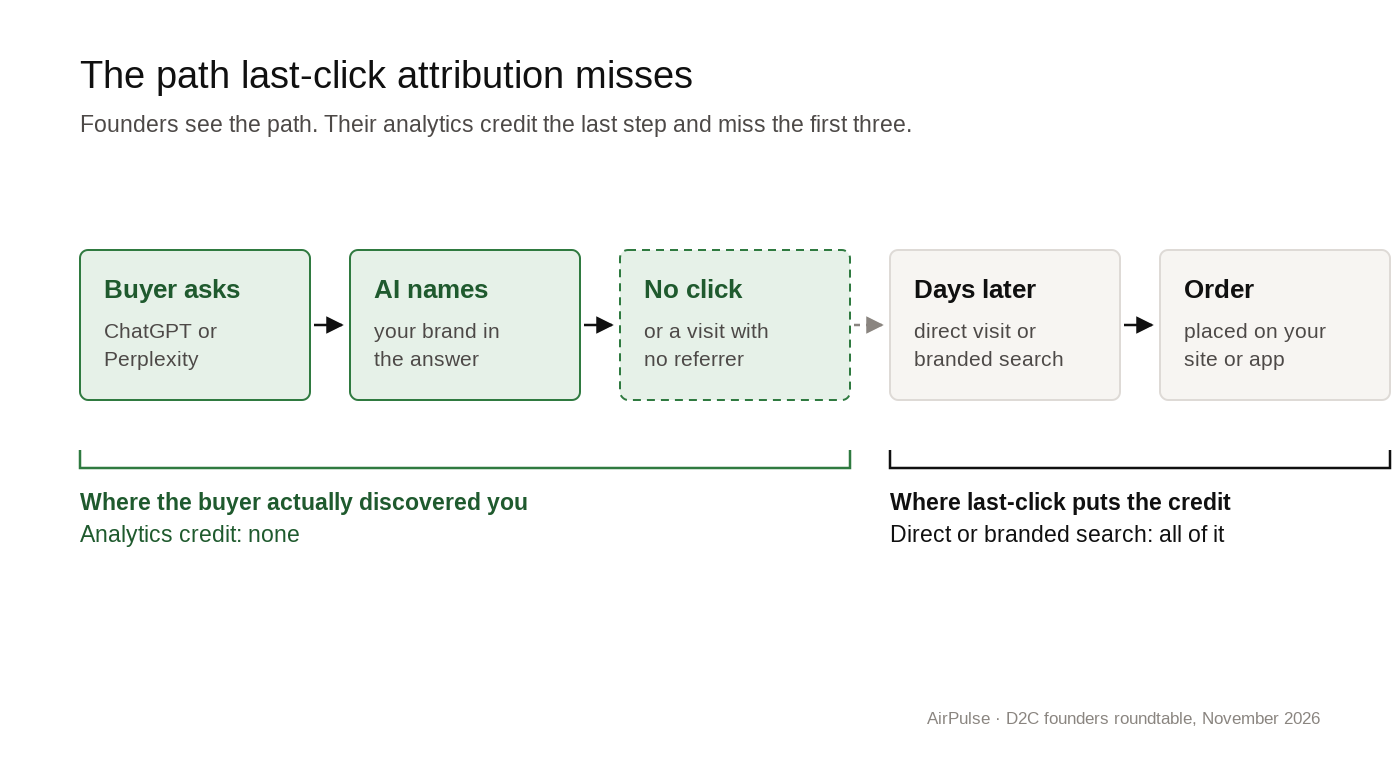
The numbers outside the room agree. AI platforms sent about 0.32% of website traffic from January to April 2026, roughly 16 times their 2024 share, while organic search sent 42.75% (SE Ranking, June 2026). Buyers have moved faster than the traffic: LLM search already reaches 22% of purchase journeys in India, and across four Asian markets 64% of its users say it shapes their brand choices (BCG, September 2026).
We see AI referrals in analytics, but they are tiny. The bigger issue is attribution. Someone discovers you in ChatGPT or Perplexity, then comes back via direct or branded search. Your last-click model gives AI no credit. So we are tracking it, but we are not yet reporting material traffic or revenue from it.
The honest answer is unmeasured. We know the path exists: AI discovery, later direct or search. But our attribution system lags the new path. We are not going to pretend we have cracked it.
Anyone claiming they are getting X% of orders from AI at scale right now is probably extrapolating. Most of what we see is preparatory: clean feeds, reviews, content.
The signal to watch is direction, not size. Shopify reports that traffic from AI search tools to its storefronts grew more than eight times year over year as of Q1 2026, and that AI-referred visitors convert at nearly 50% higher rates than organic search visitors (Shopify, May 2026). The pipe is small today, and it is widening fast.
What makes AI assistants recommend one brand over an incumbent or a marketplace private label?
Structured data, trust signals and reliable fulfilment, not brand feel. An AI agent comparing products looks at ratings, reviews, the accuracy of the product feed, specs, price transparency, stock and delivery speed. Off-site signals such as YouTube reviews and Reddit threads now work as part of the catalogue, because they are what the model can find and check.
| Factor | Traditional search and ads | AI recommendations |
|---|---|---|
| Product data | Matters, but ads can compensate | Decisive: feeds, specs, price transparency |
| Reviews and ratings | One signal among many | The primary trust signal |
| YouTube, Reddit, communities | Supplementary | Part of the catalogue itself |
| Website polish, brand film | A meaningful edge | A minor factor |
| Delivery speed and stock | An operational detail | A direct comparison criterion |
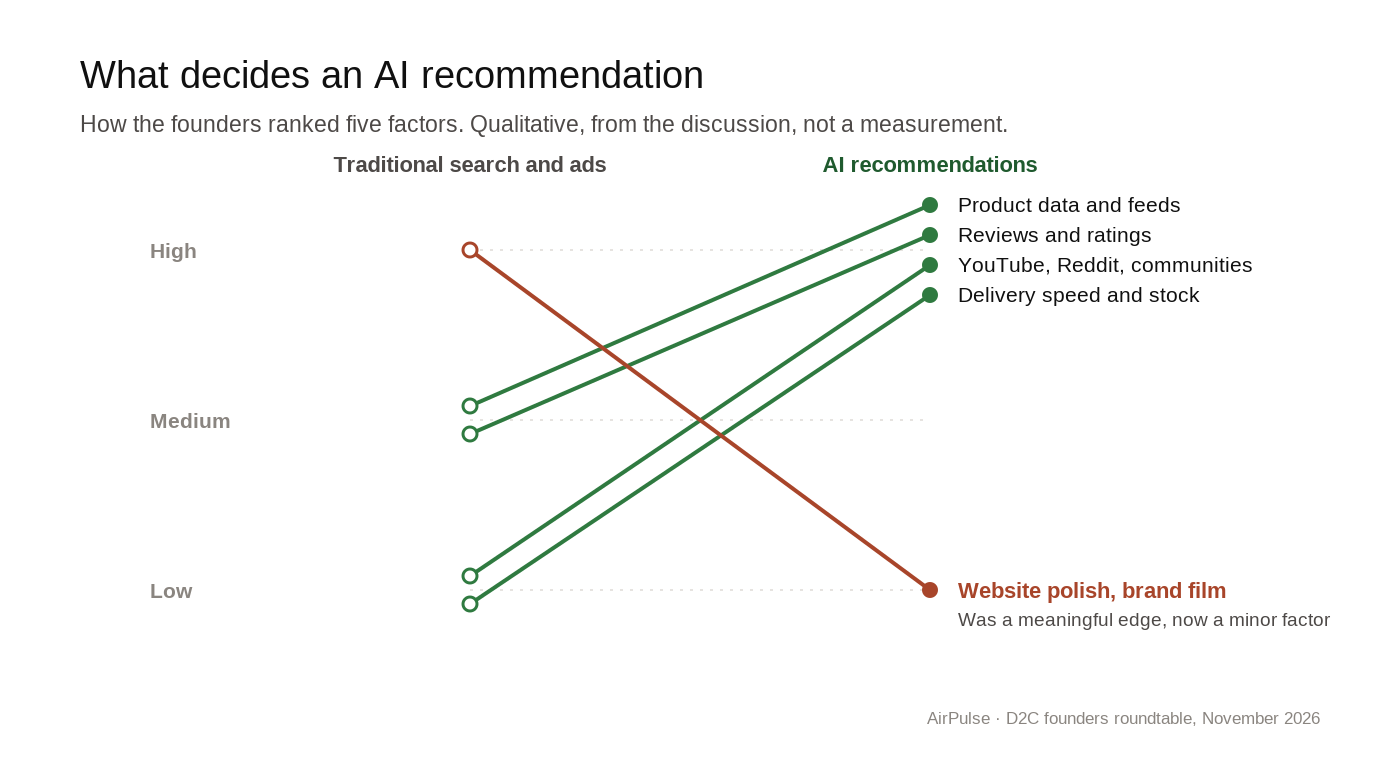
Agents do not care about your brand film. They care about structured product data, accurate feeds, ratings, reviews, specs, price transparency, stock, and delivery speed. YouTube videos and Reddit mentions matter because they are signals the model can find. Clean data gets you a fairer shot than in traditional search.
If an agent is comparing us to a marketplace private label, it will look at reviews, price, stock, and speed. Website polish is not the deciding factor. Dense data and trust signals are. A clean D2C brand with honest pricing and a good feed can still compete.
Google Shopping and Merchant Center feeds are not sexy, but they are the plumbing. If the feed is wrong, the agent recommends the wrong thing, or the competitor.
The skincare co-founder drew the conclusion: “Off-site signals, reviews, YouTube, community mentions, are part of the catalogue now. Not just the product page. The AI surface reads the whole web.”
What is the 12 to 24 month upside, and the biggest risk, from AI search and shopping agents?
The upside is low-friction discovery and restocking: an agent compares options and orders within a budget. The risk is commoditisation. If agents reduce a brand to price and delivery time, the brand becomes a SKU and the platforms with better feeds win. The founders expect India's payment and quick-commerce plumbing to speed this up.
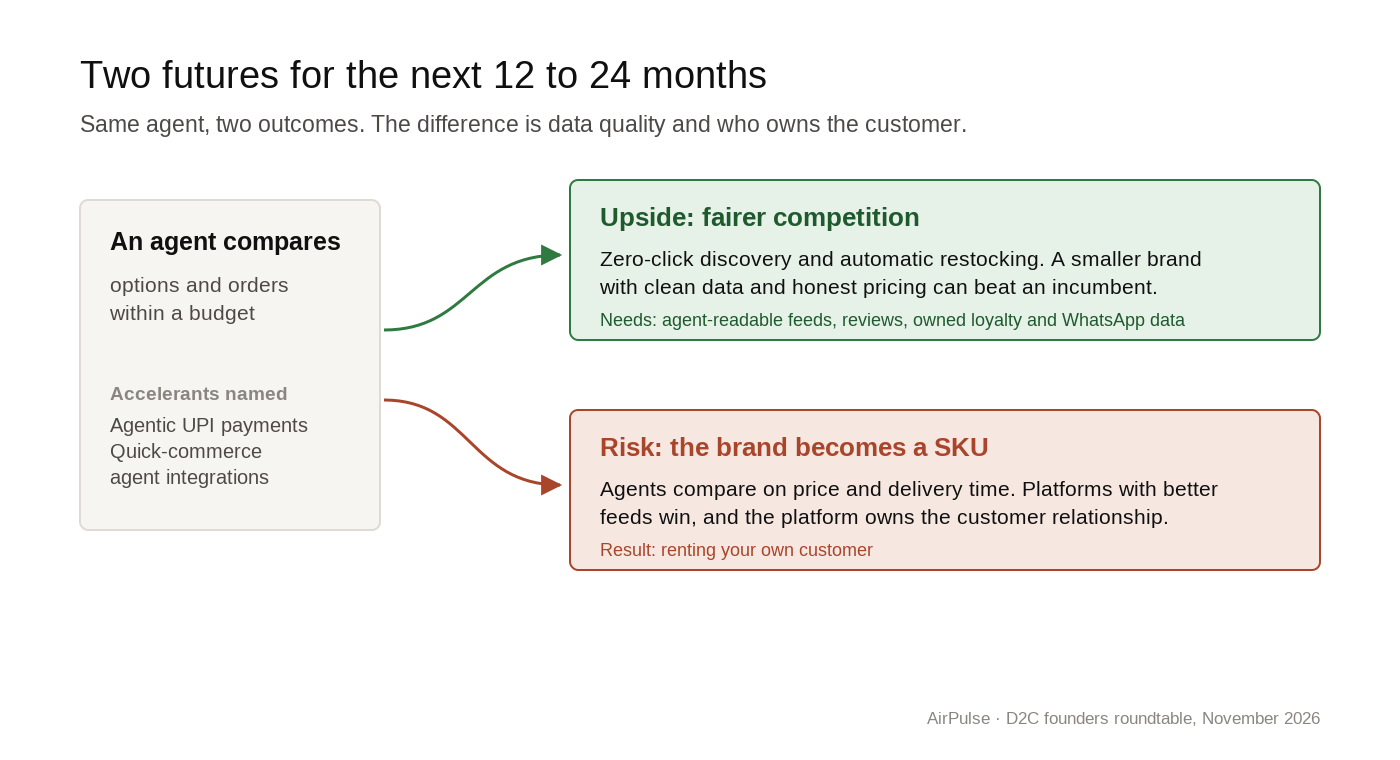
The upside is zero-click or low-friction discovery and restocking. An agent compares and orders within a budget. For smaller brands with good data, that is a fairer competition. The risk is that agents commoditise on price and speed, and brand discovery disappears.
The home decor founder worried about pricing power: “If the agent reduces us to a price and delivery-time comparison, the brand becomes a SKU. We lose the direct relationship.”
India-specific plumbing will accelerate this: UPI agentic payments, Swiggy and Zepto MCP integrations. Once the checkout and replenishment layer is agent-ready, the behaviour will move faster than most brands expect.
That plumbing is arriving, though not all of it is live. UPI agentic payments are in a limited pilot run by Razorpay and NPCI, inside ChatGPT since October 2025 and Claude since February 2026. Swiggy launched an official MCP integration in January 2026 that lets people order food and Instamart groceries from AI assistants. Zomato, Swiggy and Zepto are the merchants in the Claude pilot. We found no official Zepto MCP.
Consumer data says the behaviour is already moving. NIQ's August 2026 study across India's top eight metros found 92% of consumers have used AI while shopping and 96% are open to AI-powered shopping tools. McKinsey's June 2026 survey ranked India second of 11 markets, with 76% of Indian adults using AI for shopping in the previous three months, behind China at 80%.
Will AI agents, WhatsApp shopping and agentic checkout improve conversion, COD returns and repeat purchases?
Probably, if the product data is agent-readable and the brand owns the customer relationship. Conversion can rise when checkout is seamless. Cash-on-delivery returns can fall if agents default to prepaid or verified options. Repeats improve when agents remember preferences and the brand owns its loyalty and WhatsApp data. If the platform owns the relationship instead, the brand is renting its own customer.
If product data is agent-readable and checkout is seamless, with UPI-style guardrails, conversion can lift. COD returns could fall if the agent defaults to prepaid or verified options. The efficiency upside is real for clean catalogues.
Repeats improve if the agent has preference memory and we own loyalty and WhatsApp data. But if the agent or platform owns the relationship, we are renting the customer. That is the trade-off.
The skincare co-founder put it in one line: “Agents will remember preferences; the question is whose memory it is.” The snack founder added that in replenishment categories, “if the agent defaults to the cheapest option, we need to be visible on more than price. Reviews and availability matter.”
Should D2C brands create a separate budget for AI search optimisation?
Not yet, and almost nobody has. Spend on AI search readiness comes out of existing SEO, content and performance budgets, because the work overlaps: product feeds, reviews, off-site mentions and structured pages. Agencies are pitching GEO (generative engine optimisation) and AEO (answer engine optimisation) playbooks, but founders are not ring-fencing money for them.
Almost entirely pulled from existing SEO, content, or performance budgets. Agencies are pitching GEO and AEO playbooks, structured data, review building, YouTube and Reddit presence. But there is no ring-fenced AI budget yet. It is treated as an extension of SEO and content.
The growth head at an apparel brand named the condition for change: “If anything, it is a reallocation from generic SEO experiments to structured data and review velocity. The moment someone shows hard ROI, that changes.” The skincare co-founder was blunter: “Calling it a separate budget would be cosmetic at this stage.”
What proof would trigger a 5 to 15% reallocation of digital spend?
Hard ROI, the same bar founders apply to performance marketing: incremental traffic and attributed conversions from AI platforms, a measurable lift in branded search or direct traffic after AI exposure, CAC or payback comparable to Meta and Google, or evidence that structured-data and review work raises recommendation share in category queries. Mentions do not move budget. Orders do.
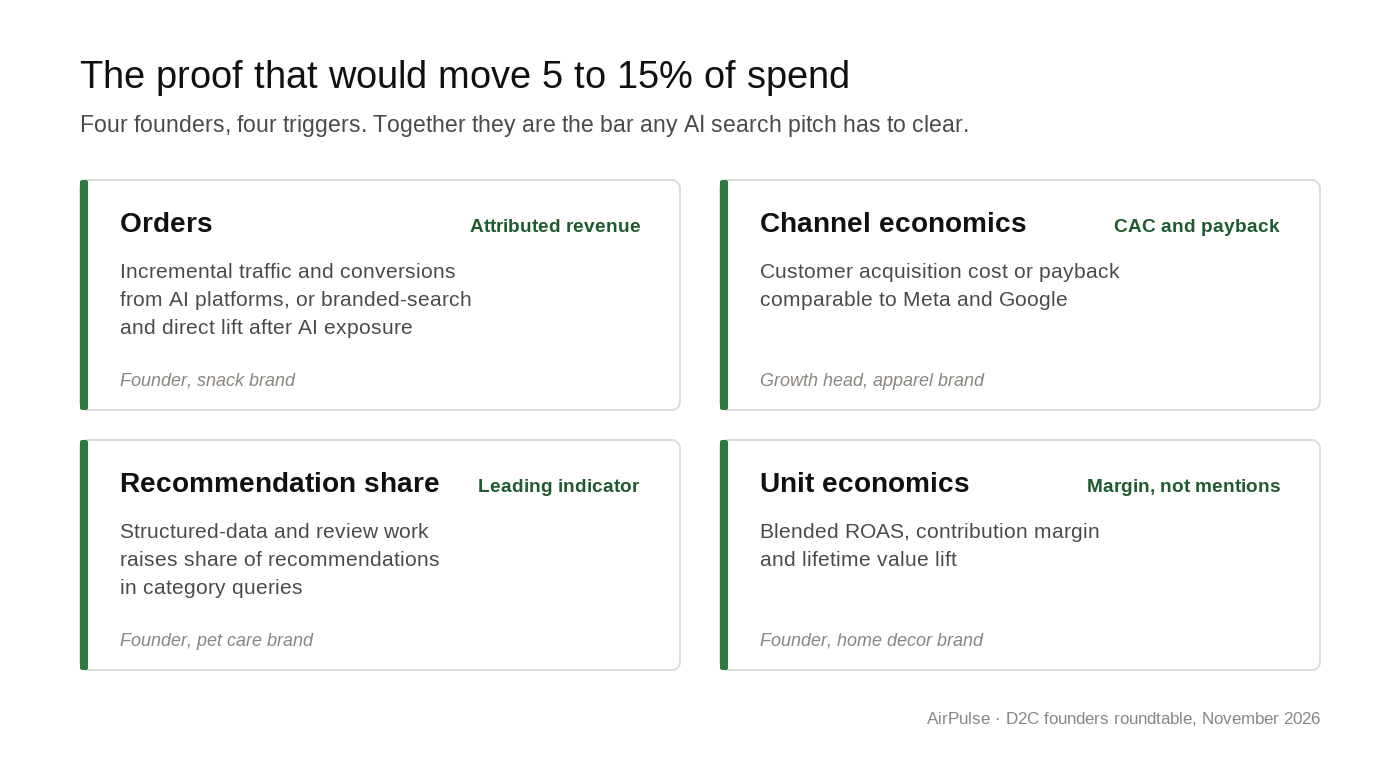
- Attributed revenue. “Show me incremental traffic, attributed conversions, or revenue from AI platforms. Or a measurable lift in branded search and direct after AI exposure. Not vanity mentions. Orders.” Founder, snack brand.
- Channel economics. “CAC or payback comparable to Meta and Google. If the efficiency is there, I will move budget.” Growth head, apparel brand.
- Share of recommendations. “Evidence that structured-data and review work improves recommendation share in category queries. That is the leading indicator.” Founder, pet care brand.
- Unit economics. “Blended ROAS, contribution margin impact, LTV lift. I am not moving 10% of spend because a consultant says AI is the future.” Founder, home decor brand.
Recommendation share is the one that can be measured before revenue moves. It needs repeated runs, not a single answer: see our measurement methodology and guide to choosing the prompts to track.
Who should own AI search readiness, and what is the biggest gap?
The SEO or content lead, sometimes the performance marketer, often an outside agency, and at smaller brands the founder. The gap is execution, not awareness. Few teams can turn “structured data and reviews” into a prioritised roadmap that connects product feeds, off-site signals, YouTube, Reddit and measurement. Most efforts stay scattered experiments, and many brands still file AI discovery under future SEO rather than treating it as its own surface.
The biggest gap is practical knowledge of how different AI systems cite sources: Google AI Overviews versus ChatGPT versus Perplexity.
Everyone says ‘structured data and reviews.’ Very few people can build a prioritised roadmap that connects product feeds, off-site signals, YouTube, Reddit, and measurement. It becomes scattered experiments.
The missing piece is a roadmap: what to fix first, what to measure, and how to prove it worked. Without that, it stays a side project.
The 90-day AI readiness roadmap for D2C brands
Here is the roadmap the room kept asking for, built from what these founders said they are doing or wish they were doing. It starts with an owner and a baseline, because nothing later can be proven without them.
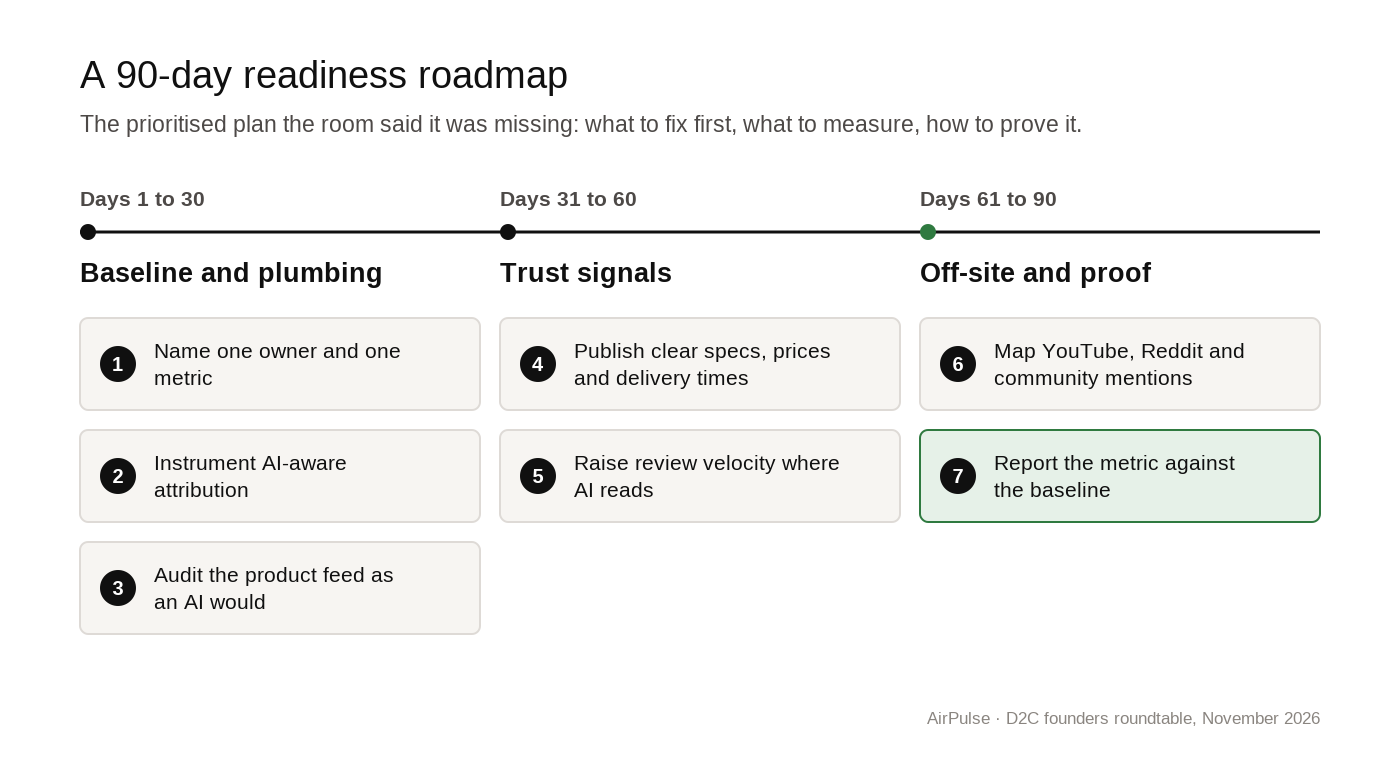
- Name one owner and one metric. One person, one roadmap, one number: recommendation share in category queries, attributed orders, or branded-search lift.
- Instrument AI-aware attribution. Track AI referrals, branded-search lift and direct traffic after AI exposure, and add a “how did you hear about us” question at checkout. Record the starting point.
- Audit your product feed as an AI would. Check Merchant Center and Google Shopping feeds for wrong prices, stale stock, missing specs and discontinued products. The feed is the plumbing.
- Publish clear specs, prices and delivery times. On AI surfaces, plain specs, honest pricing and visible delivery timelines beat brand storytelling.
- Raise review velocity where AI reads. Reviews are the trust signal agents read first. Earn them on the surfaces AI systems cite, including Google and marketplaces, not only on your product page.
- Map your off-site catalogue. List every YouTube review, Reddit thread and community mention of your brand. If the model cannot find third-party validation, it will not recommend you.
- Report the metric against the baseline. At day 90, compare the number you chose in step 1 with where it started.
The bottom line
Indian D2C founders are not in denial about AI search. They are in a preparation phase they cannot yet measure. Consumers have moved faster than brand infrastructure: LLM search already reaches more than a fifth of Indian purchase journeys, and almost no brand can attribute orders to it. Over the next 12 to 24 months, the brands that win will be the ones with the cleanest feeds, the densest trust signals and an attribution model that matches how their customers find them. Budget size will matter less.
As the snack founder said: “We know the path exists. We are not going to pretend we have cracked it.” That candour is where an AI search strategy starts. For how US marketers answered the same kinds of questions, see what 24 US marketers said about AEO in 2026.
Frequently asked questions
Are Indian D2C brands getting traffic and sales from AI search yet?
Not at material scale. AI platforms still send a small share of website traffic, though it is growing fast. The bigger issue is attribution: buyers discover a brand in an AI assistant, then return through direct or branded search, so last-click analytics give the AI platform almost no credit.
What is AEO (answer engine optimisation) for D2C brands?
AEO is the work of making a brand visible and citable in AI-generated answers from tools like ChatGPT, Perplexity and Google AI Overviews. For a D2C brand that means clean structured product feeds, strong reviews, off-site signals such as YouTube and Reddit mentions, price transparency and consistent facts across the web.
What makes ChatGPT or Perplexity recommend one D2C brand over another?
AI assistants compare structured product data, ratings, reviews, specs, price transparency, stock and delivery speed. Brand films and website polish matter far less. Incumbents win where they have denser data and more reviews. A D2C brand with a clean feed gets a fairer shot than in traditional search.
Should D2C brands create a separate budget for AI search optimisation?
Most Indian D2C brands have not. The work is funded from SEO, content and performance budgets because it overlaps with them: feeds, reviews, structured pages and off-site mentions. Founders say a separate budget is justified only after hard ROI is proven.
What proof would justify moving 5 to 15% of digital spend to AI search?
Attributed conversions or revenue from AI platforms, a measurable lift in branded search after AI exposure, CAC or payback comparable to Meta and Google, or evidence that structured-data work raises recommendation share in category queries. Founders also named blended ROAS, contribution margin and LTV. Mentions alone do not count.
Who should own AI search readiness in a D2C brand?
Usually the SEO or content lead, sometimes the performance marketer, often an external agency, and at smaller brands the founder. The owner matters less than having a prioritised roadmap that connects product feeds, off-site signals and measurement. Without one, the work stays a set of scattered experiments.
About this research
This is qualitative primary research from AirPulse, gathered at a private, invitation-only dinner roundtable in the third week of November 2026 with 10 founders and growth leaders from Indian D2C brands across skincare, snacks, pet care, home decor, fashion accessories, wellness and supplements, baby and kids, consumer electronics, apparel and quick-commerce-first FMCG. All participants spoke on condition of anonymity, so quotes are attributed by role and category only. Quotes are lightly edited for length and clarity.
The roundtable produced views, not counts, so this page reports no percentages from the room. Figure 2 is our reading of the discussion, not a measurement. Outside statistics are traced to the primary source listed below, and where a figure travels differently from how its source measured it, the text follows the source.
AirPulse tracks how brands appear in AI answers. Engine coverage depends on plan: ChatGPT and Perplexity on Starter; adds Google AI on Growth and Pro; adds Gemini on Enterprise (2 to 4 engines by plan).
Sources
- SE Ranking: AI traffic research study (June 2026)
- BCG: LLM search shapes Asian consumer buying (September 2026)
- Shopify: AI search insights (May 2026)
- NIQ: Agentic Commerce India 2026 (September 2026)
- McKinsey: Who wins when AI does the shopping? (October 2026)
- Razorpay: agentic payments with NPCI and OpenAI (October 2025)
- Razorpay: agentic payments on Claude with Zomato, Swiggy and Zepto (February 2026)
- Swiggy MCP: builder documentation