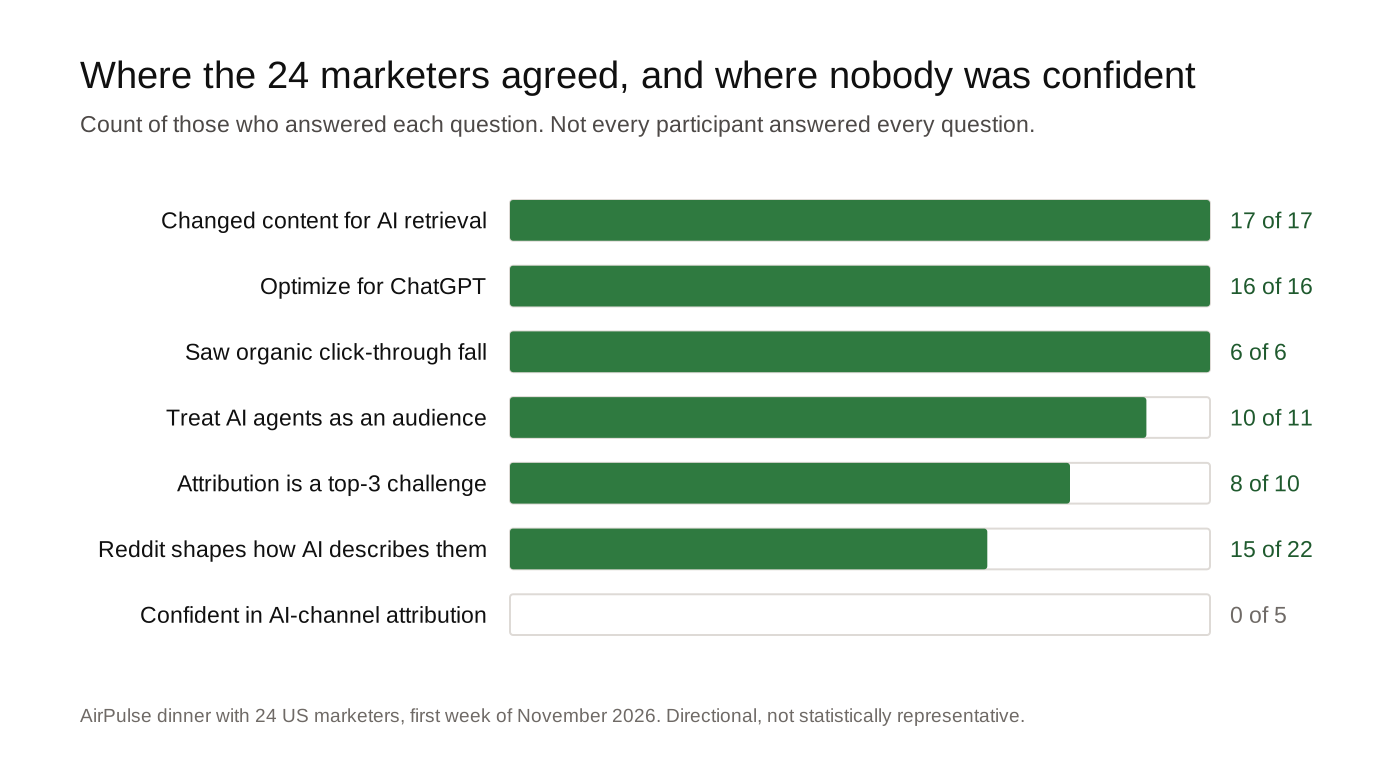
Short answer: the 24 US marketers at our November 2026 dinner treat answer engine optimization (AEO) as a priority. They report organic clicks falling as AI answers the question on the results page. ChatGPT is the platform every respondent optimizes for. Reddit, YouTube and review sites like G2 shape how AI describes their brands. Attribution is the problem none of them has solved.
AirPulse hosted the dinner in the first week of November 2026. Participants and their companies are anonymous by agreement. Not everyone answered every question, so each count below is out of those who answered that question. With 24 people, read the results as directional.
Key findings at a glance
| Finding | Result |
|---|---|
| Changed content production for AI retrieval | 17 of 17 who answered |
| Actively optimize for ChatGPT | 16 of 16 who answered |
| Name ChatGPT as the single most important AI platform | 3 of 4 who answered |
| Treat AI agents as a distinct audience | 10 of 11 who answered |
| Say Reddit influences how AI describes their brand | 15 of 22 who answered |
| Say YouTube influences how AI describes their brand | 13 of 22 who answered |
| Report organic click-through falling since AI answers expanded | 6 of 6 who answered |
| List tracking or attribution as a top-three challenge | 8 of 10 who answered |
| Confident in AI-channel attribution | 0 of 5 who answered |
What do marketers call AI search optimization?
Most call it AEO, with GEO (generative engine optimization) a close second. Of 23 participants who answered, 18 used “AEO” and 14 used “GEO”. Most used several terms interchangeably, including AI SEO, LLM visibility, AI search and LLM SEO.
Less common labels included “AI brand management”, “optimizing for bots” and “Search Everywhere Optimization”. One team had dropped “AEO” for plain “AI search”. The category still has no settled name.
Is AEO replacing SEO in 2026?
No single view won, but nobody said AEO can be ignored. Participants split three ways:
- SEO is the foundation. AEO builds on SEO principles, and strong traditional SEO still drives AI visibility.
- AEO is a separate discipline. Good SEO is not good GEO, because Google organic, Google AI Overviews and Gemini work very differently.
- SEO is folding into AEO. Brands will care less about ranking first on Google and more about being the source AI systems trust and cite. One participant called search a zero-sum race to become the single answer.
One marketer called AI visibility a business-continuity priority, because paid search has become more expensive and SEO returns have declined.
Which AI platforms do marketers optimize for?
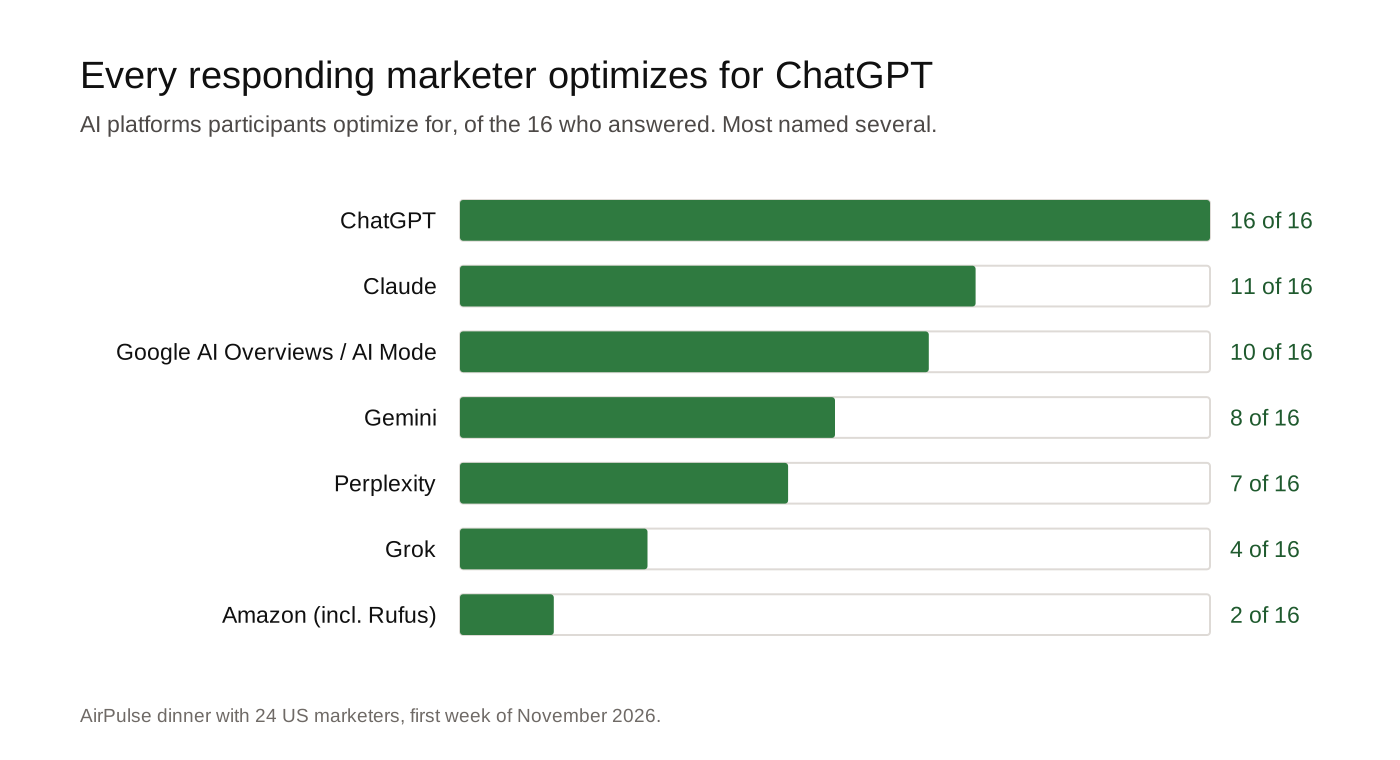
ChatGPT is the one platform every responding marketer optimizes for. Claude comes next, then Google's AI Overviews and AI Mode, Gemini and Perplexity.
| AI platform | Participants (of 16) |
|---|---|
| ChatGPT | 16 |
| Claude | 11 |
| Google AI Overviews / AI Mode | 10 |
| Gemini | 8 |
| Perplexity | 7 |
| Grok | 4 |
| Amazon (including Rufus) | 2 |
Asked for the single most important platform, three of four respondents chose ChatGPT. One said ChatGPT drives 90% of the AI referral traffic in their own data. The fourth chose Google.
How has organic search traffic changed since AI answers expanded?
All six participants who answered reported falling organic click-through, with words like “plummeted” and “falling off a cliff”. One cited a 30% to 50% fall in organic search traffic.
The losses sit in top-of-funnel informational queries, where AI gives a complete answer and the user never clicks. At the same time, one participant reported “hockey stick” growth in referral visits from LLMs. Another estimated that one in three searches now starts in an AI tool.
Which off-site sources most influence how AI describes a brand?
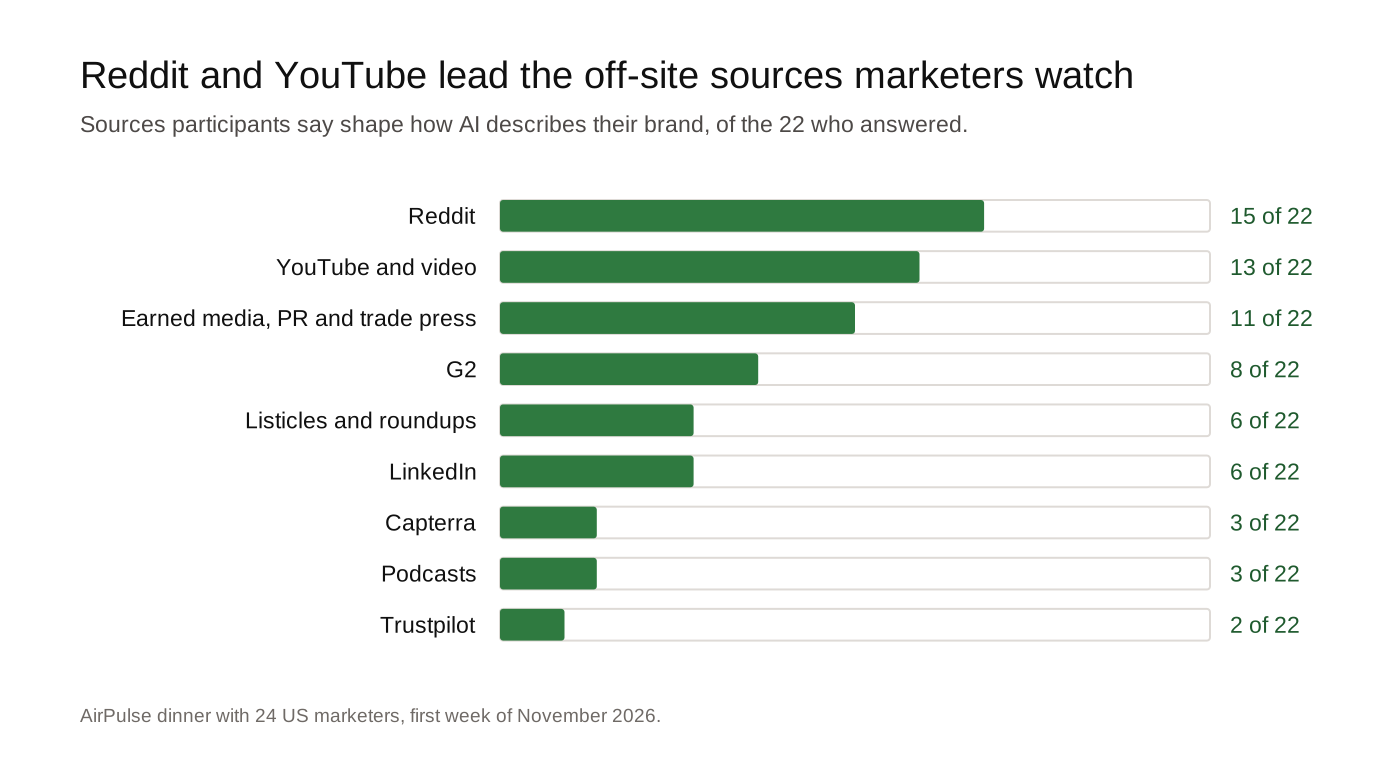
Reddit is the off-site source these marketers believe matters most, followed by YouTube and earned media. AI assistants lean on what third parties say about a brand, so reviews, forums, press coverage and roundup articles carry more weight than a brand's own claims.
| Off-site source | Participants (of 22) |
|---|---|
| 15 | |
| YouTube and video platforms | 13 |
| Earned media, PR, news and trade press | 11 |
| G2 | 8 |
| Third-party listicles, roundups and affiliate sites | 6 |
| 6 | |
| Capterra | 3 |
| Podcasts | 3 |
| Trustpilot | 2 |
Other sources mentioned include X, Medium, ResearchGate, Yelp, Thumbtack, Gartner, industry awards and rankings, customer and partner websites, and GitHub and MCP directories for developer tools.
Belief and measurement can differ. In AirPulse's own data, Reddit's share of ChatGPT citations fell sharply in August 2026 while Perplexity's held flat. See the Reddit citation-share replication.
What AEO tactics are marketers using in 2026?
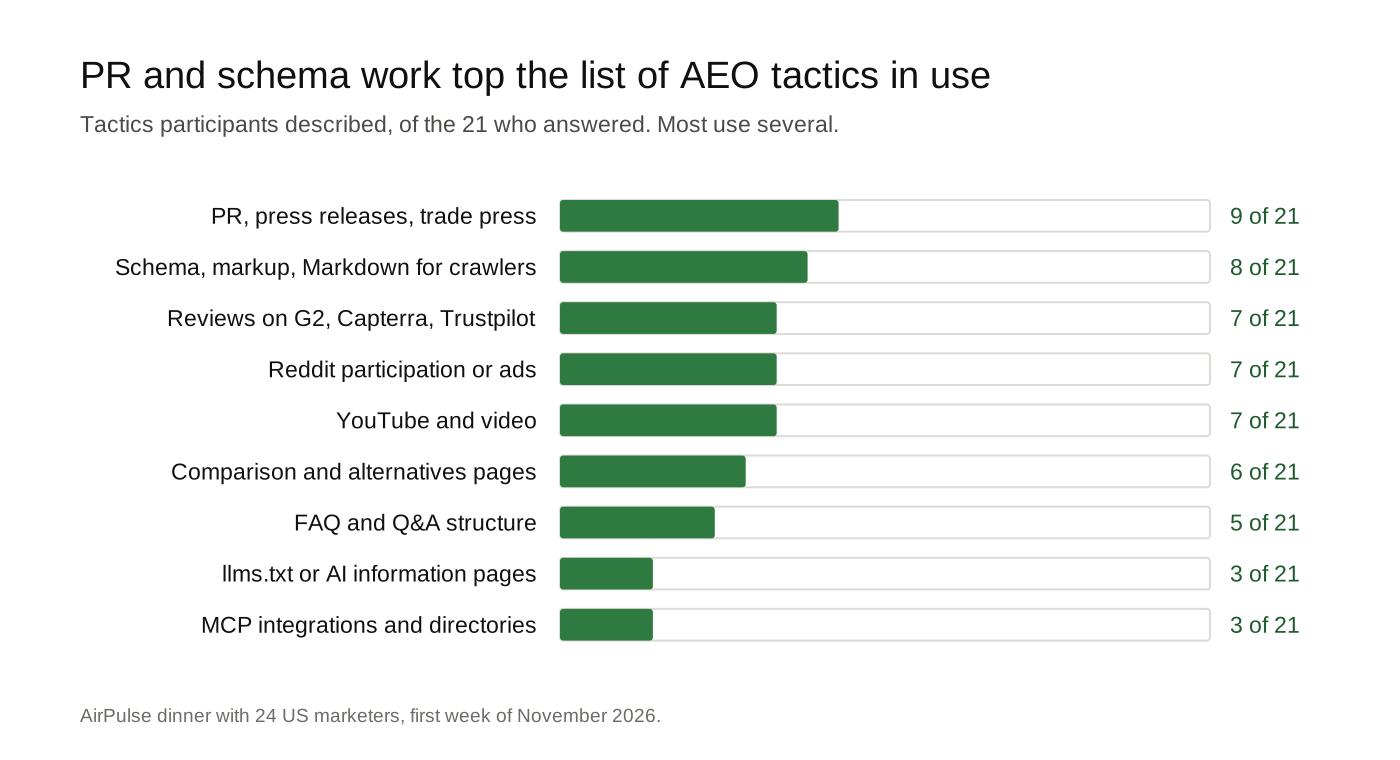
The most common tactics pair off-site authority with on-site structure. Of 21 participants who described their tactics, the most frequent were PR and earned media, technical schema work, reviews on third-party sites, Reddit participation and YouTube content.
| AEO tactic | Participants (of 21) |
|---|---|
| PR, digital PR, press releases and trade press | 9 |
| Technical optimization: schema, markup, Markdown for crawlers | 8 |
| Third-party reviews (G2, Capterra, Trustpilot) | 7 |
| Reddit participation or ads | 7 |
| YouTube and video content | 7 |
| Comparison, versus, alternatives and best-of pages | 6 |
| FAQ and question-and-answer page structure | 5 |
| llms.txt files or AI information pages | 3 |
| MCP integrations, connectors and agent directories | 3 |
Other tactics included reverse-engineering the pages AI already cites and doing outreach to them, building keyword and prompt matrices, employee posting on LinkedIn, hiring outside creators, and paid affiliate or directory placements.
Which tactics have the most impact?
Three participants named their highest-impact tactics. Their answers overlapped on four themes: getting cited in third-party articles and roundups, digital PR and trade press, authentic reviews, and commercial-intent content such as competitor comparisons. Traditional SEO foundations, YouTube and keeping content recent also came up.
How are marketers changing content for AI retrieval?
Every participant who answered (17 of 17) has changed how they produce content for AI. The common changes:
- Answer first. Lead with a direct, citable answer, then add context.
- Question-based structure. Write H2s as the questions buyers ask, with the answer directly beneath.
- Modular blocks. One participant moved from 3,000-word articles to self-contained 40 to 60 word question-and-answer blocks.
- Original evidence. Add unique statistics, original research, awards, customer data and expert insight.
- Un-gated assets. Publish pricing, case studies and full podcast or video transcripts openly, so AI can retrieve them.
- Commercial intent over volume. Prioritize buyer-decision topics and comparisons over high-volume keywords.
- Freshness. Refresh evergreen content so it answers current questions.
- Human editors. Several keep a human editor in the loop rather than publishing AI-written content unreviewed.
One participant warned that AI will invent pricing and features when a website does not state them clearly.
Should brands treat AI agents as a separate audience?
Most say yes. Ten of 11 respondents treat AI agents as a distinct audience with their own content or data needs. One described the agent as both a buyer and a gatekeeper that needs verifiable proof. In practice that meant:
- Restructuring an ecommerce (Shopify) site with schema so AI agents, not just people, can read and buy from it.
- Building MCP (Model Context Protocol) integrations and getting listed in AI connectors, plugins and developer directories.
- Publishing llms.txt files and dedicated AI information pages. Google says Search ignores llms.txt, and no major AI engine has said it uses the file.
- Producing citable proprietary data and research reports.
One participant disagreed on method, advising brands to keep clean raw HTML rather than maintain separate Markdown files for agents. The two participants asked about AI crawlers both allow them, because blocking crawlers reduces visibility. Our crawler reference covers how to tell the crawlers apart and verify them.
Are AI agents already completing transactions?
For some brands, yes. One participant reported AI agents completing bookings, appointment scheduling, lead form fills and purchases on behalf of consumers.
The platforms are still settling how this works. OpenAI launched Instant Checkout in ChatGPT in September 2025 and replaced it with retailer apps in March 2026. Google announced checkout in AI Mode and Gemini, built on its Universal Commerce Protocol, in January 2026.
How do marketers measure AI visibility?
Mostly with prompt tracking: running sets of buyer prompts across LLMs and recording whether the brand is mentioned, cited or recommended. They combine it with analytics and self-reported attribution. The methods participants described:
- Prompt tracking across ChatGPT, Gemini, Claude and Perplexity, sometimes several times a day per buyer persona, with keyword search volume as a proxy for prompt volume.
- Visibility metrics: mention rate, citation rate, share of voice, sentiment and accuracy, benchmarked against competitors.
- Citation source analysis, to see which URLs AI engines rely on.
- Analytics: LLM referral traffic in GA4 and Bing, unexplained direct traffic, branded search volume and server logs of AI crawler activity.
- Self-reported attribution: a “how did you hear about us” question on lead, intake or checkout forms.
- Manual testing, including asking an LLM why it does not recommend the brand.
One AI answer is a sample, not a measurement. Our measurement methodology and prompt-selection guide cover how many runs and which prompts.
Which AEO metric matters most?
Whether the AI recommends the brand. Among six respondents, the top metrics were being recommended or cited for category and commercial prompts, AI citation share, and downstream revenue such as demos, signups and pipeline.
How confident are marketers in AI attribution?
Not confident. None of the five respondents expressed confidence in AI-channel attribution. One called it “an attribution nightmare”: zero-click answers leave no click to track, and AI-driven visits arrive labeled as direct, branded search, referral or unknown.
How often does AI misrepresent brands?
Often, by these accounts. One participant said over 90% of the brands they track have at least one inaccuracy across AI surfaces. Others reported AI inventing pricing or features, and mixing one professional's details with another person, office or firm.
What are the biggest AEO challenges?
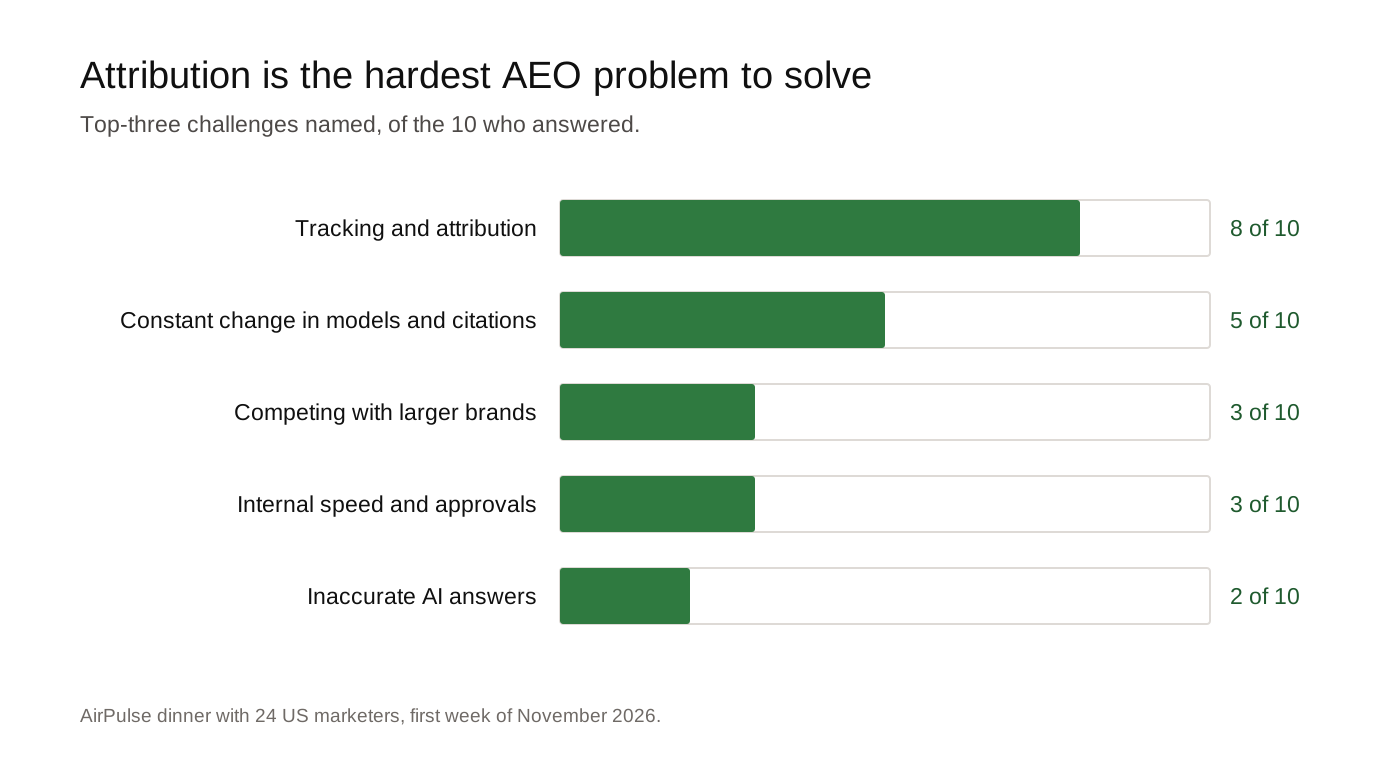
Attribution leads, named by 8 of 10 respondents.
| Challenge | Respondents | What they described |
|---|---|---|
| Tracking and attribution | 8 of 10 | No direct click data, and unclear metrics from monitoring tools. |
| Constant change | 5 of 10 | Model updates, shifting citations and different behavior across AI platforms. |
| Competing with larger brands | 3 of 10 | Incumbents have bigger budgets and more reviews, and some competitors game listicles. |
| Internal speed | 3 of 10 | Slow approvals, analysis paralysis and employees reluctant to create off-site content. |
| Inaccuracy | 2 of 10 | Hallucinations, and answers that change by user persona. |
How will AEO budgets change in 2027?
Participants expect AEO budgets to grow in 2027, with money moving back toward PR, content and earned media, the channels that feed AI citations. Three participants are using, testing or planning ads inside AI assistants, such as ChatGPT ads, alongside sponsored listicles and paid influencer content.
ChatGPT ads are new. OpenAI began testing them in the US in February 2026 for logged-in adults on the Free and Go plans, and had opened them to advertisers in 89 countries by October 2026.
What outside research did participants cite?
Participants quoted several figures from published research. We traced each one to its source. The table shows what the source says, which can differ from how the figure travels in conversation.
| As quoted at the dinner | What the source says | Source |
|---|---|---|
| Earned media accounts for 82% of AI citations. | 82% in Muck Rack's December 2025 study, 84% in May 2026. Muck Rack counts all non-owned, non-paid sources as earned; journalism alone is about a quarter of citations. | Muck Rack, What Is AI Reading? |
| Reddit accounts for 21% of AI citations. | 21% is Reddit's share of the ten most-cited sources in Google AI Overviews. Of all citations, Reddit was 2.2% in AI Overviews, 1.8% in ChatGPT and 6.6% in Perplexity (August 2024 to June 2025). | Profound, AI Platform Citation Patterns |
| 32% of executives ranked AEO their top priority for 2026, ahead of paid search. | 32% of US enterprise CMOs and digital leaders named AEO/GEO their top priority for 2026, and planned AEO investment grew faster than paid channels. | Conductor, 2026 State of AEO/GEO report (January 2026) |
| AI agents will influence 75% of B2B buying. | A prediction for 2027, published October 2026: agents will play a role in 75% of B2B purchase decisions, mostly discovery, research and renewal tasks. Forrester expects autonomous buying to stay limited to low-risk, repeatable purchases. | Forrester, 2027 B2B go-to-market predictions |
| Organic search traffic is down 30% to 50%. (Participant's own data.) | Published studies run higher. Ahrefs measured a 34.5% lower position-one click-through rate with an AI Overview in April 2025 and 58% on December 2025 data. Seer Interactive measured a 61% drop on AI Overview queries. | Ahrefs; Seer Interactive |
| One in three searches now starts in an AI tool. (Participant's estimate.) | In a 2026 survey of 500 active AI users, 37% said they start searches in an AI tool. The sample is AI users, not all searchers. | Eight Oh Two, 2026 AI and Search Behavior Study |
| ChatGPT drives 90% of our AI referral traffic. (Participant's own data.) | Conductor measured 87.4% for US sites from May to September 2025. Similarweb panel data put ChatGPT at 66% of US AI referrals in July 2026, as Gemini and Claude grew. | Conductor; Graphite and Similarweb |
| Over 90% of the brands we track have an AI inaccuracy. (Participant's own data.) | Searchable found that 93% of the companies it tested had at least one basic fact wrong or missing in AI answers. | Searchable, reported by SME Magazine (July 2026) |
AEO checklist: what to do next
- Track your AI visibility. Run your top buyer prompts on the AI engines your buyers use. Record mentions, citations, sentiment and accuracy.
- Find the sources AI cites. List the URLs AI engines use for your category and get your brand onto them.
- Invest in third-party proof. Build a steady flow of reviews on G2 and similar sites, take part genuinely on Reddit, and earn PR and trade press coverage.
- Restructure key pages. Use question-based headings, answer-first paragraphs and FAQs.
- Publish what AI needs. Un-gate pricing, case studies and transcripts. Add original data and clear facts.
- Create comparison content. Publish versus and alternatives pages for buyer-decision queries.
- Invest in video. Publish YouTube content that answers specific questions.
- Prepare for agents. Allow the AI crawlers you want, add structured schema, and consider llms.txt and MCP integrations.
- Ask customers how they found you. Add a self-reported attribution question to lead and checkout forms.
Frequently asked questions
What is AEO (Answer Engine Optimization)?
AEO is the practice of making a brand visible, accurate and recommended in AI-generated answers from tools like ChatGPT, Google AI Overviews, Gemini, Claude and Perplexity. It is also called GEO, AI SEO or LLM visibility.
What is the difference between AEO and SEO?
SEO aims to rank pages in search results and earn clicks. AEO aims to get a brand cited or recommended inside the AI's answer, often with no click at all. The marketers at the dinner agreed SEO still matters, but several said good SEO alone does not guarantee AI visibility.
Which AI platform should brands prioritize for AEO?
ChatGPT. All 16 marketers who answered optimize for it, and three of four named it the most important platform. Claude, Google AI Overviews and AI Mode, Gemini and Perplexity follow, in that order.
Does Reddit affect AI search visibility?
The marketers at the dinner think so. Reddit was the most-named off-site source: 15 of 22 said it influences how AI describes their brand, and 7 of 21 take part in Reddit or run ads there. How often engines cite Reddit changes over time, so track it rather than assume it.
Should I block AI crawlers on my website?
The two marketers asked both allow AI crawlers, because blocking them or hiding content reduces visibility in AI answers. Two answers are a small sample. Check which crawlers reach your site and verify them before you decide.
How do you measure AEO success?
Track whether AI recommends your brand for category prompts, your citation and mention rates, share of voice, sentiment and accuracy. Combine prompt tracking with LLM referral traffic in analytics and a "how did you hear about us" question on forms.
Why is AEO attribution so hard?
AI often answers without sending a click, and AI-driven visits show up as direct, branded search or referral traffic. None of the five marketers who answered were confident in their AI attribution.
What content format works best for AI answers?
Answer-first content with question-based headings, short self-contained answers, FAQs, original data and clear facts such as pricing. Comparison pages and YouTube videos that answer specific questions also came up often.
About this research
This is qualitative primary research from AirPulse, gathered at a private dinner with 24 US marketers in the first week of November 2026: heads of growth, SEO leads, agency founders and CMOs. We asked 25 questions on AEO strategy, tactics, measurement and outlook. Names and companies are withheld under the anonymity agreed with participants.
Not every participant answered every question. Each count shows how many gave a specific answer out of those who answered that question. Silence or nodding was recorded as no answer. Figures participants quoted from their own data are reported as stated. Figures they quoted from outside research are traced to their sources above. With a small group, treat the findings as directional rather than statistically representative.
AirPulse tracks how brands appear in AI answers. Engine coverage depends on plan: ChatGPT and Perplexity on Starter; adds Google AI on Growth and Pro; adds Gemini on Enterprise (2 to 4 engines by plan).
Sources
- Muck Rack: earned media holds at 84% of AI citations (May 2026)
- Muck Rack: earned media drives generative AI citations (December 2025)
- Profound: AI platform citation patterns
- Conductor: 2026 State of AEO/GEO report
- Forrester: 2027 B2B go-to-market predictions
- Ahrefs: AI Overviews reduce clicks (update)
- Search Engine Land: Seer Interactive on AI Overview click-through
- Pew Research Center: users click less when an AI summary appears
- Search Engine Land: Eight Oh Two survey on AI-first search
- Search Engine Land: Conductor on ChatGPT's share of AI traffic
- Search Engine Journal: Graphite and Similarweb AI sessions report
- SME Magazine: Searchable study on AI inaccuracies
- OpenAI: testing ads in ChatGPT
- OpenAI: ChatGPT ads expands to 26 new countries
- Search Engine Land: Google says llms.txt won't help or harm Search rankings
- Stripe: Instant Checkout in ChatGPT
- CNBC: OpenAI revamps ChatGPT shopping after Instant Checkout
- Google: agentic commerce tools and the Universal Commerce Protocol