Your brand can rank on Google, but it can still go unnoticed when buyers ask which AI tools to choose. AI visibility tools help you see where your brand appears, which competitors get recommended, and what sources shape those answers.
In this guide, we compare some of the best ai visibility tools - Airpulse, Peec AI, Otterly AI, Profound, Scrunch, and Semrush AI Visibility Toolkit. We explore their features, strengths, and best use cases, and how they help track brand discovery across AI search and social channels.

The Five Tools At A Glance
| Tool | Best fit | Entry pricing and scope | Main buying check |
| Airpulse | Teams looking for strategies, fixes, expert content, and social signals measured in AI assistants | Starter - $89 /monthGrowth - $179 /monthPro - $399 /monthEnterprise - Custom Starts from 25 tracked prompts per brand and goes on to unlimited tracked prompts Confirm pricing details here. | Can you identify visibility gaps, improve credible source coverage, and track what changes? |
| Peec AI | Marketing teams building a repeatable analytics workflow | Starter - $95 /month Pro - $245/month Advanced - $495/month Enterprise - Custom Starter lists 50 prompts, 3 selected models and daily tracking Confirm pricing details here. | Which three models and countries are included? |
| OtterlyAI | A tightly scoped first monitoring pilot | Lite - $29/monthStandard - $189 /monthPremium - $489/monthEnterprise - Custom Lite is $29 per month for 15 prompts; $25 per month on annual billing Check pricing details here. | AI Mode, Gemini and Claude cost extra |
| Profound | Enterprise teams operationalizing AI search | Trial - Free Enterprise - Custom Free seven-day trial; ongoing Enterprise pricing is custom Check pricing details here. | Trial prompts cannot be customized |
| Scrunch | Teams investigating visibility and site accessibility together | Core - $250 per monthEnterprise - Custom 125 unique prompts in the core package, and 5,000 responses per monthCheck pricing details here. | Check audit limits and AXP implementation scope |
| Semrush AI Visibility Toolkit | SEO teams adding AI research and monitoring | $99 per month per domain; 25 tracked prompts Check pricing details here. | Domains, users and prompt add-ons affect cost |
What An AI Visibility Tool Actually Measures
A brand mention, a recommendation, and a citation answer different questions. A response can name your company while recommending a rival. It can cite your educational article without naming your product. It can also describe your product using an outdated restriction that no longer applies.
Keep these signals separate in your reporting:
- Mention rate: the share of recorded answers that name your brand, using a stated prompt set and denominator.
- Recommendation context: whether the answer presents your product as a fit for the buyer’s actual needs.
- Citation presence: whether the answer links to your domain or a relevant third-party source, and which page it cites.
- Competitive presence: which alternatives appear in the same answers and which use cases they own.
- Description accuracy: whether statements about features, pricing, availability or suitability are correct.
- Business outcomes: identifiable AI referrals and their conversions, supplemented by buyer feedback where referral data is incomplete.
Visibility scores are vendor-defined. Semrush, for example, describes its AI Visibility Score in relation to a competitor benchmark; Profound builds its analysis from responses to prompts. A score of 60 in one product is not automatically comparable with 60 in another. Read the calculation before putting it into a leadership report.
- Airpulse For Converting AI Visibility Into Action
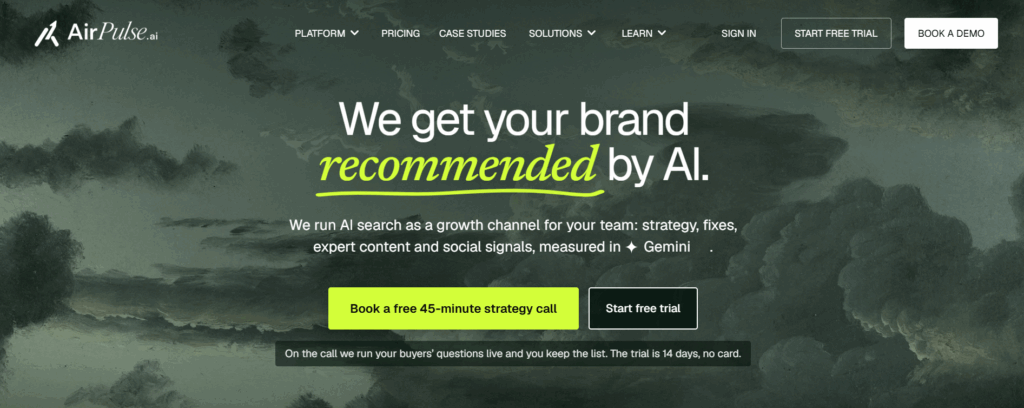
Airpulse is among the best AI visibility tools. This platform offers a broader approach to AI visibility by connecting brand monitoring with strategies to improve how businesses appear across AI search and social channels. It also helps teams understand the content gaps, understand which sources are responsible for influencing the AI-generated answers, and look for opportunities to strengthen their brand presence.
If a SaaS company identifies buyer queries where competitors receive recommendations but its brand is not included, that’s where Airpulse helps investigate these gaps by improving credible source coverage as well as developing content that supports better brand discovery.
Where it earns a place: Teams looking to move beyond tracking mentions and citations to take action on visibility insights. Its approach also considers how third-party publications, industry resources, and social platforms influence brand discovery.
Choose Airpulse when you want to connect AI visibility monitoring with practical strategies for improving brand discoverability across AI search and social channels.
- Peec AI For Focused Marketing Analytics
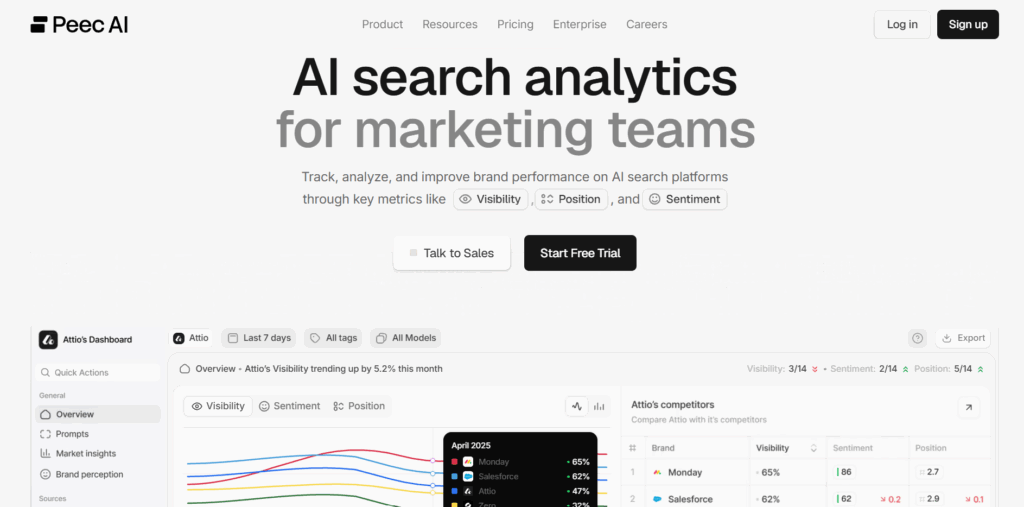
Peec AI is also among the top AI visibility tools, and it centers its product on visibility, position and sentiment. Its site also describes custom prompts and organization with tags. This makes the platform a unique choice for content as well as SEO teams looking to
- Track buyer queries
- Analyze brand visibility
- Use insights to guide content strategy
The Starter plan currently lists 50 prompts, three selected models, daily tracking, one project and unlimited users. Higher tiers expand the prompt and project allowances; Advanced lists multi-country support and a Looker Studio integration. Confirm the current subscription amount and billing term directly before purchase.
Where it earns a place: a marketing team wants a consistent view of its category without introducing a larger enterprise reporting program. For example, a project management brand could group prompts about client approvals, resource planning and agency reporting, then review where its positioning fails to appear.
The action is in the details. If you appear on broad category questions but disappear when a buyer adds a specific constraint, inspect the answers and cited sources for that narrower use case. Your next useful page may be a focused product explanation rather than another broad guide to the project management category.
What to check: three included models do not mean every available platform. Ask the vendor to demonstrate the exact surfaces, location settings and collection method your team needs. Verify how model add-ons affect cost and whether you can export enough historical evidence to explain changes later.
- OtterlyAI For A Small Monitoring Pilot
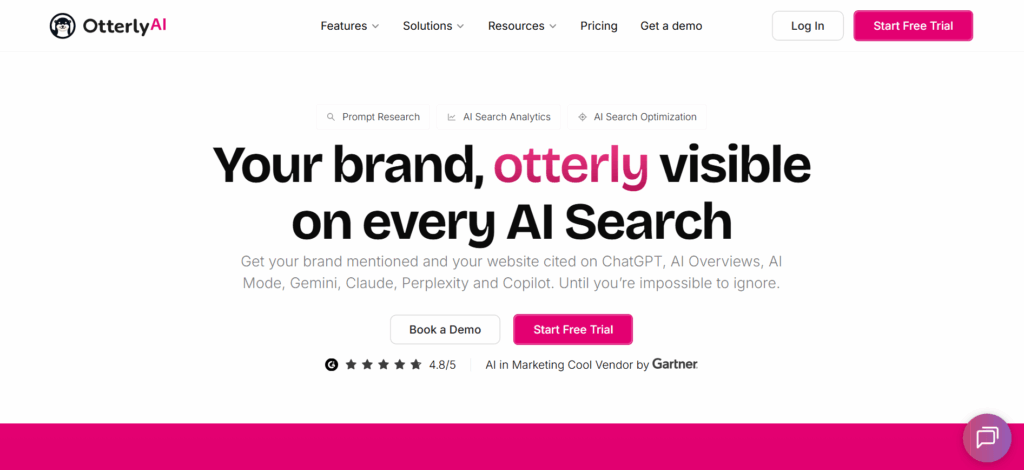
OtterlyAI is the lowest published monthly entry point among the paid self-serve plans with numeric prices verified in this comparison, making it a unique choice in this list of AI visibility tools. Lite costs $29 monthly, or a displayed $25 per month on annual billing, for 15 prompts with daily tracking and unlimited team members. Included engines are ChatGPT, Google AI Overviews, Perplexity and Microsoft Copilot. Claude, Google AI Mode, and Gemini are add-ons.
The product’s monitoring scope includes brand visibility, sentiment and citation sources. That is enough to test a focused question: are we being named and sourced on the small group of buyer queries that matter most?
A useful first deployment: choose five category questions, five use-case questions and five comparison questions for one market. Keep them stable, read the underlying answers, and record which competitors and pages recur. This is an illustrative allocation, not a vendor-prescribed setup.
Fifteen prompts become restrictive once you multiply products, countries, languages and buying stages. The listed Standard plan moves to 100 prompts at $189 month to month. Do not evaluate Lite as though it represents the cost of your eventual international program.
What to check: price the engines you actually want. AI Mode is distinct from AI Overviews, and an included Google surface does not imply all Google AI experiences are included. Also confirm which exports and integrations are available at your tier.
- Profound For Enterprise AI Search Programs
Profound‘s Answer Engine Insights queries AI platforms and aggregates their responses into a dataset for analysis. Its documentation describes prompt-driven tracking and brand performance across answer engines. That foundation suits teams that need to study competitive presence and how a brand is represented across a larger program.
The current pricing page lists a free trial with 50 prompts run daily for seven days across ChatGPT, Gemini and Google AI Overviews. The ongoing Enterprise package is custom, with tailored prompt tracking and the capability for up to nine answer engines. The trial’s recommended prompt set cannot be customized; Enterprise users can add, edit or disable prompts.
Where the enterprise fit matters: a company may have multiple product lines, regional marketing owners and a central analytics team. Its purchasing problem includes data access, reporting history, security and the ability to maintain a shared measurement approach. Those requirements deserve as much attention as the dashboard.
Ask for a demonstration using a meaningful category and a narrowly defined buyer segment. A broad view can look healthy while a high-value segment remains invisible. Your evaluation should establish whether analysts can move from a summary metric to the answer and source behind it.
What to check: agree on engines, regions, prompt scope, exports, API access and retention in the commercial proposal. The pricing page also distinguishes AI Marketer credits from monitoring scope. Confirm what your contracted package includes rather than treating all platform capabilities as unlimited.
- Scrunch For Monitoring And Technical Diagnosis
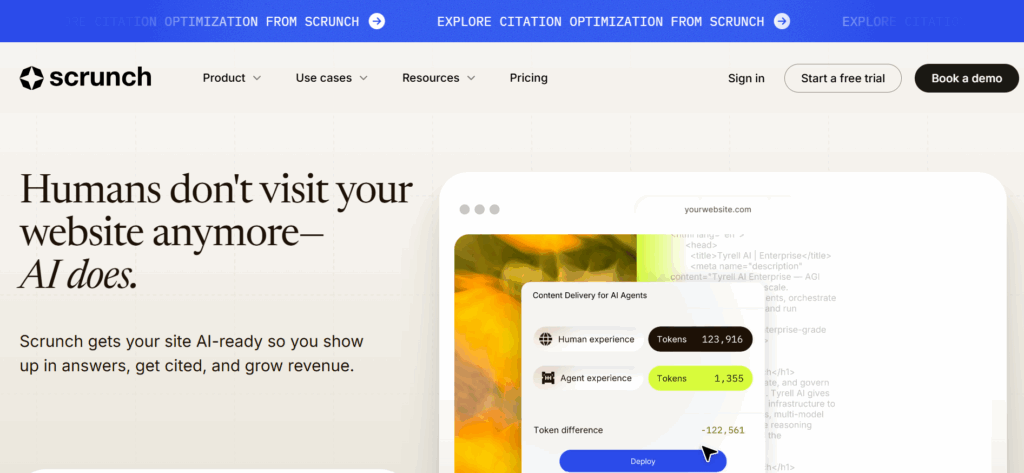
Scrunch is also a unique AI visibility tool, that combines monitoring with citation analysis, page audits and AI traffic visibility. Its published platform scope spans ChatGPT, Claude, Gemini, Perplexity, Google AI Mode and AI Overviews, and Meta. Starter lists 350 custom prompts, three user licenses, three personas and five page audits. It costs $300 per month or $250 per month if billed annually.
That combination is useful when a missing mention triggers a technical question: can the relevant system retrieve and understand the right page? Scrunch’s site describes error detection for AI crawling and an Agent Experience Platform, or AXP, that creates a lightweight version of site content for AI agents.
The practical distinction: A brand’s absence from the AI answers can have several causes. The page may be inaccessible, fail to explain the buyer’s constraint, or lose attention to a stronger third-party source. Monitoring identifies the gap; technical and content investigation determine what to do about it.
For a product page with complex navigation, compare the factual content available to agents with what a human visitor sees. If the important details are accessible and accurate, a citation gap may require better evidence or distribution instead of another rendering layer.
What to check: audit allowances are smaller than prompt allowances, so verify how much of your site you can investigate. Ask about AXP availability, deployment responsibilities and maintenance costs. Review any machine-facing representation for factual consistency with the public site; do not assume an implementation guarantees more recommendations.
- Semrush AI Visibility Toolkit For SEO And AI Research Together
The Semrush AI Visibility Toolkit brings visibility research, competitor research, prompt research, brand performance, prompt tracking and AI search site checks into one toolkit. This is a strong fit to consider when an SEO team wants to investigate AI discovery alongside its existing search work.
The standalone toolkit is listed at $99 per month per domain with 25 tracked prompts. Semrush documents additional licensing for corporate subusers, additional domain or location charges for Brand Performance, and a $60 monthly add-on for 50 more prompts. Its Semrush One bundles have different allowances.
Where it helps: a team can investigate a topic’s competitive landscape, identify candidate buyer questions and then track selected prompts over time. Research coverage and custom monitoring are different jobs: a platform appearing in a research report does not prove it is available in your daily tracker.
Semrush’s documentation gives ChatGPT and Google AI Mode as prompt-tracking examples. Confirm the current engine list inside the specific module you will buy, rather than relying on a platform-wide list of supported AI services.
What to check: calculate cost for your actual users, domains, locations and prompt total. Also ask which reports update daily and which update less often. A daily tracking chart and a brand-perception report can reflect different collection schedules.
How To Compare Tools Without Misleading Yourself
The same question can produce different answers across models, dates, regions and collection environments. Treat a monitoring result as an observation from a defined setup. It is not a census of every conversation your customers have.
Ask each vendor for the same evidence: the exact prompt, engine or interface, timestamp, market, language, full answer and source links. Clarify whether collection uses a consumer interface, an API or another method. A response from one environment should not be presented as guaranteed evidence of what every consumer sees in another.
Build your evaluation around six checks:
1. Prompt relevance. Include real buying constraints from sales calls, support tickets and customer research. Separate branded questions from unbranded discovery questions.
2. Collection consistency. Ask how failures, unavailable AI answers, retries and repeated runs affect the denominator.
3. Evidence access. Open a score and trace it to actual answers. Inspect ambiguous brand names and false positive mentions.
4. Coverage fit. Validate the precise engine, market and language combination you need, including tier restrictions.
5. Reporting continuity. Check exports, retention and what happens to historical data when you change a plan. 6. Action ownership. For every finding, identify who can correct a page, investigate a technical issue or develop a credible source relationship.
Bottom Line
Choose an AI visibility tool that helps your team make a specific decision. A small pilot can reveal whether you are missing from relevant buying questions. A deeper platform can help coordinate investigation across products, markets and technical teams. Neither is useful if the evidence never reaches the people responsible for change.
If your next challenge is turning those findings into discoverability, explore AirPulse. AirPulse helps brands get discovered in high-intent conversations across AI search and social channels. Start with the buyer questions where your expertise deserves to be part of the answer.
Frequently Asked Questions
Which AI visibility tool is best for a small business?
OtterlyAI is a practical first candidate if 15 prompts and its included engines cover your pilot. Peec AI is worth evaluating when you need a larger initial prompt set and a focused marketing analytics workflow. Compare the fully configured price, including engines and markets, before choosing.
Can these tools see every private AI conversation?
Do not assume they can. Profound explicitly describes building a dataset by sending prompts to answer engines. Ask every vendor how its data is collected, sampled and aggregated. A tracked prompt set is different from observing all real customer conversations.
Is an AI citation the same as a backlink?
A citation is a source reference in a generated answer. It may point to your site or to a third-party mention discussing your brand. Track where the citation appeared and what it supports; a count alone does not establish a recommendation, referral visit or commercial result.
Will buying a visibility tool improve my AI search presence?
Buying monitoring gives you information. Improvement depends on what you do with it and how answer engines respond. Use the evidence to correct inaccurate product information, strengthen useful pages and investigate accessibility. No vendor score guarantees a recommendation.
How many prompts should I track?
Start with the smallest set that represents a meaningful buying journey. Count
- Products
- Use cases
- Markets
- Languages and comparison needs
Before selecting a plan. Keep a stable core for trends and a separate exploratory group for newly discovered questions.
Can I replace SEO reporting with AI visibility reporting?
Keep both. SEO reporting explains search performance; AI visibility reporting examines presence and representation within AI answers. Referral and conversion measurement provide another view. Reading them together gives you more context than treating any one dashboard as the whole acquisition journey.