

Your product page highlights the product description, but that is a very small part of how people come across your brand and evaluate it. Buyers look for suggestions from AI assistants that showcase product reviews, comparison articles, online discussions, etc., to understand different brands.
If your brand has little credible third-party coverage, it may be missing from the sources that inform these conversations.
Third-party mentions can boost the visibility of your brand beyond your website. Appearing in reliable sources gives buyers a better understanding of your product, evaluate its capabilities and also determines if it deserves their consideration.
What Third-Party Mentions Actually Contribute
A third-party mention is any reference to your brand on a website or platform you’re not in control of. It can come up in
- Reviews.
- Comparison videos.
- Online discussions.
Four related terms are important for understanding how third-party coverage influences AI-generated answers.
Mention
A mention is when an answer or an external source names your brand, product, or expert but it does not necessarily mean that the brand is being recommended.
Citation
A citation is when an AI answer links or refers to a source in support of its response to a user’s question or query and the source can mention your brand without endorsing it.
Recommendation
A recommendation happens when an AI answer presents your brand as a suitable option for the user’s needs. This goes on to briefly describe your product beyond just naming your company.
Authority
Here, brand authority particularly reflects on the credibility as well as the consistency of your brand’s representation throughout the relevant external sources. It is a practical way to describe brand presence, not an official metric used by all AI platforms.
An assistant can cite a comparison page without recommending every product on it. It can recommend a brand without linking to the brand’s website. A measurement system needs to preserve those differences.
Why Independent Coverage Can Enter AI Answers
AI tools can use external information in two ways
- Knowledge learned during model training
- Information retrieved while answering a question
These processes work differently, so publishing a new review does not mean an AI tool will immediately include it in its answers.
For Google’s AI search features, external sources can be retrieved from Google‘s search index. Google also explains how it uses related searches to answer broader questions. The system gives useful comparison articles and industry guides an opportunity to appear as supporting sources, but inclusion is not guaranteed.
A useful planning model has three steps.
Page Accessibility to the System
The page must be accessible to the relevant AI discovery system. Check if it can be crawled, indexed, and also accessed without restrictions. Also, content that is hard to find and understand might not appear as a supporting source.
Content Relevance
Content relevance means that the writings depicting your brand should have proper relevance, meaning it should answer the buyer’s question and also provide useful context. A clear explanation can provide AI systems with relevant information to crawl.
Brand Representation
Third, the generated answer must use that information in a way that includes or describes your brand. These steps are diagnostic guidelines for understanding how external coverage may contribute to AI visibility, rather than a universal technical process.
Which Mentions Deserve Your Effort
Start with the buyer’s uncertainty. The right source is often the one that can resolve it credibly, whether that is an industry analyst, an experienced operator, or a customer describing a real implementation.
Focus on four types of third-party coverage that can provide buyers with useful, credible information and give AI systems more context about your brand.
Editorial Comparisons With a Clear Evaluation Method
A comparison is useful when it identifies who tested the products, what was evaluated, when the evaluation happened, and where the limitations lie. A vague “best tools” list with interchangeable descriptions offers less decision value.
Provide accurate documentation, access to a product demonstration when appropriate, and clear answers to factual questions. Let the reviewer reach an independent conclusion. If your product does not fit the category, forcing inclusion may produce a misleading description that later needs correction.
Customer Reviews With Specific Experience
A review that names directly focuses on task, operating conditions, and tradeoffs is more informative than a generic endorsement. Encourage customers to describe what feedback they have for your product, how they used it, including limitations. Request feedback consistently rather than approaching only customers who are likely to leave positive reviews.
Public review material can also reveal a mismatch between your positioning and customer experience. Fixing that mismatch may matter more than increasing the review count. Do not offer rewards contingent on positive sentiment or write reviews on customers’ behalf.
Specialist Videos And Practitioner Discussions
A hands-on video may show workflow details that a product page leaves abstract. A practitioner discussion may reveal what buyers ask before they are ready to visit a vendor site. The value comes from specificity and honest experience, not simply from using a platform that appeared in a correlation study.
Contribute where you have a useful answer. Disclose your affiliation when discussing your product. Repetitive promotional replies create a poor experience for the community and weak evidence for a buyer.
Research That Others Can Inspect
Original data gives independent writers something substantive to reference. Publish the question, sample, collection dates, definitions, and limitations alongside the findings. A small, well-scoped dataset can be more useful than a broad claim that nobody can verify.
For example, a team could study how accurately AI answers describe pricing restrictions in one software category. It would need to disclose the prompt set, platforms, dates, repeated runs, and the authoritative pricing pages used for checks. That is a proposed research design, not an AirPulse study or a reported result.
Build A Mention Strategy Around Buying Questions
Not every brand mention helps a potential buyer make a decision. Useful coverage will address questions people typically ask when they evaluate a product or service, like whether it suits their needs, how it compares with alternatives, and what limitations they should consider.
Follow these steps to build a practical mention strategy based on real buyer questions.
1. Identify the Questions Buyers Ask
Start by identifying the decisions buyers need to make before choosing a product or service. Use the sales conversations, support questions, public search behavior, and community discussions to figure out the questions people ask before opting for a particular product or service. Try including questions about suitability, alternatives, constraints, and implementation.
A starting set of 20-30 prompts is a practical workload recommendation, not a statistically representative sample of all customer demand. Cover different stages of the buying journey, and avoid filling the list only with questions that already mention your brand.
2. Check How Your Brand Appears in Existing Answers
Use these questions to examine how your brand and competitors appear across relevant search results and AI-generated answers. For each question, note down
- Which brands appear?
- Which sources are cited?
- What claims are made?
- What evidence is missing?
Then, review multiple answers because a single response might be an exception. If a source appears consistently, then treat it as a lead for further investigation, though do not see it as the only answer because opinions vary. Record the platform, prompt, location, language, and date so you can compare results more consistently over time.
3. Find Coverage Gaps and Turn Them Into Actions
Review the information about your brand visible on your site, and compare it with what buyers need to make informed decisions.
Go through aspects such as
- Outdated facts.
- Missing comparisons.
- Unclear use cases.
- Unsupported claims.
And then, see if there’s any content gap, and take action accordingly.
- If independent coverage consists of an outdated fact, request a precise correction and include a current source.
- If a buyer constraint isn’t explained properly throughout the existing sources, try publishing useful evidence and also share it with relevant specialists.
- If competitors come up in a credible category evaluation, do not forget to investigate their criteria before requesting consideration.
- If there are inconsistencies in your website, resolve them before expanding outreach.
This process can help you prioritize the improvements that address actual information gaps.
4. Build a Reliable Factual Record for Outreach
Come up with a factual record before talking with the publishers, reviewers, industry specialists, or other relevant sources. Include your
- Product name.
- Canonical URL.
- Category.
- Supported use cases.
- Current limitations.
- Dated documentation.
With all this information, external sources will eventually be able to find your brand and verify important product claims.
5. Review Results and Refine the Strategy
Consistently go through your question set and coverage records. See if the sources you identified are reliable and relevant.
Track the following indicators to evaluate the effectiveness of your strategy
- Quality of independent coverage.
- Source citations.
- Accurate brand mentions.
- Referral traffic.
- Qualified inquiries.
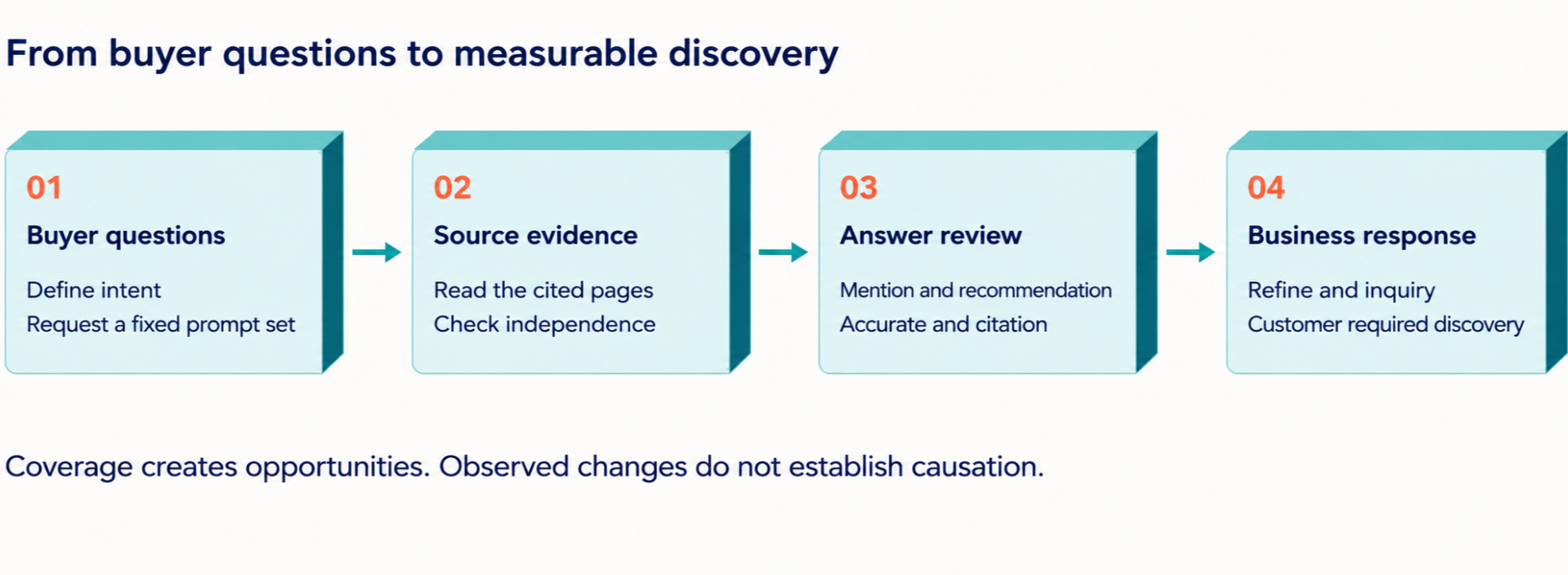
You can also repeat selected AI-platform checks to see if the brand representation or cited sources have changed. Note that these results are observations instead of proof that a particular mention caused a change.
Use what you learn to update your questions, address remaining gaps, and prioritize the next round of outreach. A strong mention strategy is an ongoing process of making credible, relevant information easier for buyers to find and easier for AI systems to interpret-not an attempt to control what either chooses to say.
Keep The Source Material Usable
A compelling mention can still be difficult to discover or interpret. Check whether the information is publicly accessible, readable as text where relevant, and clearly associated with the correct brand. Ask publishers to correct broken links, mistaken names, or missing context when these are factual problems.
For your own website, Google’s published eligibility guidance requires indexing and snippet eligibility for supporting links in its AI features. Its recommendations include crawl access, internal links, textual content, and structured data that matches the page. Eligibility does not guarantee inclusion. These are Google-specific requirements, not a promise about every assistant.
Avoid treating technical access as editorial endorsement. An indexed page can still be irrelevant or wrong. Similarly, a factual brand profile does not become an independent recommendation because it sits on a separate domain.
Measure Representation Before Calling It Authority
Create a repeatable baseline before launching outreach. Save the exact prompt, platform, search mode, locale, date, and full response. Use fresh conversations for controlled checks, record any known personalization settings, and repeat the same procedure over time. Where the interface exposes a model version, record it too.
Track these measures separately
Brand Mention Rate
Brand mention rate measures how frequently your brand appears in eligible AI-generated answers. The formula calculates it by dividing the number of eligible answer runs that name your brand by the total number of eligible runs.
Recommendation Rate
Recommendation rate measures how frequently AI-generated answers present your brand as a suitable option for a specific buyer question. Divide the eligible runs that recommend your brand by all eligible runs. Use a written definition of what counts as a recommendation so different reviewers classify answers consistently.
Citation Presence
Track citations to your own domain separately from citations to third-party pages that discuss your brand. This distinction helps you determine if the AI tools are crawling your website. A citation indicates that a source was referenced but do not assume that the recommendation is accurate.
Factual Accuracy
Check if AI-generated answers correctly highlight your
- Product.
- Target audience.
- Capabilities.
- Limitations.
And you should consider saving the incorrect statements alongside correct and updated documentation.
Business Impact
Look into the unchecked commercial signals of brand visibility, including
- Referral visits.
- Qualified inquiries.
- Customer-reported brand discovery.
These indicators help you understand whether coverage and AI visibility contribute to buyer interest. However, they don’t capture every interaction, especially when someone discovers your brand through an AI answer but later visits it through a different channel.
If a brand appears in 24 of 80 eligible runs, its observed mention rate is 30% for that sample. This hypothetical calculation is not market share, audience reach, or the probability that any customer will see the brand. Show raw counts alongside percentages, especially with small samples.
Microsoft’s AI Performance report can complement your checks with citation information for supported surfaces. It does not expose every brand mention or establish the effect of a specific campaign. Treat platform reports and controlled prompt checks as different measurement views.
Traffic also needs its own accounting. Pew Research Center’s March 2025 browsing study of 900 US adults found traditional-result clicks on 8% of Google visits with an AI summary, compared with 15% without one. That observational result does not isolate causation or predict current conversion behavior; it does demonstrate why answer visibility and website visits should not be treated as interchangeable.
Bottom Line
The strongest external mention explains why a product belongs in a particular conversation. It helps a buyer understand a tradeoff, verify a claim, or rule out a poor fit. That is the editorial standard to pursue before counting coverage.
Start with one high-intent question where your brand is absent or inaccurately described. Inspect the sources behind the answer, improve the evidence available, and review the result with a repeatable method.
AirPulse comes in to support your brand’s discovery in high-intent conversations across AI search and social. Build presence around the questions that matter to your customers, with accurate evidence at the center.
Frequently Asked Questions
Do unlinked mentions help AI visibility?
An unlinked mention can place relevant information about a brand on a third-party page, which may become a source. The available evidence does not establish a universal benefit per unlinked mention. Assess context, accessibility, and observed answers rather than assigning it an assumed ranking value.
Are third-party mentions more important than backlinks?
The Ahrefs study found strong correlations for mentions in its selected sample, but it did not establish a universal replacement for links. Links still help users navigate and can connect readers to evidence. Evaluate coverage for its relevance and credibility rather than forcing a choice between mention and link counts.
Can a small brand compete with established companies?
A practical approach is to focus on specific use cases where the brand can supply unusually clear evidence. Broad category leadership is harder to establish than suitability for a defined need. This is a strategy recommendation, not a demonstrated guarantee of improved AI recommendations for small brands.
How long does a new mention take to influence answers?
There is no reliable universal timetable for when a new mention may influence AI-generated answers. The timing depends on several factors, including when the source is discovered, whether it is accessible for retrieval, how frequently the relevant information is updated, and how the AI platform selects sources for a particular query. Monitor changes over time rather than promising a fixed number of days.
Should we remove negative mentions?
Prioritize factual corrections and underlying customer problems. A critical but accurate review may help a buyer understand fit. Request corrections for demonstrable errors, provide evidence, and preserve the reviewer’s independence.