A competitor appears in an AI-generated shortlist. Your brand does not. But your SEO dashboard still looks healthy, so the obvious question is whether the tools you already paid for can explain what happened.
Ahrefs Brand Radar and Semrush’s AI Visibility Toolkit can track brand presence in AI answers, including ChatGPT. Both offer broader discovery reports and custom prompt monitoring. But “track your brand on ChatGPT” needs a careful definition: these products observe selected answers, not every private conversation or every buyer who encounters your name.
The useful buying question is more specific: can the tool repeatedly measure the questions, platforms, and markets that influence your customers and show enough evidence to act on the results?
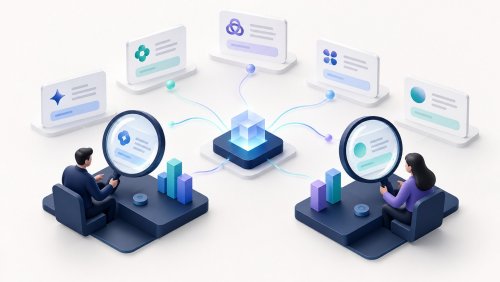
This guide compares the current products, explains what their numbers mean, and shows how to convert a monitoring report into a focused discovery strategy.
What Tracking Actually Means
Three different questions often get compressed into one dashboard request.
- Discovery: Where does your brand appear across a broad collection of AI answers? A vendor’s existing database can surface topics and competitors you had not thought to investigate.
- Monitoring: Do you appear when the same buyer questions are checked repeatedly? A custom prompt set gives you a more controlled way to follow the part of the market you care about.
- Business impact: Did that exposure lead to visits, qualified enquiries or sales? That requires additional evidence from your analytics and customer journey. An appearance in an answer is not itself a conversion.
Consider a hypothetical payroll software company. It might appear when someone asks what the company does but disappear from “Which payroll tools suit a 200-person company expanding into India?”
- The first answer indicates recognition.
- The second is closer to a buying decision.
A useful monitoring program measures both and then reports them separately.
What Ahrefs Brand Radar Can Do
Ahrefs separates its AI Visibility Index from custom prompts. The index provides immediate research across pre-collected answers; custom monitoring follows questions you choose. Ahrefs says its index prompts are derived from search demand, including its keyword database and related questions. These are search-backed observations, not a complete record of what ChatGPT users ask.
The published index covers ChatGPT, Google AI Overviews, Google AI Mode, Gemini, Perplexity, and Copilot. Custom Prompts also supports Claude. The Claude implementation is specifically described as API-based, using Sonnet 4.6 with web search; each execution consumes eight checks. Grok collection is currently paused, so it should not be treated as active coverage.
Use the broad index to investigate categories and competing brands, then create a saved report for your questions. Set the platforms, locations, and update cadence. Custom prompts can run daily, weekly, or monthly, and their history begins when tracking starts.
When it fits: Ahrefs is worth evaluating when broad competitive discovery and source research are central to your work. For an obscure category or a new brand, test custom prompts first: a large database is useful only if it covers relevant questions. A zero in a broad report should trigger a coverage check before anyone concludes that the brand is absent from AI search.
What Semrush Can Do
Semrush combines several kinds of analysis: broader visibility and competitor research, topic research, brand performance, custom prompt tracking, and AI-focused technical checks. Semrush One bundles the SEO and AI visibility toolkits.
The distinction between reports matters. Semrush’s data documentation lists ChatGPT, Gemini, AI Overviews, and AI Mode for its broad prompt database. Brand Performance uses a separate dataset, including Perplexity, for sentiment and share-of-voice analysis. A platform’s presence in one report does not establish that you can run daily custom prompts against it in another.
The dedicated Prompt Tracking guide explicitly documents ChatGPT Search, Google AI Mode, and Gemini. It supports daily tracking, response snapshots, and cited-source analysis. Its ChatGPT position metric orders domains in the citation area, that position should not be presented as a universal ranking of brand recommendations in the answer.
When it fits: Semrush is worth evaluating when the team wants AI visibility research close to its existing SEO audits and reporting. Its separate brand-perception reports can help investigate how a company is described, while prompt snapshots let the team inspect the underlying answer instead of relying solely on a score.
Compare The Reporting Jobs
| Job | Ahrefs | Semrush |
| Broad discovery | AI Visibility Index | Visibility Overview and Competitor Research |
| Repeated buyerquestions | Custom Prompts | Prompt Tracking |
| Source investigation | Cited pages and domains | Source reports and response snapshots |
| Perception analysis | Inspect answer context | Dedicated brand performance reports |
| Main purchasing check | Index access versus checkallowance | Report-specific coverage and prompt limits |
What The Metrics Can And Cannot Tell You
A mention, a citation, and a recommendation answer different questions. Record them separately when reviewing evidence.
- A mention means the brand appears in the response. Ahrefs counts one mention per response even if the name occurs several times. Semrush also tracks brand mentions to help measure visibility across AI-generated answers.
- A citation means a page or domain is cited as a source. Ahrefs also distinguishes pages that were found from pages that were actually cited. Semrush also provides source and citation insights to help you understand which websites support AI-generated answers.
- A recommendation is an editorial interpretation of the answer: does it suggest the brand for the buyer’s situation? A company can be named as an unsuitable option.
- A source can be cited for an industry statistic without its product being recommended. Neither deserves the same commercial interpretation as an explicit shortlist inclusion.
Ahrefs’ metrics documentation defines AI share of voice as a brand’s share of estimated impressions relative to other tracked brands. These impressions are estimated using Google search-volume data; they are not direct counts of impressions among ChatGPT users.
Semrush reports a benchmark score for AI visibility and a separate estimated audience measure. Its AI Topic Volume estimates demand for topics rather than individual prompts. These figures do not directly measure exposure to your brand among all ChatGPT users.
Build A Small Measurement Dictionary
For your own reporting, define an observed mention rate as:
Responses naming the brand ÷ valid responses collected × 100
For example, 18 mentions in 60 valid answers give a 30% observed mention rate. This is an illustrative calculation, not an Ahrefs or Semrush result. Keep unsuccessful checks out of the denominator and report their count separately; a failed collection is not evidence of an absent brand.
Alongside that rate, track owned-domain citations, explicit recommendations, and factual errors. Preserve the exact prompt, platform, market, and collection date. A report reading “30% across this fixed test set” is defensible. A report reading “30% of the AI market” makes a much larger claim than the sample supports.
Do not compare an Ahrefs share-of-voice percentage directly with a Semrush visibility score. Compare trends within a stable setup, then read the actual responses to understand what changed.
What You Should Budget For
The published prices below are in US dollars per month, as checked on 26 October 2026. Taxes, billing terms, and account eligibility can affect the final quote.
| Product or allowance | Published amount | What to check |
|---|---|---|
| Ahrefs Custom Prompts Basic | $50 for 2,500 checks | Platforms, locations and cadence multiply usage |
| Ahrefs AI index access | $199 for one index; $699 for all platforms | Full-platform purchase includes 2,500 customchecks |
| Semrush AI VisibilityToolkit | $99 | Includes 25 tracked prompts and one Brand Performance domain |
| Semrush One | Starts at $199 | Bundled SEO and AI access; limits vary by tier |
Where AI Visibility Reports Can Mislead You
AI visibility reports help in understanding the frequency of your brand appearing in the AI-generated answers, but data, on the other hand, can misguide you. Some reasons for this include limited prompt samples, changing answers, and estimated metrics that ultimately create a vague picture of your brand’s visibility. And such data might lead to wrong calculations and marketing decisions, furthermore.
The section below talks about the different ways AI visibility reports can mislead you.
- Branded Prompts Can Skew Visibility Results
A dashboard filled with branded questions can look impressive because the question itself supplies the company name, but for better clarity, keep branded validation separate from unbranded discovery. Test the problems, constraints, and alternatives buyers discuss before they know you exist.
Also avoid writing every question in the language of your own positioning. A buyer may describe “getting recommended by AI” instead of “generative engine optimization.” Use customer language, including the phrases your sales and support teams actually hear.
- AI Answers Can Vary Between Checks
AI answers vary, and a monitored result need not reproduce a particular user’s experience. Semrush explains that its AI visibility metrics show an estimate of how often a brand appears in AI-generated answers. This is because AI answers can vary depending on the question and context.
When an important prompt changes, inspect multiple observations before declaring a durable gain or loss. Preserve the evidence around the change: answer text, sources, platform, region, and date. For the most commercially valuable questions, review whether the recommendation still fits the intended customer, rather than counting any appearance as success.
- Citations Don’t Guarantee AI Recommendations
If an answer cites a review page and mentions your competitor, that page is worth investigating. It does not prove that buying a listing there will cause an AI system to recommend you. Seek repeated source patterns and factual gaps you can legitimately address.
Likewise, a crawler visit proves that a request occurred; it does not prove the content was recommended to a buyer. Keep bot activity, answer citations, referrals and conversions as separate stages of evidence.
- Changes to the Prompt Set Can Distort Visibility Trends
If you add easy prompts, remove strong competitors, or change the regions in a report, the headline score can improve without stronger performance on the original questions. Preserve one stable baseline and use a separate exploratory set for new topics. Annotate additions and product changes in the reporting history.
- AI Visibility Doesn’t Directly Translate Into Revenue
A buyer may read an answer, search for the brand later, and convert through another channel. Conversely, a rise in AI referrals may bring visitors who never qualify. Pair monitoring with referral data, conversion events, and a simple “How did you hear about us?” question. Treat the data as complementary evidence, not a perfect attribution model.
The practical rule is to make the claim as narrow as the evidence: saying “We appeared more often in our tracked UK comparison prompts” is more useful than saying “Our AI authority doubled.”
A Practical Workflow For The First Month
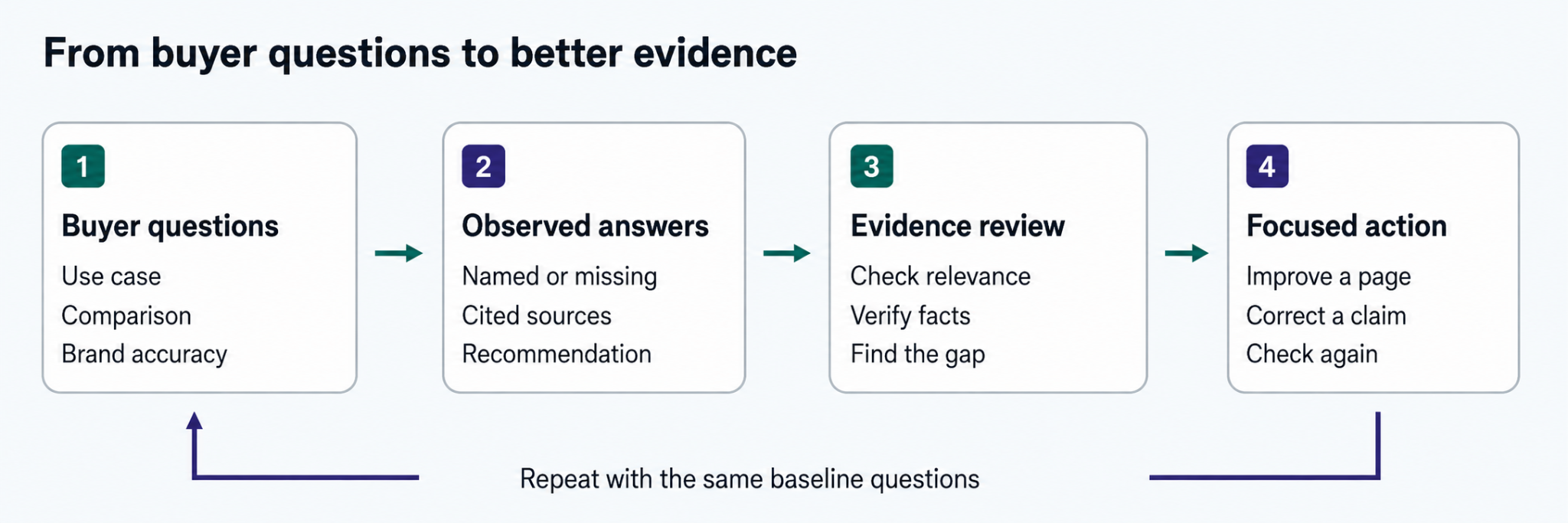
- Week One - Establish The Baseline
Choose a manageable set of buyer questions from sales conversations, support requests, and existing research. As a starting point, use 15-25 prompts spanning category discovery, use cases, comparisons, and brand validation. This is an editorial starting point, not a vendor requirement.
For a hypothetical project-management brand, useful questions might include “Which tools suit a design agency managing client approvals?” and “What should a 40-person agency compare before replacing its project-management system?” Include a branded accuracy question separately. Keep each prompt tied to a real buying need.
Choose the platforms and markets your customers use. Save the first responses, check name matching, and record competitors consistently. In Ahrefs, configure a saved report and custom prompts; in Semrush, configure a prompt tracking target with its supported engine and location.
- Week Two - Convert Absences Into A Diagnosis
Read the answers behind missing mentions. Is your brand genuinely relevant? Is a competitor answering a specific requirement more clearly? Is the citation an outdated page, a comparison, a directory, or a discussion?
Assign a specific action and owner to each priority gap. “Improve AI visibility” is too broad. “Publish an accurate guide explaining agency approval workflows, supported by our current product documentation” is actionable. Occasionally the right decision is to leave a prompt alone because your product does not fit the use case.
- Week Three - Improve The Underlying Evidence
Fix inaccurate or inaccessible product information before commissioning more content. Clarify the audience, use cases, limitations, and commercial terms that buyers need to evaluate. Make comparisons fair and verifiable. A page that claims to be suitable for everyone provides an answer engine with little useful basis for making a recommendation.
For Google’s AI Overviews and AI Mode, Google says established SEO practices still apply. Pages must be indexed and eligible for a search snippet to appear as supporting links; no special AI schema or new AI text file is required. Eligibility still does not guarantee inclusion. Do not generalize Google’s guidance into an identical technical rule for every assistant.
Where third-party pages are repeatedly cited, correct inaccurate public facts and contribute useful expertise through legitimate channels. Avoid manufactured endorsements. The aim is to make trustworthy information easier to find and use throughout the buyer’s journey.
- Week Four - Review The Same Questions Again
Compare the fixed baseline by intent, platform, and market. Review whether answers now describe the product more accurately, cite better evidence, or recommend it for the right buyer. Log publication dates and allow for collection or discovery delays before judging results.
Keep changes and outcomes in the same report, but do not label a before-and-after improvement as proof that one edit caused it. Competitors, models and source pages can change during the same period. The first month should produce a clearer diagnosis and a repeatable process, not a guaranteed growth claim.
Which Tool Should Your Team Choose
Start by evaluating Ahrefs if your main task is exploring a category, finding citation patterns and then tracking a selected set of buyer questions. Existing users can begin with their included allowance before paying for broader coverage.
Start by evaluating Semrush if your workflow already combines SEO audits, competitor research, and reporting, and you want dedicated brand-perception analysis alongside custom monitoring. Confirm the exact report and platform combination you need.
Require a focused demonstration if your brief depends on a less common language, specific regional targeting, Claude, Perplexity custom tracking, exports, or several client accounts. Ask the vendor to show your questions in the actual report, explain the collection method, and identify the limits that apply.
Neither choice should be decided by a database-size headline. Evaluate relevant coverage, inspectable evidence, and the work your team can do with it. The better purchase is the one that reliably supports those decisions within your budget.
Converting AI Visibility Insights Into Action
Tracking your brand across AI platforms can be challenging. Your brand may appear in some AI-generated answers but can be absent when potential customers ask important questions about products, services, or competing solutions.
To build a stronger AI visibility strategy, you need to understand where your brand appears, where it is missing, and what information AI platforms use when generating responses. And for that you need tools like AirPulse, which help monitor your brand’s AI visibility, identify gaps in your current content strategy, and uncover opportunities to improve your presence across AI-generated answers.
By converting visibility data into actionable insights, AirPulse helps your team make informed content decisions, address missing information, and focus on opportunities that matter to your target audience.
Bottom Line
The important question after the report is not just “How many times were we mentioned?” It is “Which high-intent buying conversations are we missing, and what evidence would help us deserve a place in them?”
Choose a small set of valuable questions, inspect the answers, and assign the next improvement. A clearer product explanation or a useful comparison can be a more sensible next step than another dashboard.
Frequently Asked Questions
Can either tool see all private ChatGPT conversations?
The documented products do not provide a complete view of private conversations. Their reports use -
- Collected answers
- Datasets
- Configured checks
Treat their results as measurements within that scope rather than a census of everything users see.
Does a zero mean the brand has no AI presence?
No. It may mean no match appeared in the selected dataset or checks. Examine prompt relevance, spelling and entity matching, platform coverage, and collection failures before interpreting the result. Broader discovery and targeted monitoring answer different questions.
Can buying either tool improve visibility by itself?
A subscription supplies evidence and workflows; your team still needs to act on the findings. Prioritize accurate product information, useful buyer-focused content, and credible external references. Measure again to see whether the answers change rather than assuming every action will work.